If you’re wondering whether chickens and turkeys can actually mate and produce offspring together, you’re not alone — and the answer’s more complicated than a simple yes or no. They can attempt mating, but true hybrids are biologically almost impossible due to mismatched chromosomes. Out of 2,900 fertilized eggs studied, only three survived. All were male and sterile. Stick around — there’s a lot more surprising biology, disease risk, and mixed-flock truth worth knowing.
Can Chickens and Turkeys Actually Mate?
If you’ve ever watched a rooster strut around a turkey hen and wondered what on earth is going on, you’re not alone — and yes, mating attempts between chickens and turkeys do actually happen. Here’s the thing: roosters occasionally attempt mating with turkey hens, though size differences usually prevent success. Turkey toms, notably, show little attraction toward chicken hens under normal conditions.
Now, both species actually use the same cloacal kiss method, so the mechanics aren’t wildly different. But genetics, feather color variation, and even feed incubation conditions don’t change the fundamental biological mismatch here.
Obviously, curiosity about this is completely reasonable if you’re managing a mixed flock. Understanding what’s actually possible — versus what isn’t — makes your decision about cohousing these birds much easier.
Why True Chicken-Turkey Hybrids Are Biologically Impossible
So here’s the thing — even when mating between chickens and turkeys technically occurs, the biology shuts the whole experiment down almost immediately. You’re dealing with a chromosome mismatch that’s genuinely brutal: chickens carry six chromosome pairs, turkeys carry nine, and their hybrid offspring end up with 15 unpaired chromosomes that can’t organize into anything functional.
Now, it gets worse. Female embryos hit what’s fundamentally a sex‑lethal wall — they die so early you’d barely call it a pregnancy. Of 2,900 fertilized eggs across multiple attempts, only three birds survived. All male. Obviously, three males can’t reproduce with anything.
You’re not choosing between difficult and easy here — you’re choosing between understanding why this fails and believing it shouldn’t. Genetic diversity is essential to maintaining vigor, disease resistance, and performance — and when two species this chromosomally distant attempt to combine, there is simply no diversity to leverage, only biological incompatibility.
What Happens to Fertilized Eggs From Turkey-Chicken Crosses
When a chicken and turkey actually manage to fertilize an egg together, what you get next is fundamentally a race against biology — and biology wins almost every time. Here’s the thing — eggization genetics simply don’t cooperate. Chickens carry six chromosome pairs, turkeys carry nine, leaving hybrid embryos wrestling with 15 mismatched chromosomes that can’t pair properly.
Now, that chromosomal chaos triggers embryonic mortality almost immediately. Beltsville researchers cracked 2,900 fertilized eggs before producing just three surviving “churks,” all male, all sterile. Obviously, those aren’t odds you’d bet on.
All right, you’re probably wondering if selective breeding changes anything — and honestly, it barely budges the needle. Biology isn’t negotiating here. Understanding this makes your crossbreeding decisions markedly clearer and smarter.

SET OF 2: Set of 2 cooking cones includes Sittin’ Chicken as well as the Sittin’ Turkey that cooks up to an 18 lb Turkey. EASILY INFUSE FLAVORS: The ceramic holder allows...
Do Any Chicken-Turkey Hybrids Survive?
Honestly, you’re probably hoping the answer here is “yes, sometimes” — and the truth is technically yes, but barely enough to matter. Here’s the thing: the genetic barriers between chickens and turkeys are so significant that survival isn’t really the right word for what occasionally happens. Embryonic mortality claims the overwhelming majority of fertilized eggs before they even hatch.
Now, a handful of documented reports mention limited live offspring, but researchers consistently flagged missing details and reproducibility problems. You can’t build confidence around results nobody can repeat.
All right, so what does this mean for you? It means nature’s already made the decision. The biological walls here aren’t cracks — they’re solid. Understanding that actually makes your next move pretty obvious.
Why the Turken Isn’t the Hybrid You Think It Is
Here’s the thing — after all that talk about failed hybridization and embryonic dead ends, you might be staring at a Turken and thinking you’ve finally found the exception. You haven’t. And honestly, that’s not a disappointment — it’s actually more interesting.
Breed origin history tells you the Turken came from Transylvania, developed mainly in Germany. The turkey-hybrid rumor? Pure myth born from a naked bird with a suspicious nickname.
Now, naked neck genetics explain everything. A single dominant gene on Chromosome 3 creates that bare neck — no turkey DNA required. Obviously, selective breeding did all the heavy lifting here.
Despite its unusual appearance, the Turken is a dual-purpose breed, reliably producing brown eggs while also offering good meat quality and efficient feed conversion.
Is It Safe to House Chickens and Turkeys Together?
So you’ve got 3 birds — maybe a small turkey flock, maybe just one big tom — and you’re wondering whether they can share a yard with your chickens without everything going sideways. Here’s the thing: space coop calculations matter more than most people realize. Turkeys need considerably more room, and cramped quarters accelerate aggression fast.
Now, the bigger concern is your health‑risk assessment. Chickens carry blackhead disease asymptomatically — meaning they’re fine, your turkeys aren’t. That silent killer transmits through shared water, feed, and feces. Once a turkey contracts this parasite, there is no cure available and the bird is essentially lost.
All right, so can you do it? Yes, with serious hygiene protocols, separate feeding stations, and mature turkeys only. But if you’re raising turkeys for meat, honestly, keep them separated. The smart move here is pretty obvious.

𝐏𝐫𝐨𝐦𝐨𝐭𝐞𝐬 𝐍𝐚𝐭𝐮𝐫𝐚𝐥 𝐁𝐞𝐡𝐚𝐯𝐢𝐨𝐫 & 𝐏𝐡𝐲𝐬𝐢𝐜𝐚𝐥 𝐄𝐱𝐞𝐫𝐜𝐢𝐬𝐞 Thi perch adopts 3-layer fir structure design to encourage the leg strength and coordination,while the swing promotes movement, balance and healthier behavior.This chicken roosting bars can keep your chickens active and healthy
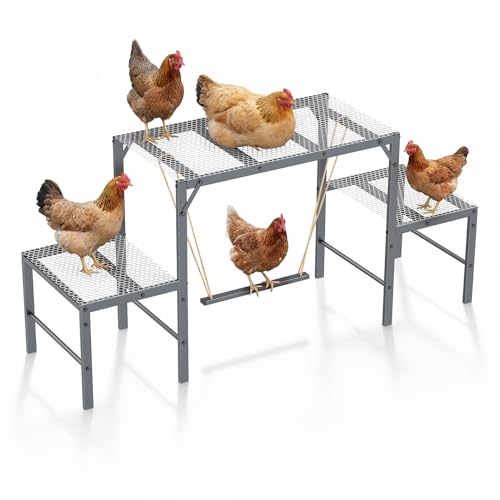
Large Capicity of Chicken Perch: Magicfly chicken coop perch is designed for 10-12 chickens and measures 57.48"L x 16.92"W x 26.96"H. Comes with 1 chicken swing, 3 resting platform with numerous perches. This accessory provides generous and safe space for hens to rest, exercise, and engage in natural behaviors—promoting physical well-being, fostering a harmonious environment, and yielding eggs of superior quality.
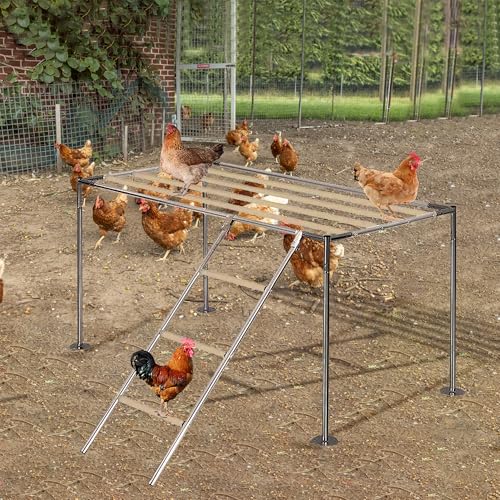
Chicken Coop Essentials:Our roosting perch are built with corrosion-resistant galvanized pipes and organic wood. They are durable and easy to clean, keeping chickens away from wet ground most of the time. They can provide your chickens with a reliable and comfortable resting place, which is deeply loved by chicken.
The Blackhead Disease Risk Every Mixed Flock Owner Faces
Now, blackhead transmission happens when turkeys ingest contaminated droppings, earthworms, or soil your chickens have already cycled through. Turkeys hit 70–100% mortality. Chickens? Fine. Obviously, that asymmetry is brutal.
Mixed-flock biosecurity isn’t optional — it’s survival math. No federally authorized treatment exists since nitarsone was pulled. You can’t medicate your way out of this one. You can only prevent it. Separate housing isn’t overcautious. It’s the only smart move you’ve got.
How to Prevent Aggression and Feeding Conflicts in Mixed Flocks
Keeping chickens and turkeys apart solves the blackhead problem, but it doesn’t automatically solve the other headache waiting for you — what happens when birds share the same space and start making each other miserable. Here’s the thing: aggression in mixed flocks almost always traces back to two culprits — poor space management and a broken feeding hierarchy.
You need at minimum 10 square feet per bird in the run. Obviously, cramped quarters breed cranky birds. Multiple feeders and water stations eliminate the ugly scramble that triggers pecking wars. Tom turkeys strutting aggressively around hens? Isolate them temporarily. Now, introduce new birds gradually using the see-but-don’t-touch method.
Get the space and feeding setup right first, and you’ve already solved most of your problems before they start.

【Elevated Design Keeps Feed Clean】Unlike traditional ground-level models, our chick feeder and waterer set features a stable tripod base with adjustable legs. This raises the unit off the ground, helping to prevent baby chicks from scratching bedding or dirt into their food and water for a cleaner feeding area.

MODERN BACKYARD CHICKEN FEEDING STATION Create a cleaner and more organized coop with this all-in-one chicken feeder and waterer set. Designed for modern backyard chicken keepers who want both convenience and farmhouse-style aesthetics.

【Chicken Water Feeder】Automatic chicken waterers are the perfect addition to your coop. Our chicken water cups provide a constant supply of drinking water for your flock, and can be used with a 5-gallon chicken waterer or any other container.
Can a Chicken Hen Hatch and Raise Turkey Poults?
Maybe you’re staring at a broody hen who won’t leave her nest no matter what, and you’re wondering whether you can put that stubborn determination to work for your turkey eggs. Here’s the thing — you absolutely can. Swap her eggs for turkey eggs, slip a few extras under her post-hatch, and solid broody management handles the rest naturally. Poults actually learn faster by following chicks, which gives them real survival advantages early on. Now, bro disease — blackhead — is your biggest legitimate concern since young turkeys are highly susceptible. Check with your county extension office first. Worm your hen regularly, keep nesting areas clean, and move everyone to a safe nursery crate quickly. You’ve already got a broody hen. That’s honestly the hardest part done. Turkey poults require higher-protein starter crumbles than chicken chicks, so keep a supply on hand and ready the moment they hatch.