
You’ll need to employ multiple examination methods to accurately determine baby chick gender. Start with vent sexing, which involves cloaca eversion to identify reproductive structures – the most precise technique when performed correctly. Analyze wing feather patterns, noting females develop earlier with long-short tip variations. Observe anatomical markers like comb and wattle development, plus leg characteristics. These fundamental techniques form the foundation for mastering professional chick sexing expertise.
Physical Examination Methods for Baby Chick Sexing
When examining baby chicks to determine their sex, veterinarians and poultry professionals rely on several physical examination methods that require careful observation of anatomical features.
Vent sexing remains the most accurate technique, involving careful eversion of the cloaca to identify reproductive structures. You’ll observe a small bulb or Y-shaped opening in males, while females display a slit-like aperture. Trained professionals only should perform this delicate procedure. Physical indicators also include leg morphology assessment, where males typically develop thicker shanks. Additionally, you’ll notice more prominent comb and wattle development in male chicks, though genetic traits vary by breed. Proper handling during examinations requires stable brooder conditions to minimize stress and prevent development issues. While these secondary methods support identification, they’re most effective when combined with vent examination. You’ll achieve peak results by considering breed-specific characteristics and conducting thorough anatomical assessments using multiple physical markers.
Wing and Feather Pattern Analysis
Although less invasive than vent sexing, wing and feather pattern analysis provides reliable indicators for determining a chick’s gender during early development. You’ll observe that female chicks develop wing feathers earlier, often before hatching, while males initiate feathering post-hatch. The key wing feather characteristics include alternating long-short patterns at wing tips in females, whereas males display uniform feather lengths. While comb size observation can support gender identification, wing feather patterns remain more definitive.
Feathering gene variations affect sexing accuracy across breeds. You’ll find this method most effective in American Standard Breeds, particularly Rhode Island Reds and New Hampshires, where males exhibit fast normal-feathering genes and females show delayed-feathering traits. The Rhode Island Red has proven particularly suitable for wing sexing due to its consistent feathering patterns and high egg production potential. For ideal results, examine wing patterns within 72 hours of hatching, as male feathers quickly catch up to female lengths after the first week. This method typically achieves 50-55% accuracy rate when identifying male chicks in a newly hatched group.
Observing Comb and Wattle Development
Two key physiological markers, combs and wattles, provide valuable insights for determining chick gender, though their development occurs gradually over several months. You’ll notice male chicks typically develop larger, brighter red combs and wattles compared to females, with initial signs appearing around 3 weeks of age. When conducting comb color comparison, look for males’ deep red hues versus females’ paler, peachy tones. Wattle size variations become more pronounced between 8-12 weeks, with males displaying more upright and prominent features.
Be aware that breed-specific characteristics can affect your assessment. For example, Silkies exhibit minimal comb and wattle differentiation between sexes. Regular biosecurity measures during handling and examination help prevent disease transmission between birds. You’ll achieve most reliable results around 15 weeks, coinciding with point of lay, when males display fully developed, vibrant structures while females maintain smaller proportions.

Perfectly Sized for Poultry: Our kit includes a 1-liter waterer and a 2pcs food trough, specially designed to cater to the needs of small poultry, such as chicks, bantams, and other pint-sized fowl. Ensure your birds get just the right amount of feed and water, preventing waste and mess.
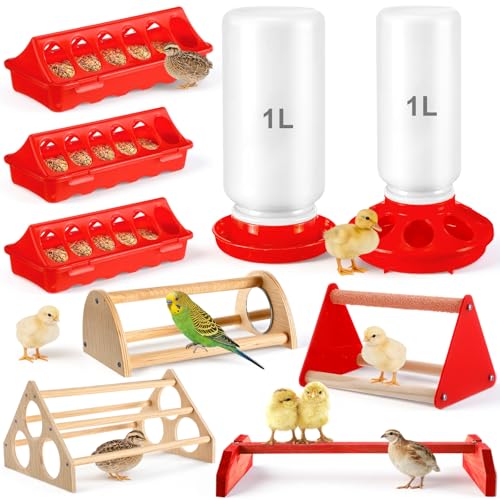
Ideal Chick Feeder Waterer Kit for Raising Chicks: the small chick starter kit offers everything your chicks need for a healthy start; Included are 3 pcs 12-hole chick feeders, 1 pcs chick waterer, 1 pcs 1L feeder and 4 pcs roosting perches; This brooder box set ensures all essentials are covered during the critical early weeks of your chicks' lives; The roosting perches add extra fun for your chicks, making them an ideal choice for new poultry enthusiasts

Chicken Waterer Capacity : 1L ,size is 7.7" x 5.9" Chicken Feeder Capacity : 1L ,size is 9.45" x 6.1". chick feeder and waterer kit suit for 12 chicks / 2-3 fully grown hens. For Use With Up To 25 Chicks Till 3 Weeks of age.A prefect baby chick starter kit.
Understanding Body Structure and Leg Characteristics
Body structure and leg characteristics provide several reliable indicators for determining chick gender, though these traits require careful observation and breed-specific knowledge. You’ll notice female chicks typically display a more rounded body shape with softer contours, while males exhibit a blockier chest and torso structure. When examining leg characteristics, you’ll find males generally possess thicker, more muscular legs compared to the females’ slender, fine-boned structure. For breeds like Silkies, DNA testing methods offer nearly 100% accuracy when visual indicators prove challenging. Having automatic waterers installed ensures chicks stay properly hydrated while you spend time examining their physical characteristics.
Pay attention to leg coloration within the first few days after hatching. Males often show a pinkish tint, while females tend toward yellowish hues, particularly in yellow-skinned breeds. However, remember that body shape and leg structure variations differ considerably among breeds, so you’ll need to reference breed-specific standards for accurate gender determination. For optimal accuracy in gender identification, perform examinations when chicks are 3 to 7 days old.
Behavioral Indicators and Early Signs of Gender
When observing chicks during their early development stages, distinct behavioral patterns emerge that can help determine their gender. Male chicks typically display early behavioral dominance through assertive actions like puffing up, standing taller, and exploring their environment more boldly. You’ll notice they’re more likely to strut, bump chests, and attempt to climb objects.
Vocalization patterns also provide valuable clues. While definitive crowing doesn’t occur until maturity, male chicks often practice louder vocalizations weeks before females. You’ll observe females maintaining quieter chirps and more reserved behavior, staying closer to their group. As they develop, males exhibit increasingly confident movements and upright postures, while females adopt a lower, more cautious stance. These behavioral indicators become more reliable when combined with physical development markers like comb growth and feathering patterns. Experts can determine gender through vent sexing examination within days of hatching, though this method requires significant expertise.