
You’ll find that most backyard chickens reach 6 to 10 feet vertically, covering 30 to 40 yards per burst flight. Lightweight breeds perform considerably better, sometimes doubling these distances. Bantams exhibit superior capabilities due to lower wing loading and specialized wing geometry. Heavier commercial strains, selectively bred for meat and egg production, show markedly compromised flight ability. The biomechanics constraining their performance reveal why understanding breed-specific characteristics becomes essential for effective containment design.
Typical Flight Performance by Height and Distance
When you observe chickens in flight, you’ll notice they’re surprisingly capable aviators despite their reputation as earthbound birds. Their flight characteristics reveal consistent patterns across typical conditions. You’ll find that average chickens achieve 6 to 10 feet vertically, though lighter breeds sometimes reach 15 feet when accessing roosts. Distance variation depends greatly on breed and environmental factors. You’ll observe short bursts covering 30 to 40 yards typically, with backyard chickens managing around 50 feet during standard flights. The hop-and-flap motion limits sustained duration, restricting most flights to mere seconds. You’ll notice light-breed chickens reach approximately 10 miles per hour, enabling them to clear 6-foot fences with running starts. Heavier breeds like Cornish are less inclined to fly and rarely leave the ground even when given the opportunity. These flight parameters remain relatively consistent across diverse poultry populations under normal circumstances.

Comfortable Fabric:The breathable hen chickens harness is made of quality polyester material,which is soft,breathable to wear,they will not resist to wear it.
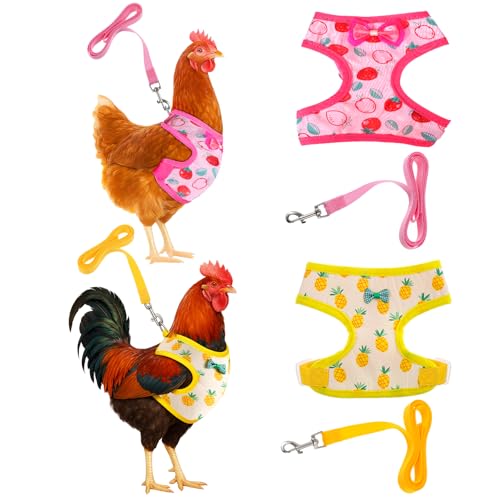
【Comfortable Design】Crafted from soft polyester fabric, this Adjustable Chicken Harness ensures a skin-friendly and breathable experience for small pets like ducks, geese, and hens. The lightweight, elastic material prevents discomfort during extended wear.

Package Include: You will receive 4 pack of chicken training harnesses and 4 pieces of matching leashes, and they have 4 different colors: pink, black, blue and purple. The number is sufficient for you to use and replace, or share with your friends.
How Breed and Body Type Affect Flight Capability
Because wing loading—the ratio of body weight to wing surface area—directly determines a chicken’s aerodynamic potential, breed selection fundamentally shapes flight performance across poultry populations. Bantam and lightweight breeds achieve superior burst-height and distance due to lower wing loading, while heavy meat-type breeds like Cornish Cross exhibit poor lift and near-ground movement.
Genetic influences compound these disparities. Breeds with longer, narrower wings and well-developed pectoralis muscles generate stronger wingbeats and higher launches. Game birds and junglefowl crosses retain ancestral wing proportions favoring sustained flight capability. Conversely, selective breeding for meat yield or egg production has unintentionally compromised flight ability in commercial strains, prioritizing rapid growth and docile temperament over aerodynamic efficiency and escape-flight behavior. As chickens mature and gain weight, their increased body mass progressively reduces their capacity for sustained flight, making younger birds considerably more capable of achieving significant heights than their adult counterparts.

TEACHES HEALTHY CHEWING HABITS - Includes two puppy chew toys and an edible chew treat perfect for every developmental phase

TEACHES HEALTHY CHEWING HABITS - Includes two puppy chew toys and an edible chew treat perfect for every developmental phase

COMPLETE STARTER FEED FOR CHICKS: Specifically formulated for chicks from hatching to 16 weeks, this non-medicated chick starter feed delivers balanced nutrition and essential nutrients to support strong, healthy early growth and development.
Record-Breaking Flights and Real-World Observations
While breed characteristics and wing morphology establish the theoretical limits of chicken flight, documented evidence reveals substantial variation in actual performance metrics. You’ll find that historic flights demonstrate this variability strikingly. Sheena, a bantam, achieved the Guinness-verified record of 192.07 meters in 1985—a benchmark you can reference as authoritative. The record was officially verified and documented by Bill and Bob Knox in Parkesburg, Pennsylvania, establishing a standard for bantam flight. However, flight myths persist regarding unnamed chickens allegedly covering 301.5 feet in 13 seconds, though no primary sources confirm these claims.
Interestingly, chickens are known to have difficulty digesting lactose, which can affect their overall health and energy levels, potentially impacting their flight capabilities. It’s also worth noting that some chicken breeds, particularly the female parent birds known as broiler breeders, are specifically managed for reproduction rather than flight. Additionally, many smaller breeds, such as Silkie chickens, often lack the requisite flying abilities due to their compact and fluffy build. You should note that the Red Bull Flugtag 2013 event documented a 258-foot glide by aerospace engineers piloting a chicken-themed craft, not an actual chicken. Meanwhile, video footage from 2020 claimed record-breaking high-altitude flights over West Virginia mountains, yet these lack independent verification.
You’ll recognize that discrepancies between verified Guinness records and anecdotal reports highlight the importance of rigorous documentation when evaluating genuine chicken flight capabilities.
The Biomechanics Behind Chicken Flight Limits
To understand why chickens can’t sustain prolonged or high-altitude flight, you’ll need to examine the anatomical and physiological constraints that fundamentally limit their aerial performance. Their pectoralis and supracoracoideus muscles generate flight power, yet fatigue and metabolic limitations restrict repeated high-power maneuvers. You’ll find that domestic chickens operate near maximal muscle power output during takeoff and climbing, leaving minimal reserve capacity. Additionally, their low wing aspect ratio and high wing loading force substantial energy into overcoming induced drag during slow, lift-dependent flight. Unlike the striated muscle adaptations that enable specialized flight performance in other avian species, chickens lack the refined sarcomeric structures optimized for sustained contraction. These biomechanical constraints—inadequate muscle fiber architecture, insufficient tendon elasticity, and aerodynamic inefficiency—collectively prevent you from observing sustained vertical ascent or extended high-altitude flight in domestic fowl.
Containment Strategies Based on Flight Ability
Once you’ve grasped the biomechanical constraints limiting chicken flight, you can apply those principles directly to practical containment design. Your height recommendations should exceed maximum voluntary lift by 1.5–2.0 meters to prevent short-burst escapes from ground takeoff. Incorporate overhangs or inward-leaning top rails that eliminate vertical trajectories chickens exploit during flight attempts. Implement netting above runs with small-aperture mesh, properly tensioned to minimize entanglement while accounting for descent-speed risks. Deploy vegetative barriers at fence-tops to reduce escape motivation by obscuring landing targets. When designing multi-tier aviaries, maintain ≥55 centimeters usable headspace between tiers for natural wing behavior. Your flight design must accommodate feather condition variability—clipped or damaged primaries increase descent velocity, requiring more conservative clearance margins throughout the system. Research using depth sensing technology has demonstrated that accurate measurement of maximum vertical height reached during wing flapping is essential for optimizing housing systems and ensuring adequate space for this recognized space-intensive behavior.
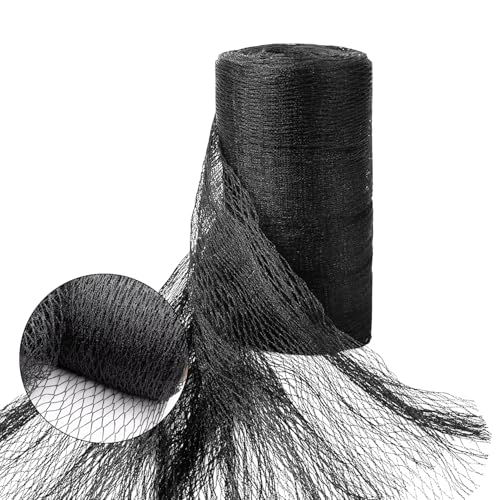
Bird Netting for Chicken Coop: Cover your chicken run, chicken pen, or poultry fence with our large mesh netting to keep predators like hawks, owls, foxes, and raccoons out. Our aviary netting with 1 inch mesh size effectively prevents small animals, such as rabbits and mice from entering, unlike bird nets with larger 2.4 inch holes. This poultry netting also prevents your chickens from escaping and wandering into your garden or neighbor's yard, protecting your plants and vegetables.

【Heavy Duty Bird Netting】 Our lightweight but heavy duty bird net is is made of nylon multifilament net which is UV-proof, this nylon netting won't tangle and tear easily, highly durable and reusable.
Bird Netting for Chicken Coop: Cover your chicken run, chicken pen, or poultry fence with our large mesh netting to keep predators like hawks, owls, foxes, and raccoons out. Our aviary netting with 1/2 inch mesh size effectively prevents small animals, such as rabbits and mice from entering, unlike bird nets with larger 2.4 inch holes. This poultry netting also prevents your chickens from escaping and wandering into your garden or neighbor's yard, protecting your plants and vegetables.
What Research Still Doesn’t Tell Us About Chicken Flight
Despite decades of poultry research, significant gaps persist in our understanding of chicken flight mechanics—gaps that directly impact the efficacy of your containment designs. You’ll find that wing kinematics during feather loss remain largely unstudied across housing conditions, leaving critical questions unanswered about how birds compensate kinematically during descent and landing. Furthermore, chickens display minimal behavioral flexibility compared to wild species like rock pigeons, which adapt rapidly to feather loss. Importantly, pine shavings used in coops may impact respiratory health, revealing a need for improved studies on chicken welfare during flight. Predators such as raccoons and birds of prey are known to primarily target the easily accessible chicken heads, underscoring the importance of effective containment strategies. You’re also missing breed-specific power output measurements and slow-flight data essential for predicting maximum flight distances beyond anecdotal observations. Critically, you lack longitudinal developmental studies examining age-related flight performance changes and multi-tiered aviary navigation patterns. These knowledge voids fundamentally limit your ability to predict escape trajectories and design appropriate barrier heights reliably. Lighter breeds like Leghorns demonstrate superior flight capability compared to heavier dual-purpose breeds, yet comprehensive comparative studies across all commercial varieties remain absent from the literature.