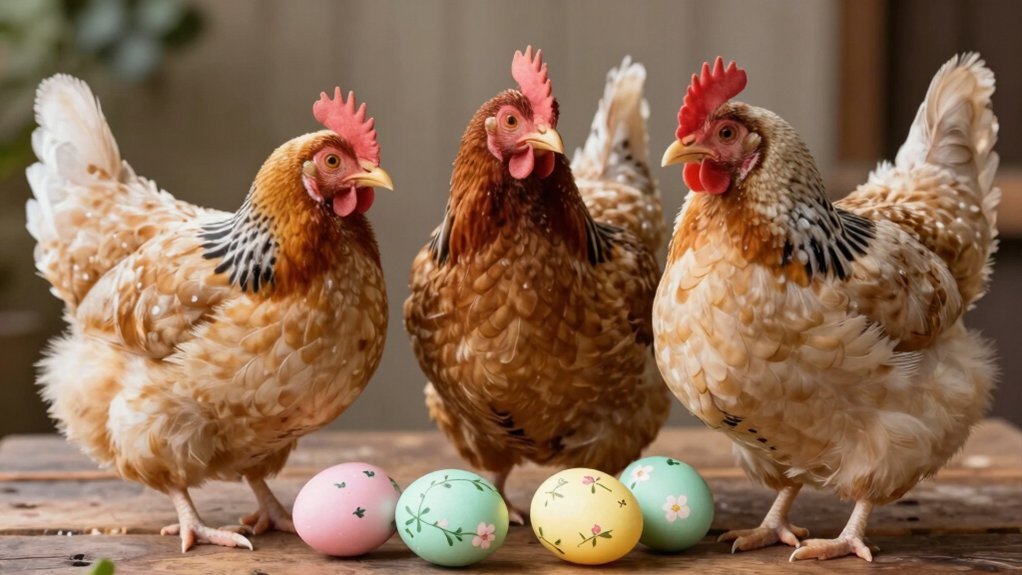
You’re probably wondering why some hens lay pure blue eggs while others produce a rainbow of shades; the key is that Ameraucana is a standardized breed with a pea comb, slate legs, full muffs and a dominant O allele that guarantees blue shells, whereas Easter Eggers are a mixed‑heritage group that can show any comb type, leg color, or feathering and may lay blue, green, olive, brown, or pastel eggs depending on their gene mix. Obviously, Ameraucana eggs stay consistently blue and you’ll get about 150‑200 medium eggs a year, while Easter Eggers can lay 200‑280 eggs in varying colors and sizes. If you check for the pea comb, full muffs, and slate legs, you’ll know which you’re getting, and a solid pedigree will confirm a true Ameraucana.
What Makes a True Ameraucana Different From an Easter Egger?
What makes a true Ameraucana different from an Easter Egger? You’re probably puzzled because both look similar, but the breed standard is the key. Here’s the thing: Ameraucana is APA‑recognized, standardized in 1984, and must meet strict compatibility factors like pea comb, slate legs, no ear tufts, and one of eight approved color varieties. Easter Eggers are a catch‑all for mixed‑heritage birds, so their feather patterns, leg colors, and comb types vary wildly.
Now, check the breeding records. A pure Ameraucana line consistently produces blue eggs, pea combs, and muffs generation generation after generation. Egg Eggers may lay blue, green, brown, or pastel shells, and their offspring rarely breed true to any standard. Obviously, those records reveal purity versus hybrid status. Unlike Easter Eggers which may have ear tufts, true Ameraucanas display unique facial feathers known as muffs and beards. While Ameraucanas are limited to blue eggs, these hybrids are valued for laying uniquely colored eggs ranging from blue to green. Each hen consistently lays eggs of the same egg color throughout her life, ensuring a predictable palette for your flock.
Takeaway: If you want predictability, follow the official standard and verify breeding records. Next, compare your flock’s egg color and leg hue to the APA criteria.
How Do Egg‑Color Genes Affect Shell Color?
Ever wonder why some hens lay sky‑blue shells while others produce green or brown tones? Here’s the thing: a single dominant O allele gives you a blue base, biliverdin spreading through the shell. If a hen also carries protoporphyrin genes, that brown pigment overlays the blue, turning it green or olive. You’ll see lighter blues in younger birds; hen age impact can thin the pigment layer, making colors look pastel. Environmental influences—stress, diet, season—shift pigment deposition, so a hen may lay deeper blues in summer and paler shells in winter. The gene responsible for these unique hues originated from the Araucana chicken breed of South America, introducing the blue pigment that combines with brown to create green shades. While all eggs begin as white calcium carbonate, specific pigments are deposited during formation based on the hen’s genetic traits to create the final color. It is crucial to distinguish between breeds, as the regular Sapphire chicken lays blue eggs while the distinct Sapphire Gem variety produces large brown eggs.
What decides the final shade?
The mix of O and brown alleles, plus modifiers, sets the palette. A single O copy already produces blue, but two copies stabilize the hue.
Takeaway
Blue, green, and brown shells all stem from the same genetic toolkit, tweaked by age and environment. Next, ask yourself which physical traits set Ameraucanas apart from Easter Eggers.
Which Physical Traits Distinguish Ameraucana From Easter Eggers?
How can you tell an Ameraucana from an Easter Egger at a glance? You’ll notice full muffs and a beard on an Ameraucana, while an Easter Egger may have little or none. Facial feathering is consistent on the breed, but the Egger’s feathering can range from full to almost bare.
Now, check the comb and wattles. Ameraucana has a pea comb and tiny or absent wattles; Easter Eggers often show pea combs too, but size and shape vary more.
All right, look at leg coloration. Slate‑blue or slate legs define Ameraucana, sometimes black in the black variety. Easter Eggers display a rainbow of leg colors—dark olive, yellow, pink, even greenish—depending on their mixed lineage. While both lay blue-hued eggs, the specific shade results from genetics, not diet rather than what the chickens eat. Interestingly, the earlobe color of these birds can also offer clues about their genetic background and potential egg pigmentation.
Takeaway: combine facial feathering, comb type, and leg coloration for reliable identification. Next, consider how these traits affect their temperament. Unlike the mixed-breed Easter Egger, the purebred Araucana is defined by its tufted ears and complete lack of a tail.
How Do Their Temperaments Compare?
You’re probably wondering why the feather‑and‑leg clues matter when you start judging personality.
How does their temperament differ?
Ameraucana birds stay calm, docile and sweet‑natured, so you’ll notice steady flock compatibility and easy handling. Easter Eggers, being mixed‑breed, swing from friendly to skittish; some become affectionate, others stay independent. That variability means handling ease can shift dramatically between individuals.
What about flock behavior?
Ameraucanas integrate smoothly, rarely dominate or get bullied, offering low‑drama flock presence. Easter Eggers adapt well too, but they might spark occasional pecking‑order disputes. Much like the calm, friendly personalities found in Silkie chickens, consistent gentle interaction helps stabilize flock dynamics across different breeds. Like Silkies, these breeds can also imprint on humans to become more affectionate companions. Other breeds such as Australorps are similarly valued for their calm temperament and reliability within a family setting.
What influences these traits?
Regular, gentle handling from a young age boosts confidence for both, making them more predictable.
Takeaway: If you crave consistency, Ameraucanas give you reliable temperament; if you enjoy surprises, Easter Eggers keep things interesting. Next, consider how many eggs you’ll collect and their size.
How Many Eggs Will You Get, and How Big Are They?
Your confusion about numbers and size is normal; let’s clear it up.
How many eggs can you expect?
Ameraucanas usually lay 150‑200 eggs yearly, about three to four each week. Easter Eggers often match or exceed that, ranging 200‑280 eggs if genetics and care are right. Remember, Easter Eggers are mixed‑breed, so output can wobble more than a true Ameraucana. While production breeds may start as early as 16 weeks, these varieties typically begin laying between 18 to 22 weeks of age. Unlike some newer hybrids bred for high volume, the blue color of these eggs is genetically determined and remains consistent throughout a hen’s life.
What size will they be?
Both breeds start with small hatchlings; as pullet development stages progress, eggs grow to medium size for Ameraucanas and medium‑to‑large for Easter Eggers. Expect the first few clutches to be modest, then settle into a steadier size as hens mature.
Takeaway
Good chicken care tips—balanced feed, proper lighting, low stress—boost both quantity and size. Once your pullets hit full maturity, you’ll see a reliable cadence of medium‑sized eggs. Although myths about nutritional differences exist, blue eggs are nutritionally equivalent to other eggs.
Next, consider how you’ll house, feed, and protect these birds.
How Should You House, Feed, and Protect These Birds?
A lot of people wonder how much space their Ameraucana or Easter Eagger needs before they start building a coop. You should aim for at least 3‑4 sq ft inside and 8‑10 sq ft of run per bird; more space cuts stress and pecking. A well‑ventilated, draft‑free coop with dry bedding keeps lungs healthy, and a sturdy roost bar plus a 12‑in‑by‑12‑in nest box per 3‑4 hens gives them a comfy night spot. While larger coops provide better welfare and flexibility, the design must also balance practicality with the specific physical needs of the birds based on breed and climate. Although general guidelines often suggest one nesting box for every 4 to 5 hens, providing one nesting box for every 3 to 4 Ameraucanas ensures ample laying space for these medium-sized birds. Since Ameraucanas are large fowl, adhering to these space requirements is crucial to prevent disease and aggressive behaviors.
Now, feed them right. Offer starter mash at 20 % protein until 16 weeks, then drop to 16 % for maintenance. During molt, switch back to 20 % protein—this molt feeding boost feather regrowth. Keep water fresh and add foraged greens when possible.
All right, protect them. Cover openings with half‑inch hardware cloth, install an automatic door, and clean weekly to avoid ammonia. Monthly deep cleans curb lice and mites. Takeaway: give space, adjust protein, and secure the coop, then you’ll enjoy healthy, productive Ameraucanas. Next, check how to verify a true Ameraucana.
How Can You Verify You’re Buying a Real Ameraucana?
You’re probably wondering how to tell a genuine Ameraucana from an Easter Egger before you spend a dime.
What should the bird look like?
Check for beard, muffs, pea comb, slate legs and clean shanks. No ear tufts—those flag Araucanas. A medium, rounded body with upright carriage seals the breed.
Do the eggs match?
True Ameraucanas lay consistently blue shells. If you see green, olive, or mixed colors, you’re likely looking at a hybrid. Understanding the genetic factors behind egg coloration helps explain why some breeds produce such diverse hues while others remain consistent.
How do you vet the seller?
Ask for pedigree and parent‑stock proof; reputable breeders offer lineage authentication. Examine seller reputation—look for accurate spelling (“Ameraucana”) and clear breed claims.
Takeaway: Verify physical traits, egg color, and documentation before you buy. Next, compare the seller’s records with breed standards to confirm authenticity.
Keep in mind that these hens typically begin producing their first eggs between 17 to 22 weeks of age, though some late bloomers may take up to 30 weeks.