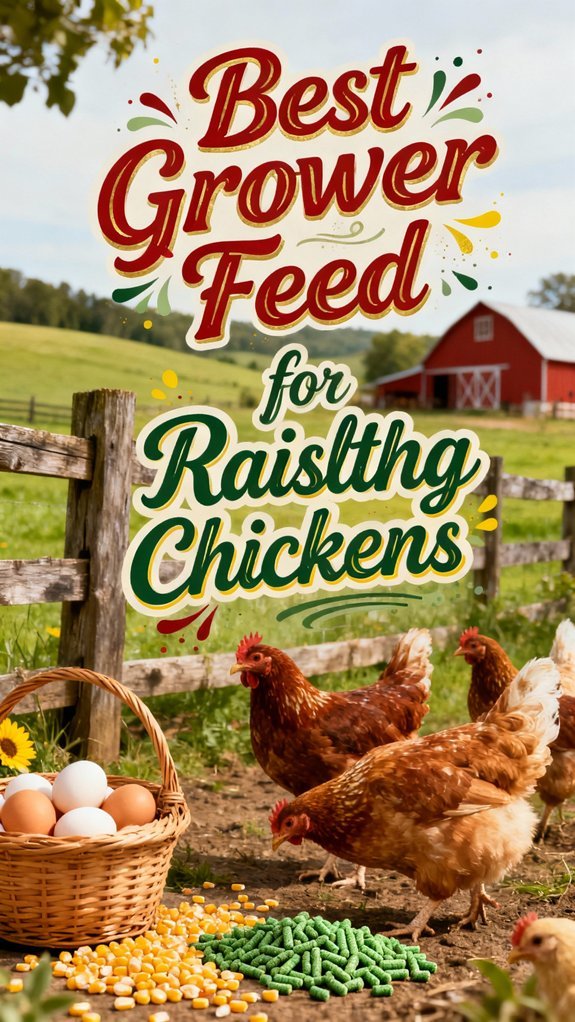
You’ll dramatically improve your flock’s growth and health by selecting a grower feed with 16-18% protein, balanced amino acids (1.30% lysine and 0.50% methionine), and optimized calcium-to-phosphorus ratios (1.25-1.60% calcium with minimum 0.6% phosphorus) between weeks 6-18. Pellet form minimizes waste and improves feed conversion efficiency. Incorporate probiotics like Bacillus subtilis and exogenous enzymes to enhance nutrient absorption. Shift gradually over 4-7 days when switching feed types to prevent digestive upset. The specifics of ingredient sourcing and cost-effectiveness strategies await your exploration below.
Understanding Nutrient Requirements for Growing Chickens
Because growing chickens undergo rapid development, you’ll need to provide precisely calibrated nutrients that support bone formation, muscle growth, and metabolic function. Your birds require 22% protein in starter feed during weeks 1-3, with critical amino acids like lysine at 1.30% and methionine at 0.50%. You must balance calcium at 0.95% available phosphorus to establish skeletal integrity. Additionally, ensuring an adequate level of calcium for eggshell strength is vital for laying hens as they transition from the grower to layer phase. Fat content at 5.0% facilitates vitamin absorption and provides essential fatty acids for energy metabolism. Incorporate fat-soluble vitamins A, D, E, and K alongside adequate fats to enhance uptake. Providing grit for digestion can also help chickens efficiently process their feed. Furthermore, regular use of First Saturday Lime in the coop can support a cleaner environment that promotes overall flock health. You should also consider popular brands that offer feeds specifically formulated for growth, ensuring chickens receive comprehensive nutrition that meets their needs. Chickens should also receive quality grains in their diet to maintain optimal health and egg production. You’ll need macrominerals—calcium, phosphorus, sodium, potassium, magnesium—and microminerals including copper, iodine, iron, manganese, selenium, and zinc. Limit fiber to under 10% for ideal nutrient density. Grains alone lack sufficient minerals, so premixes remain essential for balanced nutrition. Dietary needs vary based on breed, age, and weather conditions, requiring adjustment of nutrient ratios as your chickens progress through different growth stages.
Selecting the Right Protein Sources for Optimal Growth
To optimize growth in your pullets, you’ll need to select protein sources that deliver both sufficient crude protein and the specific amino acid profiles required during each developmental stage. You’ll find soybean meal—offering 40–48% crude protein with balanced essential amino acids—serves as your primary foundation. However, you shouldn’t rely solely on one source; instead, combine plant-based options like field peas (20–25% protein) with animal proteins such as fish meal (60–72% protein) to achieve superior amino acid balance. You’ll particularly benefit from addressing methionine and lysine, your most common limiting amino acids. Consider supplementing with synthetic amino acids to correct deficiencies cost-effectively. Including black soldier fly larvae provides a natural protein source that fulfills hens’ instinctive foraging behaviors while contributing additional amino acids to support overall nutrition. This protein source selection approach enables you to formulate stage-specific diets supporting lean tissue and feather development without excessive nitrogen excretion.
Balancing Minerals and Calcium in Grower Formulations
While you’ve carefully selected protein sources to support lean tissue development, you’ll now need to manage the critical calcium-phosphorus relationship that underpins skeletal growth and metabolic function. You’ll want to maintain phosphorus at 0.6% minimum while limiting calcium to 1.25-1.60% in grower feeds—exceeding this range risks skeletal damage in birds under 18 weeks. Incorporating herbs like oregano and garlic can also provide immune-boosting benefits that further enhance the health of your chickens during this growth phase. It’s crucial to avoid materials that may pose respiratory hazards, such as cedar shavings, which are known to be toxic to chickens. Additionally, ensuring that chickens have access to appropriate grit is essential for optimal digestion.
You should use calcitic limestone rather than dolomitic varieties, as dolomitic’s high magnesium content interferes with mineral utilization. Combining small particle calcium sources like ground limestone for quick availability with large particle grit provided separately optimizes phosphorus absorption and bone development. You’ll also benefit from incorporating plant-based calcium sources such as canola meal (6.8 g/kg) and soybean meal alongside supplemental vitamin D3 to enhance overall mineral bioavailability. Avoid providing grower feeds to chicks under 16 weeks, as excess calcium intake can disrupt kidney function and potentially shorten their productive lifespan.
Choosing Feed Form and Managing Feeding Schedules
The form you select for your grower feed directly impacts both nutrient delivery and feeding efficiency during the critical 6-18 week growth period. Pellets minimize spillage and waste, making them ideal for your feeding strategy, while crumbles provide satisfying texture but risk higher food loss. Mash guarantees balanced nutrient intake, preventing selective grain consumption that causes deficiencies. Chicks are typically one to two days old when purchased, which makes the right feeding approach even more crucial. Adding a homemade feed recipe can provide nutritious formulations tailored to your flock’s needs. Including premium complete feeds ensures that your chickens get the vital nutrients necessary for healthy growth. Additionally, incorporating homemade chicken treats can provide extra vitamins and minerals to support overall health.
Your feeding schedule requires shifting chicks to grower feed at 6 weeks, maintaining 16-18% protein through week 18. At 20 weeks or first egg lay, switch to layer feed—earlier introduction risks kidney damage from excess calcium. This ensures that hens receive the necessary nutrients for strong eggshell quality. Supplement your feed form choice with free-choice rock grit and limit scratch to 10% of their diet. Consider fermented feed to enhance digestion and reduce droppings throughout this growth phase. Fermented feed introduces beneficial bacteria that improve gut health and ease nutrient absorption during the crucial development period.
Incorporating Health-Supporting Additives and Functional Ingredients
Beyond optimizing feed form and scheduling, you’ll strengthen your grower flock’s resilience by strategically incorporating health-supporting additives and functional ingredients during weeks 6–18. Probiotics like Bacillus subtilis and Lactobacillus spp. increase beneficial gut bacteria abundance and improve growth performance. Prebiotics such as mannan-oligosaccharides enhance microbial stability and short-chain fatty acid production, bolstering intestinal barrier function. Synbiotic combinations amplify immune markers and antioxidant enzyme activity. Exogenous enzymes—phytase, xylanase, protease—boost phosphorus and amino acid digestibility while reducing anti-nutritional effects. Organic acid blends acidify the gut, lower pathogen loads, and prime immune function. Additionally, a consistent parasite control program is essential for overall poultry health, reducing stress and environmental burdens caused by pests. Botanical compounds from oregano, turmeric, and cinnamon provide antimicrobial and antioxidant effects. Additionally, quality layer feed that meets specific nutritional requirements is crucial for the overall health of chickens as they grow. Enzymes break down anti-nutritional elements in grains like wheat and barley, maximizing nutrient absorption and feed efficiency for optimal grower performance. Strategic feed additives optimize digestion enhancers and gut health while reducing antibiotic dependency.
Comparing Feed Options and Evaluating Cost-Effectiveness
Once you’ve fortified your grower rations with health-supporting additives, you’ll need to evaluate which feed formulations and delivery systems offer the best return on investment for your flock’s development stage and production goals. Your cost analysis should examine feed conversion ratio (FCR) alongside ingredient pricing—pellets typically reduce waste and improve FCR compared to mash, lowering cost-per-bird despite higher per-ton premiums. Furthermore, apply the principles of hybrid vigor to choose feed that enhances growth potential. Additionally, ensuring your feed includes adequate calcium sources is essential for maintaining strong bone health and overall growth in young chickens. A balanced diet consisting primarily of quality layer feed is crucial for optimal health and development. The choice of feed type, whether mash, pellets, or crumbles, can also significantly impact the feeding efficiency and health of your flock. Roosters, which are generally larger and exhibit different nutritional needs, can also influence the overall flock dynamics. Calculate total grower-phase expenses by multiplying FCR by feed price and days on feed. Organic or specialty formulations command price premiums; justify these through documented performance gains or market differentiation. Most grower feeds contain protein levels between 18-20%, which supports optimal growth rates during the critical development stage. Bulk purchasing reduces per-unit costs considerably for larger operations, while smaller flocks may benefit from bagged convenience despite higher logistics expenses.
Transitioning Between Feed Phases for Maximum Results
Your flock’s nutritional requirements shift dramatically as birds mature, and selecting cost-effective feeds means little if you can’t time phase changes to match their physiological development. Implement replacement strategies over 4–7 days by gradually blending old and new feed, incrementally increasing the new feed proportion to minimize digestive upset. Your feed adjustments must align with specific milestones: introduce grower feed at 4–8 weeks, switch to developer feed around 12–20 weeks, then shift to layer feed at first egg or 16–20 weeks. Incorporating fresh sage into their diet can also enhance their overall health due to its nutritional properties. Additionally, consider providing oyster shells as a calcium supplement starting around 18-20 weeks to support strong eggshell formation and overall hen health, as hens can also benefit from crushed eggshells which offer a natural calcium source. Baking and crushing eggshells for your hens is a simple process that promotes calcium intake, which is essential for strong eggshell formation. It is crucial to ensure the presence of high calcium content in the layer feed to promote optimal egg laying capacity as your hens mature. Monitor consumption and droppings daily during shifts to detect refusal or digestive issues early. Match pellet sizes between feeds where possible to improve acceptance and reduce waste, ensuring smooth nutrient changes that support ideal growth and production without compromising flock health. Overlaps in feed transitions can occur without concern, allowing flexibility as your flock responds to nutritional adjustments at different rates.