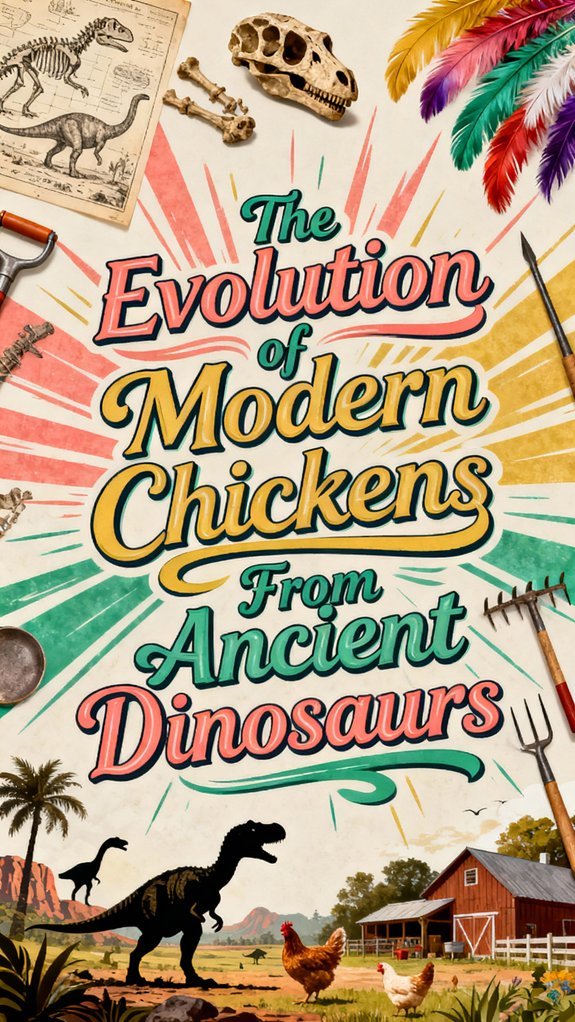
You can trace modern chickens directly to theropod dinosaurs through genetic lineage and skeletal evidence. Their wild ancestor, the red junglefowl, domesticated roughly 8,000 years ago, retained latent genetic machinery from ancient reptilian forms. Contemporary chickens still possess dormant developmental pathways—reactivating BMP4-Msx1 signaling regenerates tooth-like structures absent for millions of years, while inhibiting Sonic Hedgehog produces proto-feathers resembling early dinosaur forms. Selective breeding intensified these transformations, reshaping phenotypes dramatically. Understanding how evolutionary reversibility operates at the genetic level reveals fascinating implications about developmental plasticity.
Fossil Evidence Linking Birds to Non-Avian Dinosaurs
Through direct fossil evidence, feathered non-avian theropods demonstrate that you’re examining organisms whose integuments bridge the gap between dinosaurs and birds. Fossil displays from sites like the Liaoning Lagerstätten preserve remarkably detailed feather impressions across multiple theropod clades—dromaeosaurids, troodontids, and basal paravians—revealing morphological diversity from filamentous protofeathers to asymmetrical flight feathers. Additionally, it has been suggested that these theropods may have consumed nutritious food sources similar to what modern chickens enjoy, such as shrimp, indicating a dietary adaptation that supports their survival and evolution. Furthermore, the addition of fresh vegetables to their diet, like cucumbers, highlights an aspect of how nutritional needs may have influenced their evolutionary path.
Quill knobs on Velociraptor ulnae provide osteological corroboration for large, anchored feathers. This phylogenetic distribution of feathered theropods across several distinct groups supports homology rather than convergent evolution. Feather evolution progressed incrementally through documented complexity stages, establishing that feathers predate true birds. Studies suggest these feathered theropods flew with quick, short bursts similar to modern pheasants, indicating functional aerodynamic structures. You’re witnessing paleontological evidence that clarifies avian origins through integumentary structures preserved in stone.
Phylogeny and Genetic Continuity
While fossil evidence establishes the evolutionary pathway from theropod dinosaurs to modern birds, molecular genetics reveals how contemporary chicken lineages descended from specific wild ancestors and diversified across geographical regions. You’ll find that ancient mtDNA haplogroups A, C, and F, present in Yellow River populations over 4,500 years ago, persist in modern chickens, demonstrating genetic continuity. Optimal eggshell quality in these birds may be partially attributed to the genetic adaptations acquired throughout their evolution. Genetic drift during domestication reduced nuclear diversity by 70%, yet substantial mtDNA phylogeographic structure remained intact. Studies of breeds like Anjian chickens reveal that multiple maternal origins continue to influence modern poultry populations, as evidenced by the clustering of distinct haplotypes in contemporary lineages. Adaptation mechanisms drove fixation of the TSHR-Gly558Arg allele in domestic chickens from *Gallus gallus spadiceus*, reaching 94.0% frequency. Analysis of ancient DNA from northern China confirms the middle/lower Yellow River as the domestication origin, establishing how selective pressures and population bottlenecks shaped modern poultry genetics.
Developmental Genetics and Atavistic Experiments
Molecular manipulation of developmental pathways reveals that modern chickens retain latent genetic machinery for ancestral traits—a phenomenon you can observe when researchers strategically suppress or activate specific genes during embryogenesis. By inhibiting Sonic Hedgehog signaling on embryonic day 9, you’ll produce proto-feathers mirroring Early Triassic dinosaur forms. Gene regulation experiments demonstrate that suppressing fibula-shortening genes restores elongated dinosaur-like leg bones. You can reactivate tooth development through BMP4-Msx1 signaling in oral tissues, generating tooth-like structures absent for millions of years. These evolutionary reversals underscore how trait reactivation occurs through targeted molecular intervention. Furthermore, the prolific egg-laying capabilities of breeds like the Rhode Island Red highlight the evolutionary adaptations that have occurred within modern chickens. Additionally, many chicken breeds benefit from a well-balanced diet consisting of high-protein layer feed, which supports their overall health and productivity. Your manipulation of developmental pathways confirms that evolutionary changes remain reversible at the genetic level, validating the molecular continuity between modern birds and their dinosaurian ancestors. The Sonic Hedgehog gene also facilitates embryonic development across various animal species, demonstrating its fundamental role in shaping biological form.
Skeletal Transformations: From Dinosaur to Bird
The shift from theropod dinosaurs to modern birds didn’t occur through wholesale anatomical replacement but rather through coordinated remodeling of existing skeletal elements—a process you can trace through progressive changes in cranial architecture, axial reduction, and forelimb reorganization. Your cranial adaptations involved bone fusion and rostral elongation, replacing teeth with keratinous beaks while increasing jaw mobility through palatal rearrangement. Simultaneously, axial modifications compressed the tail into a fused pygostyle, reducing rotational inertia and shifting locomotor mechanics toward forelimb propulsion. These transformations weren’t uniform; instead, you observe mosaic sequences of vertebral loss occurring through lineage-specific pulses. Corresponding forelimb reorganization consolidated digits and reshaped wrist articulations, enabling wing folding and effective flight mechanics—all supported by microstructural bone continuity with coelurosaurian ancestors. Additionally, this evolutionary progression highlights how automatic waterers can play a crucial role in our modern understanding of avian needs.
Integumentary Evolution: The Story of Feathers
As skeletal remodeling concentrated locomotor mechanics into forelimb propulsion, a parallel integumentary revolution transformed your dinosaurian ancestors’ body surfaces through feather elaboration. Proto-feathers emerged as simple tubular filaments around 200 million years ago, initially lacking barbs, barbules, and follicles. These structures served proto-feather functions beyond flight: thermal insulation, visual signaling, and camouflage. Additionally, studies have shown that the insulation properties of feathers played a crucial role in regulating body temperature and enhancing survival in varying climates. To ensure these early birds survived predators, their predator avoidance strategies included using feather coloration for effective camouflage. Interestingly, evidence suggests that the development of feathered creatures with affinity for white egg-laying traits corresponds with their adaptability in diverse environments. Furthermore, homemade chicken treats can also provide essential nutrients, helping to support a chicken’s health in tandem with their evolutionary adaptations. Developmental evidence reveals that Sonic hedgehog signaling controlled filament branching, enabling stepwise progression toward modern feather morphology. Fascinatingly, Araucana chickens exhibit unique traits such as blue eggs and tufted ears, showcasing the diversity that evolved within birds. Fossil intermediates document changes from hollow tubes to barb clusters to rachis-bearing vanes. Heterochronic shifts in developmental gene expression generated feather diversity across early paravian lineages. The robustness of feather development mechanisms demonstrates evolution’s capacity to maintain complex morphological traits despite genetic perturbations. By the Late Cretaceous, your avian predecessors possessed asymmetric flight feathers with mechanical loading capabilities, representing the culmination of millions of years’ integumentary innovation.
Respiratory System Changes Across the Dinosaur-Bird Transition
While your skeletal frame underwent dramatic remodeling to support flight, your respiratory system underwent an equally profound transformation—one that paradoxically preceded powered flight by millions of years. Your theropod ancestors possessed skeletal pneumaticity and flow-through ventilation, maximizing pulmonary efficiency under Mesozoic low-oxygen conditions. Rigid parabronchial lungs—constrained dorsally by bicapitate ribs—enabled unidirectional airflow and superior gas exchange compared to mammalian tidal respiration. Air sacs functioned as bellows, driving continuous ventilation without lung expansion. Uncinate processes enhanced ventilatory mechanics, while cartilaginous uncinate processes likely developed gradually from ancestral archosaurs to support increasing muscle loads and trunk stability. Gastralia gradually diminished as pelvic-air-sac systems evolved. These respiratory adaptations reflected mounting evolutionary pressures favoring sustained metabolic activity. By establishing efficient dinosaur respiration mechanisms, your lineage acquired respiratory foundations essential for avian physiology long before flight demands emerged.
Survival and Diversification Across the K–Pg Extinction
Your lineage’s survival through the Cretaceous–Paleogene boundary hinged on morphological and physiological traits that’d accumulated across millions of years of theropod evolution. Small body size, generalist feeding strategies, and flight capability enabled avian resilience when larger dinosaurs perished. Your ancestors exploited ecological niches vacated by extinct competitors, particularly as post-impact forest collapse favored ground-foraging generalists. Molecular evidence suggests multiple neornithine lineages crossed the boundary, demonstrating heterogeneous survival rather than single-lineage persistence. Beak-bearing, tooth-reduced morphologies proved advantageous under catastrophic conditions. Geographic variation produced uneven extinction patterns, with southern-hemisphere populations recovering faster. The mixotrophic food webs that emerged during ecosystem recovery provided crucial sustenance for early avian radiations seeking alternative food sources. This ecological release—reduced competition from large reptiles and archaic bird groups—accelerated morphological diversification as survivors radiated into emptied niches, exploiting novel diets and habitats throughout the Paleogene. During this period, protein-rich sources such as dried mealworms became increasingly important for the health and survival of avian species adapting to new dietary challenges, alongside other high-protein options like termites that helped sustain chicken ancestors as they adapted to diverse environments. Additionally, the humor in chicken behavior, as seen in famous sayings like “rule the roost,” reflects how these resilient creatures have found a place in culture even as they adapt to survive. Ensuring proper health care for young chicks was also critical, as issues like pasty butt could threaten their survival in rapidly changing habitats. Providing a balanced diet, rich in essential nutrients, was key to supporting the health of these early birds.
Red Junglefowl: The Wild Ancestor of Domestic Chickens
From that Paleogene radiation of avian lineages emerged the Galliformes, an order whose ground-foraging, generalist members’d eventually produce one of humanity’s most consequential domesticates. You’ll find that red junglefowl (Gallus gallus) served as the primary wild ancestor through subspecies G. g. spadiceus, domesticated 7,000–9,500 years before present in Southeast Asia. The species exhibits pronounced sexual dimorphism—males weigh 1.3–2.0 kg with ornate plumage; females reach 1.0–1.5 kg. Their behavioral adaptations—omnivorous foraging, territorial displays, and cryptic nesting—enabled successful domestication. Red junglefowl prefer disturbed habitats and edges across their range from Pakistan to Indonesia and throughout Oceania. Genomic analyses reveal genetic variation through introgression from other Gallus species, particularly for domestic traits like yellow skin. Bidirectional gene flow between wild and feral populations continues blurring evolutionary boundaries, demonstrating domestication’s ongoing complexity and evolutionary significance.
Modern Selective Breeding and Its Effects on Chicken Genetics
Since the domestication of red junglefowl, humans’ve systematically transformed chickens through selective breeding—a practice that’s fundamentally altered their genetics, physiology, and phenotype. You’ll observe that modern genetics prioritize breeding efficiency through rigorous culling and pyramidal pureline structures, selecting only the top 10% of chicks as next-generation breeders. This methodology yields dramatic results: contemporary broilers grow 300% faster than 1960 counterparts, reaching market weight in mere weeks. You’ll note that selective pairing methods—including clan mating and artificial insemination—maintain consistency across generations while minimizing defects. However, these intensive breeding protocols precipitate welfare complications: accelerated growth causes mobility impairment and structural conformation changes. Maintaining genetic diversity among breeding stock is essential for reducing inherited defects and ensuring sustainable flock health across multiple generations. Modern genetics simultaneously reduce aggression and cannibalism, eliminating certain management practices while creating dependency on controlled breeding systems for trait stability.