You can technically get eggs from broiler chickens if they survive past their typical market age of 5-9 weeks, but you’ll find their reproductive output negligible. Their genetics prioritize rapid meat growth over egg-laying capacity, creating strong negative correlations between growth rate and reproductive efficiency. Broilers that do lay produce far fewer eggs than dedicated layer breeds like Australorps, which yield up to 364 annually. The reasons behind this genetic trade-off reveal fascinating insights into commercial poultry production.
Understanding Broiler Chicken Breeding
While broiler chickens you’d purchase for meat can’t produce eggs commercially, broiler breeders—the parent stock generating fertile eggs for broiler production—follow a carefully managed breeding system. You’ll find that primary breeders use pedigree, great-grandparent, and grandparent generations in a production pyramid structure. These broiler genetics rely on sophisticated breeding techniques combining quantitative genetics, computer science, and DNA chip technology to identify genetic markers. Single nucleotide polymorphisms (SNPs) aid your pedigree selection programs, targeting rapid growth rate, feed efficiency, and breast meat yield. You’ll also employ crossbreeding high-performing strains to enhance hybrid vigor. Breeders separate males and females during rearing due to differing growth rates and nutritional needs, then transfer them to production farms between 18-23 weeks of age. Interestingly, the use of hybrids in various poultry breeds has become a common practice to improve production traits. At around 24 weeks, Broiler breeder females start laying fertile eggs, indicating that they have reached their productive potential, which ultimately supports the commercial production of broiler chicks. Additionally, providing a balanced diet is crucial for maintaining the health and productivity of broiler breeders, and it is important to ensure they receive layer feed when they begin laying eggs to support optimal health and egg production. Proper nutrition should include essential calcium to aid in the formation of strong eggshells.
The Timeline: When Broilers Reach Maturity
The timeline for broiler maturity reveals a fundamental disconnect between commercial production and biological development. You’re looking at slaughter ages of 5–9 weeks for standard broilers, well before they reach any physiological milestones related to reproduction. Sexual maturity doesn’t typically onset until around 12 weeks—already beyond market windows for most birds.
Fast-growth genetics like Cornish Cross and Cobb 500 strains actively delay reproductive development while prioritizing rapid muscle gain. If you kept these birds alive, pullets would eventually reach first lay around 18–24 weeks, similar to layer strains. However, broiler timelines never permit this progression. Genetic selection has fundamentally altered energy allocation, pushing reproductive maturation further out while accelerating growth rate. Selective breeding has created broiler lines that prioritize meat production over egg-laying capacity entirely. Commercial broilers simply never encounter the conditions necessary for egg production.

A Complete Feed Specifically Balanced for Pastured Poultry

COMPLETE ALL FLOCK FEED FOR MIXED BACKYARD FLOCKS: Versatile poultry feed & all flock feed designed to support chickens, ducks, turkeys, geese, & more; a balanced bird food that simplifies feeding a diverse species in your backyard or homestead

TAILORED FOR BROILERS: Our organic chicken feed is specifically designed for growing chicks beyond 4 weeks of age. Our chicken grower feed is enriched with probiotics, and contains a carefully balanced blend of protein, vitamins, and minerals to promote the development of healthy bones and feathers from chick to hen.
Why Broilers Never Lay Eggs for Consumption
Even if broilers survived past market age, they’d still produce few eggs worth consuming—a consequence of decades-long genetic selection prioritizing meat yield over reproductive output. Broiler genetics fundamentally diverge from layer breeds; you’re looking at birds engineered for rapid growth and muscle development, not sustained egg production.
The genetic trade-off manifests in reduced ovarian function. Broiler breeders experience multiple simultaneous ovulations, resulting in defective double-yolked eggs unsuitable for commercial use. Their reproductive systems simply can’t deliver the consistent egg quality that commercial operations require. Additionally, broilers show shorter lay duration and lower total egg numbers compared to specialized laying breeds. Modern poultry management software cannot compensate for these inherent biological limitations in broiler reproductive capacity.
You’re basically dealing with birds whose biology prioritizes converting feed into body mass rather than maintaining reproductive efficiency. That fundamental mismatch renders broiler eggs commercially nonviable.
The Role of Broiler Breeder Flocks
Understanding why broiler eggs don’t work commercially requires examining the breeding infrastructure that sustains the entire broiler industry. You’ll find that breeder flock management fundamentally differs from meat-bird production. Modern broiler breeders undergo rigorous genetic selection and controlled feeding programs designed specifically to produce fertile eggs for hatcheries—not consumption-quality eggs.
You must maintain precise body-weight uniformity, time photostimulation carefully around 20–21 weeks, and implement restricted feeding to optimize reproductive efficiency. Through egg quality assessment protocols, you monitor fertility rates, hatchability percentages, and embryo viability rather than culinary characteristics. Hatcheries require specialized biosecurity measures including fencing, gated access, and employee decontamination facilities to maintain the integrity of the egg supply chain.
You’re managing for maximum fertile egg production within a 40-week laying cycle. This specialized breeding infrastructure prioritizes genetic traits for meat growth in offspring, creating birds fundamentally unsuitable for egg production in commercial settings.
Comparing Broilers to Layer Chickens
While broiler chickens and layer chickens descend from the same species, their divergent breeding purposes have created two fundamentally different birds suited to entirely separate production goals. You’ll notice broiler behavior prioritizes rapid growth over reproduction, with birds reaching 4-7 kg compared to layers’ 1.4-1.6 kg. This size difference creates significant physiological trade-offs. Layer advantages include selective breeding for consistent egg production—up to 300 annually—and extended laying cycles spanning two years or more. Broilers, conversely, show lower peak production and shorter lay duration due to growth-reproduction conflicts. Their excessive weight causes multiple ovulations and defective eggs. Interestingly, incorporating obstacle courses in their environment can help stimulate physical activity, potentially leading to improved overall health. Additionally, feeding broilers a diet enriched with high calcium content can support better health, though their genetic selection fundamentally prioritizes meat efficiency over reproductive capacity. Proper nutrition management during the broiler rearing period ensures optimal growth while maintaining baseline health standards that support any minimal egg production that may occur. Incorporating essential herbs in their diet can help promote overall health, potentially allowing for some degree of egg production in broilers. Notably, certain breeds like the Australorp are renowned for their remarkable egg-laying abilities, producing up to 364 eggs per year, contrasting sharply with the lower productivity of broilers. In contrast, breeds like the Red Star are specifically bred for high egg output, making them much more efficient layers compared to broilers.

Superior calcium from Oolitic Aragonite: Provides high-quality calcium sourced from naturally occurring Oolitic Aragonite for optimal poultry nutrition

PREMIUM CHICKEN FOOD FOR LAYING HENS WITH OMEGA-3: High-quality chicken layer feed made for strong egg production; fortified with chicken feed omega 3 & extra chicken feed calcium to support healthy shells & provide complete daily nutrition for your hens

COMPLETE STARTER FEED FOR CHICKS: Specifically formulated for chicks from hatching to 16 weeks, this non-medicated chick starter feed delivers balanced nutrition and essential nutrients to support strong, healthy early growth and development.
Selective Breeding and Its Impact on Egg Production
The genetic architecture underlying broiler production reveals fundamental trade-offs that severely constrain egg-laying capacity. You’ll find that strong negative genetic correlations exist between rapid body growth and reproductive efficiency. When breeding technologies like genomic selection and structured line crossing prioritize breast meat yield and feed conversion, they divert physiological resources away from ovarian function and consistent ovulation. Additionally, coops designed for backyard chickens can impact management strategies for broiler breeders.
This genetic trade-off manifests in reduced peak egg production, shortened laying duration, and increased double-yolk eggs unsuitable for commercial use. Your broiler breeders experience earlier sexual maturation variability and erratic ovulation patterns—consequences of selection indices favoring somatic growth. Consequently, you must compensate through intensive management interventions: feed restriction, photoperiod manipulation, and controlled nutrition protocols become essential to normalize reproductive performance despite genetic predisposition toward poor lay. The continuous refinement of breeding goals remains crucial for any improvement in flock quality and reproductive outcomes across generations.


Optimizes Breeding Performance: Morning Bird powder protein enhances fertility and supports all stages of development. This concentrated formula is perfect for use during breeding periods or seasonal transitions to ensure optimal health and reproductive success.

Optimizes Breeding Performance: Morning Bird powder protein enhances fertility and supports all stages of development. This concentrated formula is perfect for use during breeding periods or seasonal transitions to ensure optimal health and reproductive success.
The Lifecycle of a Commercial Broiler
Can Broiler Chickens Produce Eggs?
The Lifecycle of a Commercial Broiler
Despite these genetic constraints limiting reproductive capacity, commercial broilers follow a precisely engineered lifecycle designed to maximize growth rather than egg production. You’ll observe this through distinct phases: the starter phase (0-2 weeks) where chicks double or triple their weight to 150-200 grams, the grower phase (3-4 weeks) reaching 600-800 grams, and the finisher phase (5-7 weeks) achieving 2-3 kilograms. Throughout the broiler lifecycle, you’ll manage phase feeding with four to six specialized diets meeting changing nutrient demands. Temperature control, lighting schedules, and feed restriction regulate broiler growth, preventing metabolic disorders. During the critical brooding period, frequent monitoring occurs 3 times daily to assess feeders, drinkers, temperature, ventilation, and litter conditions, establishing the foundation for optimal flock health and performance. This rapid broiler growth trajectory culminates at market weight within 5-7 weeks, fundamentally incompatible with reproductive development or egg production capabilities. Additionally, the prioritization of growth over reproduction means that many broilers will not reach the immune system reaction necessary to produce eggs. Furthermore, as part of their growth optimization, broilers often receive nutrition specifically designed for muscle development, which further detracts from their ability to produce eggs.
Feed Restriction in Breeder Management
Because broiler breeders’ genetic predisposition toward rapid growth directly conflicts with reproductive development, you’ll implement feed restriction as a critical management strategy to redirect nutrient allocation toward reproductive capacity rather than excessive body weight gain. You’ll restrict intake to 32-33% of ad libitum consumption, employing methods like skip-a-day feeding or daily portion control. This reproductive management approach prevents over-fleshing while optimizing follicle development and feed efficiency. You’ll follow breeding company growth curves, gradually increasing portions from 26g to 44g per bird by week six. Peak restriction occurs between weeks 8-16 during critical development. Continuous monitoring of body condition through weekly fleshing scoring ensures proper nutrient allocation and maintains the balance between growth suppression and reproductive health. When properly implemented with matching target weights and uniformity, feed restriction enhances egg production, reduces post-peak overweight risks, and increases Grade A chick output by approximately 4%. Furthermore, ensuring that proper nutrition during the laying phase supports overall hen health can significantly impact egg production outcomes, as balanced feeds are essential for optimizing egg-laying performance. Additionally, providing essential components in the diet helps to support reproductive health and overall chicken performance. To enhance overall health, consider incorporating premium feeds that contain optimal protein levels and necessary vitamins and minerals. Understanding the chicken life cycle helps in tailoring management practices to fit the birds’ developmental stages.


Health and Welfare Considerations in Broiler Production
While feed restriction and genetic selection optimize reproductive performance in broiler breeders, you’ll find that intensive broiler production systems present substantial health and welfare challenges that demand careful management. Lameness represents the most serious welfare problem, stemming from rapid growth that overwhelms immature skeletal development. You must monitor leg health closely, as fast-growing strains exhibit considerably higher rates of gait impairment and musculoskeletal deformities compared to slower-growing lines. Additionally, providing nutritional treats like fresh greens can support overall health and well-being in your flock. In addition, implementing effective mite control strategies can help maintain overall flock health, as pests can exacerbate stress and discomfort in birds. Stocking density directly correlates with footpad dermatitis and hock burn; maintaining densities below 30–36 kg/m² improves outcomes. You’ll reduce behavioral frustration and contact dermatitis by implementing environmental enrichment and optimizing litter management. Strategic strain selection toward slower-growing genetics greatly decreases cumulative pain and mortality rates across your flock. Transitioning to slower-growing breeds can reduce disabling pain by approximately 66% and excruciating pain by 78% compared to conventional fast-growing strains.

Dust-Free Formula: Reduces respiratory issues for chickens and keepers, ensuring a healthier living environment; Significantly reduces odors by minimizing moisture buildup and improving airflow
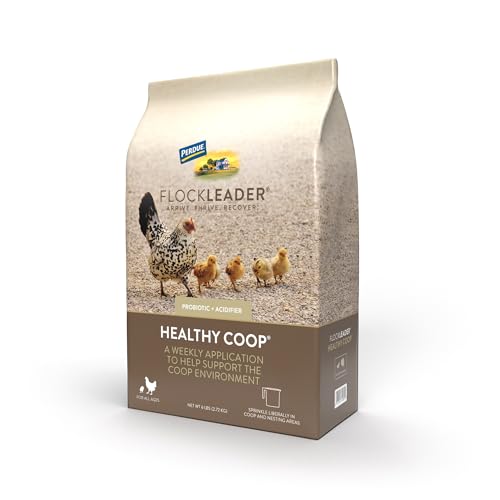
KEEPS YOUR COOP SAFE: The probiotics, acids and moisture absorbers in Healthy Coop help to keep your coop safe, neutralize odors, and keep bedding dry.

100% Certified Organic: GrubTerra Hemp Bedding for Chickens is crafted from sustainable hemp, providing an eco-friendly option for bird cage environments. It is perfect for guinea pig cages, mice, hamsters, and pretty litter setups, ensuring a cleaner, greener space.