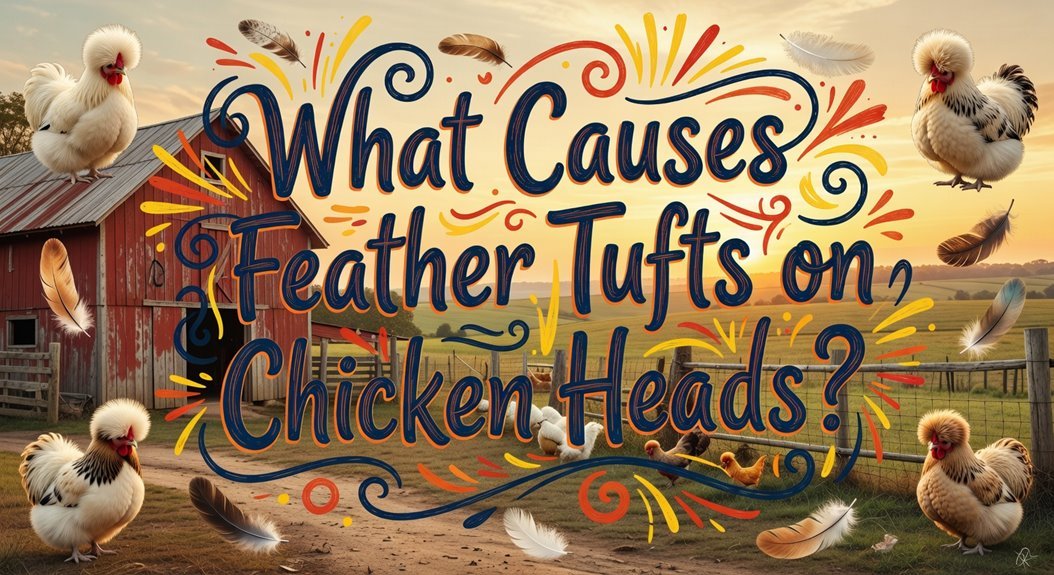
You’ll find feather tufts stem from an autosomal dominant Et gene mutation causing skin peduncles near ear canals. Unlike combs or muffs, these specific protrusions support ornamental plumes unique to Araucanas. Since homozygous embryos die, only about 25% of surviving chicks display the trait, while both sexes inherit it equally. Variable expression creates straight or curled appearances, yet aggressive pecking often damages them. Understanding this volatile genetics reveals why breeders meticulously track pedigrees to maintain the standard without lethal losses, a complexity we’ll unpack further as you explore the specific breeding challenges ahead.
What Are Chicken Head Tufts and Where Do They Grow?
Although often mistaken for standard plumage, chicken head tufts represent a specific genetic abnormality where feathers emerge from a peduncle, a protruding skin flap located near the ear. You’ll observe these structures framing the face sides, positioned distinctly under the earlobes rather than atop the head like combs. This unique growth pattern directly relates to specific feather genetics, involving an autosomal dominant mutation that alters normal development. When examining ear anatomy, you notice the tufts grow around this peduncle, sometimes protecting the ear canal opening while remaining separate from wattles or standard earlobes. These feathers vary in direction, hanging straight or curling up, yet they always originate from that specific skin protrusion. You must distinguish them from universal features, as they appear only in certain genetic lines. Understanding this precise location helps you identify the mutation’s physical manifestation accurately without confusing it with other cranial appendages found on all poultry. Notably, only the Ro chicken breed and its derived mixed breeds naturally produce these distinctive head tufts.
Which Chicken Breeds Have the Unique Tuft Mutation?
Where exactly does the autosomal dominant Et gene manifest in modern poultry? You find it primarily within Araucana standards, where tufts emerge specifically around the ear peduncle. While breeds like Polish display crests via distinct HOXC mutations, only Araucanas carry this unique Et variation. Historical Quetro ancestors established these traits, yet current genfted genetics confirm that non-Araucana lines lack this specific dominant allele. You observe visible tufts in roughly twenty-five percent of hatched chicks due to lethal homozygous effects. Mixed breeds inherit the mutation through dominance, but pure Araucana lineage remains the sole repository recognized by major poultry associations. You cannot locate true ear tufts in Silkies or Sultans, as their head feathering stems from entirely different genetic mechanisms unrelated to the Et locus found in South American fowl. Some chickens also exhibit a polydactyl trait, where extra toe development is linked to a dominant gene. The saddle feather shape helps differentiate roosters from hens, underscoring the importance of feather morphology in breed identification.
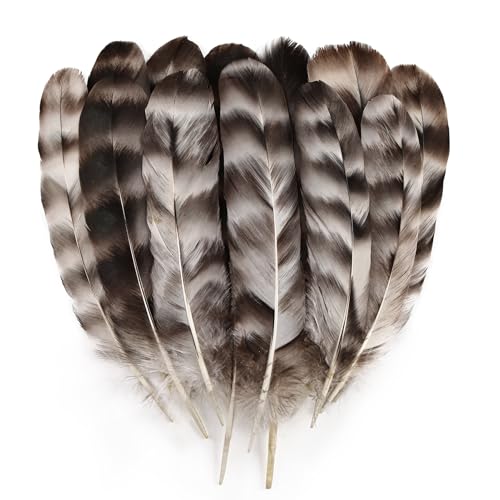
PREMIUM QUALITY MATERIALS: Our reed chicken feathers come off naturally and will not harm any animals. The chicken feathers are hand selected and then professionally cleaned, steamed and sterilised. Ensure no odour and safe to use

34% HIGH PROTEIN: A nutrient-dense treat to help support feather growth, muscle development, and egg production.

Package: Come with 15 pieces natural wild turkey feathers. Natural looking and soft, perfect for various craft needs.
How Does the Dominant Tuft Gene Affect Offspring?
Because the autosomal dominant Et gene exhibits reduced penetrance and lethal homozygosity, you’ll observe that breeding two tufted parents (Et/et+) results in approximately 25% embryonic death during late incubation rather than a full complement of tufted offspring. This lethal homozygosity (Et/Et) typically occurs between days 17 and 19, drastically altering expected genetic inheritance ratios. You won’t see all surviving chicks display tufts due to penetrance variability; indeed, many heterozygotes remain clean-faced despite carrying the allele. When mating a tufted bird with a non-tufted one, you’ll get roughly 50% tufted progeny, yet expression remains inconsistent. The TBX1 candidate gene on chromosome 15 drives this complex trait. You must account for significant post-hatch mortality too. Ultimately, managing these crosses requires understanding that visible phenotypes don’t always match genotypes, creating unpredictable flock outcomes regarding head feathering patterns.
Do Both Roosters and Hens Grow Head Tufts?
While the lethal homozygosity of the Et allele dictates survival rates, it does not restrict tuft expression to a specific sex. You observe that both roosters and hens develop these cranial feather clusters because the trait follows autosomal dominant genetic inheritance patterns. Since the gene resides on non-sex chromosomes, you find no biological mechanism limiting growth to females or males exclusively. However, you must note significant phenotype variability within flocks; individual birds display tufts hanging straight, curling upward, or appearing on only one side. Roosters possess distinct saddle and hackle feathers, yet their head tufts emerge independently from these sex-linked characteristics. When you mate two tufted parents, you expect seventy-five percent of surviving offspring to exhibit tufts, regardless of gender. Clean-faced birds lack this trait entirely, proving that lineage alone guarantees nothing without the active dominant allele driving expression in both sexes equally today.
How Are Tufts Different From Combs, Muffs, and Beards?
How do you distinguish the lethal peduncle-based tufts of Araucanas from the vascular combs or HOXB8-driven muffs and beards found in other breeds? You examine feather morphology closely. Tufts erupt from skin flaps near ears, driven by specific genotype genetics unique to Araucanas. Combs differ entirely as vascular tissue atop the head, serving thermoregulation without feathers. Muffs and beards, conversely, stem from chromosome 27 duplications boosting HOXB8 expression on cheeks and chins. You observe that muffs and beards always appear together, unlike solitary tufts. While combs cool blood, facial feathers offer no functional advantage, remaining ornamental. Tufts arise from autosomal dominant mutations, whereas muffs follow incomplete dominance via the Mb gene. You identify these distinctions by locating growth origins: peduncles for tufts, cheek skin for muffs, and chin areas for beards. This precise differentiation clarifies breed-specific traits effectively. Adding fresh fruit treats such as watermelon can also promote overall health in chickens. Proper coop sanitation reduces rodent presence and consequently lowers the risk of snakes entering the area.
Why Do Some Tufts Curl Like Handlebar Mustaches?
Although the autosomal dominant mutation drives tuft formation exclusively in Araucanas, you’ll observe that feather curling into handlebar shapes stems from variable growth vectors rather than a separate genetic switch. You’ll note how peduncle morphology dictates the initial emergence angle from the skin flap beneath the earlobes. This structural foundation influences whether feathers project outward or downward immediately. Moreover, curl direction genetics modulate the shaft’s curvature as keratin deposits during development. You’ll see some birds display upward-sweeping plumes mimicking mustaches, while others exhibit straight, hanging clusters. These variations occur randomly within the breed, affecting males and females equally. The specific vector determines if the tuft frames the face laterally or curls distinctly upward. You must recognize that no distinct gene controls this curl; instead, physical forces acting on the growing feather shaft create the diverse aesthetic presentations observed today. Just as fixed eyeballs force chickens to move their heads to maintain visual focus, these physical growth vectors mechanically dictate the final shape of the feathers without a dedicated genetic switch for curling. The Frizzle gene mutation in KRT75 also illustrates how keratin alterations can affect feather structure.
What Causes Feather Loss Around the Ear Tufts?
You’ve just examined how genetic vectors shape ear tuft aesthetics, but feather loss in these same regions stems from distinct environmental and physiological stressors rather than hereditary traits. You observe flock dynamics where dominant birds peck subordinates to establish hierarchy, creating bald patches. Stress induced conditions elevate this aggression markedly. Simultaneously, you identify mite infestation as a primary culprit; parasites concentrate near warm ear tufts, causing excessive preening that pulls feathers. You also detect nutrient deficiency, specifically a feather deficiency protein gap, which triggers compensatory pecking as chickens consume plumage to supplement dietary lacks. Rooster treading mechanically damages neck feathers during mating, while sudden light changes provoke pre-molt shedding. You must distinguish these empirical causes: social conflict, parasitic irritation, dietary insufficiency, mechanical wear, and hormonal cycling all drive localized alopecia independently of genetics. Additionally, you may find that over-preen behavior driven by lice infestation in the interior preen area leads to further feather removal near the head and neck regions. Regular cleaning with diluted neem oil can help eradicate ear mites and reduce irritation. Molting often presents sensitive pin feathers that can be mistaken for mite damage.

Protect your oasis with Captain Jack’s Neem Max Ready-to-Use Spray; this multipurpose product acts as a 4-in-1 insecticide, fungicide, miticide and nematicide

Protect your oasis with Captain Jack’s Neem Max Ready-to-Spray solution; this multipurpose product acts as a 4-in-1 insecticide, fungicide, miticide and nematicide

Protect your oasis with Captain Jack’s Neem Max Ready-to-Use Spray; this multipurpose product acts as a 4-in-1 insecticide, fungicide, miticide and nematicide
How Can You Prevent Parasites and Picking on Tufts?
While genetic factors dictate tuft formation, you must actively manage environmental vectors to stop parasites and picking. Remove droppings daily and change bedding weekly to maintain strict dust hygiene. Disinfect surfaces monthly, guaranteeing ventilation eliminates dampness where mites thrive. You’ll provide a dedicated dust bath containing dry soil mixed with food‑grade diatomaceous earth. This abrasive medium physically destroys lice and mites upon contact. Quarantine new birds for thirty days, applying preventative sprays before integration. Avoid overcrowding, which accelerates parasite transmission and feather pecking incidents. Supplement feed with pumpkin seeds to paralyze internal worms effectively. Control rodent and wild bird access to block external vector introduction. Deworm flocks every three to six months in high‑risk zones. Repeat treatments to destroy resilient eggs. Apply petroleum jelly directly on affected tufts for immediate mite removal. Consistent empirical observation guarantees early detection and rapid intervention against infestation. Keep litter dry because dry litter limits parasite breeding and reduces the risk of internal infections that weaken the flock. Heavy northern fowl mite infestations can cause anemia and reduced egg production. Increased scratching and head shaking often signal mite irritation in affected birds.

Supports Healthy Feathers & Skin: This 20-pound bag is made with food-grade diatomaceous earth and calcium montmorillonite clay, this dust bath absorbs excess oils, keeping your flock’s plumage clean.

Supports Healthy Feathers & Skin: You will receive 2 bags (20 pounds each), made with food-grade diatomaceous earth and calcium montmorillonite clay, this dust bath absorbs excess oils, keeping your flock’s plumage clean.

Natural Pest Control: (2) 20oz bags to effectively kill mites, lice, fleas, and other external parasites through dehydration.
Why Do Breeders Prize Araucana Head Tufts?
Because ear-tufts constitute the sole defining morphological trait separating the Araucana from all other recognized poultry breeds, you must prioritize their expression to meet American Poultry Association show standards. You cannot exhibit clean-faced birds, as judges immediately disqualify them despite superior type or color. This strict adherence drives intense market demand for specimens displaying perfect, symmetric tufts. You navigate complex lethal gene mechanics where homozygous embryos die, forcing you to accept low hatch rates. Only twenty-five percent of offspring express the desired phenotype, making successful breeding a statistical challenge. You meticulously track pedigrees to maximize visible tufting while managing reduced fertility linked to rumplessness. Ultimately, you value these structures because they define genft aesthetics unique to this lineage. Without them, the bird loses its distinct identity against Ameraucanas possessing mere muffs. You breed specifically for this rare, dominant trait despite significant embryonic mortality risks inherent in the process. Their fluffy fur-like feathers also require careful temperature management to prevent cold stress.