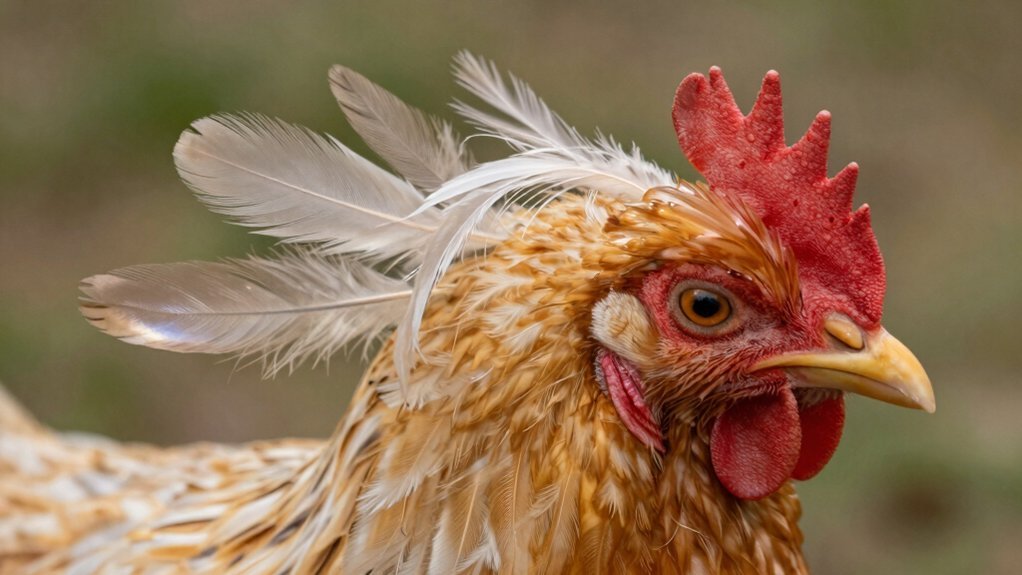
You’re probably wondering what those pointed, rear‑back feathers are called and why they matter for sexing chickens. Saddle feathers sit just in front of the tail base on the lower back, forming a distinct “saddle” silhouette; roosters sport long, narrow, lance‑tipped feathers, while hens have shorter, rounded, blunt ones that become noticeable around 8‑10 weeks. Spot them by viewing a calm bird from the side, parting the surrounding plumage, and looking for symmetric, glossy, pointed feathers—if you see that, you’ve likely got a rooster. Next, you can confirm with comb size or wattles, or explore other sexing clues.
Define Saddle Feathers and Their Location
saddle genetics determines how prominent that patch becomes. Some breeds inherit a broader, more visible saddle, while others show only a faint line of slender feathers.
Obviously, you’ll see them grouped with hackles and sickles, not as a single feather.
Takeaway: saddle feathers sit on the lower back, shaped by genetics, and give chickens a characteristic rear‑back silhouette. Next, you’ll want to learn how to tell male from female saddle feather shapes. Unlike the soft, fluffy feathers found on Silkie heads due to a lack of barbicels, saddle feathers are typically sleek and streamlined to contour the bird’s lower back. While saddle shape is distinct, other traits like the Frizzle gene mutation can alter feather structure by affecting keratin development, causing feathers to curl outward rather than lie flat. These feathers grow from a feather follicle and can be actively raised or lowered by muscle action to aid in communication or temperature regulation.
Identify Male vs. Female Saddle Feather Shapes
How can you tell a rooster’s saddle feathers from a hen’s? You’re probably staring at a flock and wondering which silhouette means male. Here’s the thing: rooster feathers are long, narrow, and end in a lance‑like tip, almost like tiny streamers that drape down both sides of the tail base. In anatomical diagrams they appear as sharp, angular lines, while hen feathers stay shorter, rounder, and blunt—more like neat ovals that blend smoothly into the back.
Now, look at the overall shape. A rooster’s saddle creates a pointed, angular outline; a hen’s forms a softer, fuller silhouette. Artwork styles that emphasize contrast will highlight the rooster’s visible strands versus the hen’s flatter lay. Roosters also develop these distinct features alongside flashier tail feathers as they mature into their dominant role. While saddle feathers are a strong visual indicator, you should also observe comb development since males typically display larger, redder combs by six to eight weeks of age. Additionally, as roosters mature, they grow bony spurs on their legs that serve as weapons for fighting and self-defense.
All right, compare side‑by‑side. If you see distinct pointed strands, you’ve got a male. If the feathers lie flatter and rounder, you’re looking at a female. The takeaway: shape cues give you a reliable first clue. Next, check other sex‑specific traits to confirm. Only roosters have saddle feathers.
Recognize When Sex‑Specific Saddle Traits Appear
When you wonder when those pointy saddle feathers start showing up, the answer is usually around 8 to 10 weeks. You’re right to ask because genetic inheritance drives when the male‑specific lengthening appears, while lighting conditions can hide or highlight the contrast.
Now, between 8 and 12 weeks most birds reveal useful cues: males lengthen the saddle region, females keep it short and rounded. Obviously, breeds like Silkies may mask these signs, so you’ll need good light to see the subtle shape differences. It is important to note that chicks typically complete their full feathering by 5 to 6 weeks, a milestone that precedes the development of these sex-specific saddle traits. During this juvenile phase, birds are also developing gender differences as they transition from rapid growth toward maturity.
All right, by week 12 the traits become prominent enough for practical sexing, especially if you observe under bright, even lighting. Takeaway: watch the saddle shape from 8 weeks onward, adjust lighting, and note breed quirks. Next, compare those traits on a live bird step‑by‑step. Keep in mind that wing feather patterns can also provide early gender clues in certain breeds before saddle traits fully develop.
Spot Saddle Feathers on a Live Bird Step‑by‑Step
You’re probably wondering how to actually see those saddle feathers on a live bird without stressing it. First, pick a calm chicken on a low perch and stand at its side. Scan from the back toward the tail base, focusing on the narrow “saddle” zone just in front of the tail. Part the surrounding plumage gently; you’ll spot a line of long, pointed feathers on roosters or shorter, rounder ones on hens. This area sits directly anterior to the pygostyle vertebrae that support the complex tail feather arrangement used for flight stabilization and display. While visual inspection identifies shape, the specific black or yellow pigmentation in these regions is often controlled by genes like SOX5 that influence melanin distribution in certain breeds. All right, now check wind disruption handling. A light breeze makes the saddle area look looser, so wait for a pause or use a hand to shield the bird briefly. Here’s the thing: camera angle tips matter. Position your phone or camera at eye level, slightly behind the bird, to capture the side view without distortion. Takeaway: a relaxed bird, side‑view scan, and steady camera give you a clear read on saddle feather shape, length, and flow. Ready to compare sexes? Sharp‑tipped saddle feathers are a definitive rooster identifier.
Avoid Confusing Saddle Feathers With Hackles or Sickles
Why do saddle feathers look like hackles or sickles? You’re probably seeing the pointed tips and thinking they’re the same. The trick is to check feather symmetry and hackle stiffness. Hackles sit on the neck, run along the side, and feel stiffer than the softer, more flexible saddle feathers on the back.
All right, now look at placement. Neck feathers = hackles; back feathers just before the tail = saddles. If the feather arches and curves outward, you’re looking at tail sickles, not saddles.
Here’s the thing: rooster saddle feathers are long, pointed, glossy, and symmetric on both sides, while hackles are narrower and stiffer. While some breeds are prized for their back contours, others like the fluffy cheeks of the Faverolle or Silkie draw attention to facial feathering rather than saddle definition.
Takeaway: locate the feather, feel its stiffness, note its symmetry, and you’ll sort them instantly. Next, check breed quirks that hide or highlight saddle feathers. While saddle feathers define a rooster’s silhouette, some breeds like feather-footed chickens are better known for the unique plumage growing on their legs and feet rather than their back contours. These distinct leg feathers require dry, well-maintained runs to prevent damage and maintain the bird’s striking appearance.
Breed Quirks That Hide or Highlight Saddle Feathers
You’re probably staring at a rooster and wondering why its saddle feathers sometimes disappear behind a crest or a fluffy body.
Do certain breeds hide saddle feathers? Obviously, heavy crest prominence in Polish birds masks the saddle line. Their large, globe‑like crests draw eyes away, while long saddle feathers may extend past wing tips, making the shape hard to spot.
Do feather‑footed birds obscure the clues? In Cochins, Brahmas, Silkies, Faverolles, and Langshans, dense plumage texture and feathered legs create a full‑feather look that blends saddle, back, and tail. You’ll need to part the fluff or view the bird from the side. Notably, Silkies possess five toes on each foot, a polydactyl trait that adds to the dense lower body coverage obscuring the saddle region.
What about unusual feather structures? Silkie and frizzle breeds alter normal feather edges; soft, hair‑like texture or outward curls distorts the saddle’s pointedness.
Takeaway: Identify the breed’s texture and crest prominence first; then adjust your view angle. Next, compare the saddle to the surrounding plumage to confirm sex cues. This challenge is especially notable in Silkies, where their distinctive fluffy feathers and unique texture can completely mask the typical pointed shape of saddle feathers found in other breeds. Owners must remember that this unique coat requires staying dry and clean to support a long, happy life.
How to Pair Saddle Feather Checks With Comb and Body Clues
You’ve just figured out which breeds hide the saddle line, and now you’re wondering how the comb and body clues fit into the puzzle.
How do comb development timing and wattles color progression help?
Now, watch the comb grow before the feathers sharpen. Roosters usually sport a larger, taller, redder comb a 8‑12 weeks, while hens stay smaller and paler. Wattles follow a similar path: they redden early, and a deepening hue alongside pointed saddle feathers almost guarantees a male.
What body signs should you pair with feather checks?
All right, notice stance and bulk. A more upright, assertive posture and thicker legs often appear before the saddle line fully forms. Broad shoulders and an angular outline reinforce the male guess.
Takeaway
Combine pointed saddle feathers, a pronounced comb, and reddening wattles with a sturdy, upright body for the most reliable call. Next, re‑check every week as the birds mature.
Use Alternative Sexing Methods When Saddle Feathers Are Damaged
If your birds’ saddle feathers are torn, missing, or hard to see, you’ve hit a common snag. You’re probably wondering how to keep sexing accurate without those visual cues. Here’s the thing: you can switch to auto‑sexing breeds, use sex‑linked hybrids, or rely on DNA sexing and vent sexing when needed.
What’s a quick backup?
Auto‑sexing chicks show distinct down colors at hatch, so you skip feather checks entirely. Sex‑linked crosses give you a clear hatch‑day color split, letting you sort males from females instantly.
When you need professional precision
Vent sexing works like a hatchery’s cloaca inspection—fast and reliable if you’ve got trained hands, but it isn’t backyard‑friendly. DNA sexing, using CHD1Z/CHD1W markers, can process 500–800 birds daily with a simple feather‑sample PCR, giving you lab‑grade certainty. While saddle feathers are unavailable, you might also observe wing feather patterns where females typically display alternating long and short feathers unlike the uniformly sized feathers of males. Additionally, looking for larger pinker combs can help identify potential roosters since they often develop these features earlier than hens. As chicks mature, males may also exhibit bolder behavior compared to their female counterparts.
Takeaway
If saddle feathers fail you, choose a breed with hatch‑day markers or employ DNA sexing for large batches; vent sexing remains a specialist option. Next, decide whether a hatch‑day trait or a lab test fits your flock size and resources.