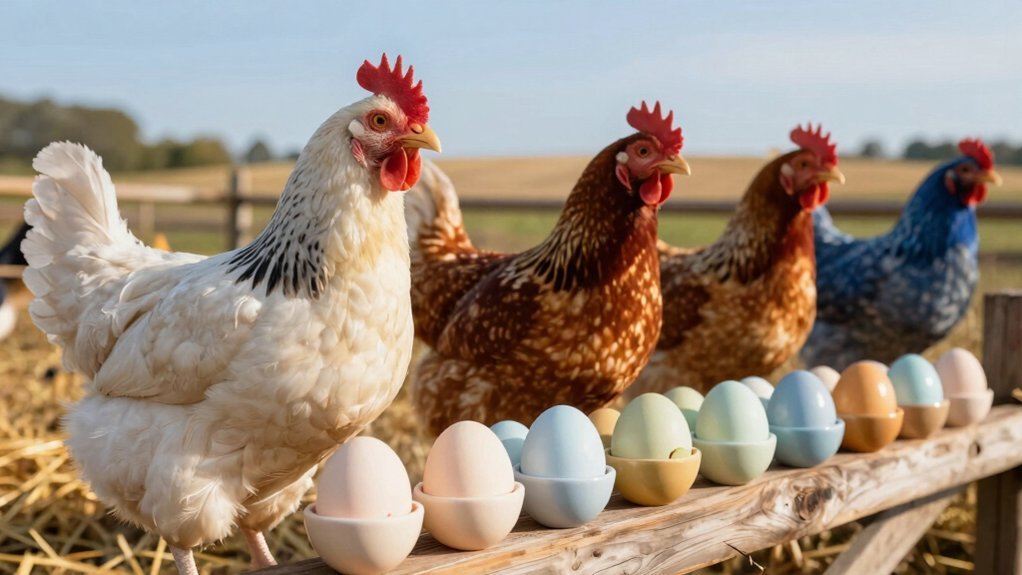
You’re right to wonder why some hens lay blue, green, brown, or white shells—it’s all about pigments and a few key genes. The dominant O gene deposits biliverdin, giving you true blue shells in Ameraucana, Araucana, and Cream Legbar; brown pigment overlays that blue to make green or olive in Olive Eggers and Swedish Isbar; white comes from Leghorn‑type breeds lacking pigment; and brown (light to chocolate) comes from Rhode Island Red, Marans, and Welsummer. Pick a pure breed for each hue you want, and you’ll get a vibrant, predictable egg basket.
Egg Color Basics: How Genetics Determine Shell Hue
Why does my hen lay blue eggs while another lays white? You’re wondering why the same coop can produce such different shells. Here’s the thing: blue layer genetics dominate the basic shell hue inheritance. If a hen carries even one blue allele, she deposits biliverdin, turning the shell blue, while a white‑only hen lacks that pigment pathway.
Now, think of the blue gene like a switch that’s “on” in heterozygous birds and “full‑on” in homozygous ones. A heterozygous hen (one blue, one white allele) still lays blue eggs, but a homozygous blue bird guarantees consistent blue output. White layers, lacking the switch, lay plain shells. This genetic trait remains consistent throughout a hen’s life across breeds like the Ameraucanas and Araucanas. These distinct breeds are easily told apart because Ameraucanas sport facial muffs and beards whereas Araucanas have ear tufts instead.
All right, remember: the presence of a single blue allele decides the base color, and brown overlays later alter it. Your next step is to check your hens’ pedigrees for that dominant blue gene. While blue pigment forms the base, brown pigment coating applied over blue shells creates the various green hues seen in certain breeds.
Egg‑Color Breed Reference Table
Understanding which breeds give you blue, green, brown, or even pink eggs can feel like a puzzle, but you’re on the right track.
Which breeds produce blue shells?
You’ll find Ameraucana, Araucana, Cream Legbar, Easter Egger, and Whiting True Blue. Ameraucana can lay up to 300 eggs yearly, while Cream Legbar tops out at 200. Egg color marketing often highlights these shades for niche markets, and egg color folklore ties them to “sky‑blue mornings.” It is important to remember that egg color results from genetics rather than diet, so providing balanced nutrition is essential for health but will not alter the shell hue. The specific blue hue is created when the pigment oocyanin is deposited on the eggshell during its formation.
Who gives you green eggs?
Olive Egger, Swedish Isbar, Favaucana, Easter Egger (when brown overlays blue), and Maran crosses deliver green or olive tones. The Isbar claims natural green without hybrid tricks, a point that folklore loves. These unique hybrids are created by crossing blue egg layers with dark brown layers to achieve their distinctive olive green eggs.
Which breeds lay brown and dark‑brown eggs?
Rhode Island Red, Australorp, Barnevelder, Wyandotte, and Sussex produce standard brown shells. Black Copper Marans, Golden and Silver Cuckoo Marans, and Welsummer generate chocolate‑brown eggs, often featured in egg color marketing for gourmet appeal.
Are pink or purple eggs possible?
Light Sussex and some Orpingtons can lay pink, while Langshans occasionally show plum‑purple shells.
Takeaway: match the breed to the hue you want, then explore local hatcheries or shows for real‑world examples. Next, compare production rates to your flock’s size.
White‑Egg Breeds You’ll Spot Most Often
You’re probably wondering which white‑egg layers you’ll actually see on a backyard or farm, and that’s a smart question.
Which breeds dominate the white‑egg scene?
White Leghorn tops the list, laying 280‑320 large eggs a year—about five to six a week. Ancona and Andalusian, both Mediterranean breeds, drop 180‑220 and 150‑200 eggs respectively, delivering medium‑sized shells. Hamburg and Minorca add reliable output, 200‑250 and 250‑300 eggs, mostly small‑to‑medium. These birds are extensively raised in large-scale commercial operations worldwide to supply grocery stores with white eggs due to their adaptability to various housing systems. Notably, breeds like Ancona are also prized for their heat tolerance alongside their feed efficiency.
What other names might pop up?
Hybrid California White and Austra White keep production high, with off‑white to cream eggshell coloration. Polish, Dorking, and Lakenvelder appear on many lists, though they lay fewer eggs.
Takeaway
If you want consistent white shells, start with Leghorn, Ancona, or Andalusian. Next, consider whether you need volume or variety in size and temperament. Notably, Leghorns are highly efficient due to their high feed-to-egg conversion ratio, making them an economical choice for sustained production.
Brown‑Egg Breeds: From Light Tan to Chocolate Dark
If you’re trying to sort out which brown‑egg layers fit your backyard, you’re not alone—many keepers wonder where the light tan ends and the chocolate dark begins.
You’ll see New Hampshire hens laying large, light brown shells about three to four a weekly, while Rhode Island Reds push five‑plus medium‑large eggs per week when healthy. Buff Orpingtons and Sussex give steady medium browns, roughly 200‑250 eggs a year, and they stay calm around kids.
Here’s the thing: chocolate‑brown specialists like Marans, Welsummer, and Barnevelder produce deep mahogany shells that marketers love for “gourmet” egg color marketing. Black Copper Marans tops the list for the darkest hue.
Originating in southwestern France, these dual-purpose qualities make Marans popular for both their flavorful meat and their distinctive dark chocolate or russet-colored eggs.
Prospective owners should verify breeding standards with reputable hatcheries or specialty breeders to ensure the birds possess the authentic genetics required for such dark egg coloration.
Although not all individuals lay pitch-dark eggs, the breed is also cherished for its calm, sociable nature alongside its moderate egg production of 150-200 per year.
All right, remember that seasonal egg production can dip in winter, but hardy breeds such as Rhode Island Red and New Hampshire keep laying through cold snaps. Choose a breed that matches your climate, temperament preference, and the egg shade you want to showcase.
Takeaway: Light‑tan layers are great for consistent, friendly flocks; dark‑brown breeds add visual wow‑factor to your egg basket.
Next step: Which shade fits your kitchen aesthetic—light tan for everyday meals or chocolate dark for special brunches?
Blue‑Egg Breeds and the Dominant Blue Gene
You’re probably wondering why some flocks lay shells that look like the sky while others stay brown, and that’s a great question.
How does the O gene work?
The blue shell comes from the oocyan (O) gene, which is autosomal and incompletely dominant. One O allele (O/o) already makes a blue egg, but two copies (O/O) give a richer, cleaner hue. Think of it like mixing paint: a single drop colors the canvas, two drops deepen the shade.
Which breeds carry it?
Ameraucana, Araucana, Cream Legbar, Whiting True Blue, and many Easter Eggers all have the O gene. Cream Legbars also auto‑sex, letting you tell chick sex by color at hatch. It is important to note that Ameraucanas are genetically distinct from Easter Eggers, which are mixed breeds capable of laying blue, green, or brown eggs with more variable traits. Unlike those mixed varieties, the Whiting True Blue is a distinct breed developed by Dr. Tom Whiting known for its heat tolerance.
How do you keep the blue pure?
Selection strategies focus on breeding O/O birds and testing egg color each lay. Breed development often removes brown‑tint modifiers, so you get consistent sky‑blue shells.
Takeaway:
Pick a line with proven O/O birds, test early, and you’ll enjoy reliably blue eggs. Next, explore how green‑egg genetics intersect with blue. While Ameraucanas are favored for their unique eggs, they are moderate layers compared to commercial breeds, typically producing roughly 3 to 4 eggs per week.
Green‑Egg Breeds: When Blue Meets Brown
Why do some eggs turn green instead of blue or brown? You’re curious because the hue isn’t a mystery pigment; it’s the result of pigment composition where a blue shell meets a brown overlay. The blue base comes from the Araucana or similar breeds, and the brown pigment strength determines whether you see mint, olive, teal, or deep khaki‑green.
What breeds give you that green? Araucanas lay pale blue‑to‑green eggs, while Olive Egggers—crosses of a blue layer and a dark‑brown layer—produce olive, teal, or mossy shades. Isbars offer light, mossy green, and Green Queens range from mint to deep olive. Easter Egggers can vary widely, so expect shade variation even within one flock. These hybrids are valued not only for their unique shells but also for their calm temperament and dual-purpose utility in small-scale flocks. Olive Eggers typically lay 150 to 200 eggs per year, providing a steady supply of colorful eggs for backyard keepers. It is important to distinguish these green layers from the Sapphire Gem chicken, which features stunning blue plumage yet lays large brown eggs rather than green or blue ones.
How does genetics work? The blue gene is dominant; brown pigment adds on top, creating the green spectrum. Olive Egggers are bred specifically for that olive hue, whereas Easter Egggers don’t breed true, so each chick may lay a different shade.
Takeaway: If you want consistent green eggs, choose a pure breed like Araucana or a targeted cross like Olive Eggger. Otherwise, expect a palette of greens across your birds. Ready to pick a breed that matches your color preferences? Average lifespan of five to eight years.
Cream, Tinted, and Pinkish Egg Breeds
When you see a soft, warm‑white egg that looks almost ivory, you’re probably wondering why it isn’t pure white. The answer lies in bloom variability and shell thickness, which can tint a cream egg pinkish under bright light. Buff Orpingtons and Silkies often lay these warm‑white eggs; Silkies’ genetics even add a faint pink sheen when the bloom is heavy.
Which breeds give you true pinkish tones?
Silkie genetics produce the most reliable pink‑tinted shells, while Light Sussex, Salmon Faverolles, and Croad Langshan sometimes show a rosy cast. Bloom can make a pale brown look pink, so lighting matters. These subtle color shifts are part of the natural pigment deposition process that occurs as the egg moves through the hen’s oviduct.
What should you expect?
Cream‑laying hens like Buff Orpingtons lay 200‑240 eggs a year, with occasional pinkish shades. Tinted breeds such as Salmon Faverolles lay about 200 eggs, often with a blush hue. While Olive Eggers are typically known for olive green eggs, genetic variation allows them to occasionally produce pale pink eggs as well.
Takeaway: Bloom and genetics decide whether you get cream, tinted, or pinkish eggs. Observe your hens in natural light to spot the true color. Next, compare egg‑shell textures to gauge bloom strength.
Hybrid Egg‑Color Breeds (Easter & Olive Eggers)
Now, you’re probably wondering why those pastel‑ish creams turned into a rainbow of blues, greens, and olives. Here’s the thing: Easter Eggers aren’t a true breed, they’re hybrids, usually a blue‑egg gene carrier crossed with a brown layer. That mix creates egg color variations like blue, green, olive, pink, tan, cream, and sometimes white or yellowish tones. Genetic unpredictability means each hen settles on a color after her first egg, then stays consistent.
All right, what about Olive Eggers? They’re bred specifically for green‑to‑olive shells, crossing a blue layer with a dark brown layer. The brown overlay blends with the blue base, giving that olive hue. Commercial lines tweak parent crosses to stabilize shades, but you’ll still see some variation.
Obviously, both hybrids lay medium‑sized eggs, 200‑280 a year, and look great in backyard flocks. Takeaway: expect a splash of color, but don’t count on every bird matching the same shade. Next, you might wonder how age, diet, and environment tweak those shades.
How Age, Diet, and Environment Influence Egg Shade
Why does my hen’s egg color change over time? You notice the shade fading as she ages, and that’s normal. Age changes hue because older birds deposit less protoporphyrin IX, so pigment declines and shells look paler.
How does egg size impact shade? As hens grow, eggs get larger; the same amount of pigment spreads over more surface, diluting color.
What role does diet play? Nutritional influences boost pigment production, but even a perfect feed can’t stop the age‑related drop. Good protein and methionine help, yet older hens still lay lighter shells.
Do environmental stress effects matter? Absolutely. Heat or poor housing triggers oxidative stress in the shell gland, further cutting pigment. Stable conditions keep the color steadier.
Age‑related pigment decline is a natural part of the aging process, not a sign of illness. Takeaway: Expect lighter shells as hens age, especially if they’re larger, stressed, or on a marginal diet. Next, you might wonder how to choose the best egg‑color for your flock.
How to Pick the Best Egg‑Color for Your Flock
You’re probably wondering which egg‑color breed will actually give you the shades you want, and that’s a solid question.
What colors do you need first?
Start with the basics: White Leghorn for reliable white, Cream Legbar for true blue, Swedish Isbar for natural green, and Black Copper Maran for deep chocolate brown. Pair a blue breed with a brown one to create olive‑green hybrids, expanding your color pairings without extra effort.
How do you balance flock diversity and egg aesthetics?
Pick one pure breed for each target hue—Rhode Island Red for dependable brown, Ameraucana for pastel blue, and an Easter Egger if you love surprise shades. This mix guarantees a vibrant basket while keeping production steady.
What’s the final step for basket planning?
Choose breeds that match your purpose: high‑output whites for volume, friendly Orpingtons for warm brown eggs, and strong foragers like Welsummers for speckled shells. The takeaway: a simple, purposeful mix yields consistent colors and a beautiful egg display.
Next, decide which three colors will anchor your flock and source those breeds from reputable hatcheries.