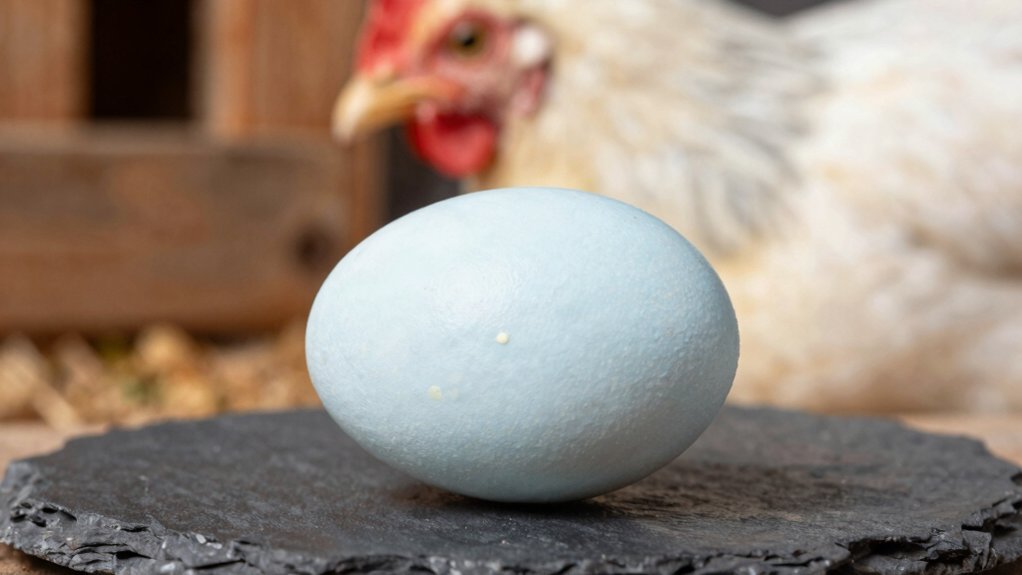
You’re probably wondering why Cream Legbar eggs look like pastel sky‑blue or teal and how many you’ll get each year. Here’s the thing: the blue‑egg gene from Araucana ancestry makes the shell color vary from pale blue‑green to a richer sky‑blue, especially when the bird is homozygous for the trait, and a healthy hen typically lays 180‑230 eggs annually, peaking at about four a week during her first year. Obviously, the breed’s auto‑sexing chicks, ornamental crest, and clean legs set it apart, and if you keep reading you’ll learn how to spot those chicks and set up the perfect coop for steady production.
Cream Legbar Egg Color: Range & Why It Varies
You’re probably wondering why Cream Legbar eggs aren’t the deep blue you’ve seen in pictures. The breed’s egg shade genetics stem from a dominant blue‑egg gene inherited from Araucana ancestors, but each hen carries a unique mix of pigment intensity factors. Some birds lay pastel sky‑blue shells, others a pale blue‑green, and a few produce very light blue that looks almost white.
Now, here’s the thing: heterozygosity in the blue‑egg gene means not every egg gets the same pigment dose. Breeding lines that are homozygous for the gene tend to give more consistent, richer blues, while mixed lines produce a broader palette. All right, remember that “blue” for Cream Legbars usually means a soft, pastel hue, not a saturated sapphire. The takeaway? Expect a range of light blues and occasional greenish tinges, and look for lines that have been selectively bred for stronger pigment intensity. Ready to compare specific lines or explore how genetics affect other traits? While genetics determine the base color, the fact that these hens are generally not broody supports the consistent egg production needed to maintain a steady supply of these uniquely shaded eggs. It is also worth noting that brown pigment coating a blue shell can create the greenish hues sometimes observed in this breed. Unlike dietary myths, the color of blue eggs results strictly from genetics, so no amount of feed adjustment will deepen the shell’s natural pigment.
Cream Legbar Egg Production: Typical Rates & Seasonal Changes
If you’re wondering why Cream Legbar egg counts seem to swing between 180 and 230 a year, the answer lies in genetics, management, and seasonality. You’ll see a typical weekly rate of about four eggs, which adds up to roughly 200 in a full year. At peak, a strong line can push past that, especially when you give the birds a solid nutritional impact—high‑quality feed and free‑range foraging boost both shell quality and frequency.
Why does winter change the numbers?
Winter daylight shortens, so the laying rhythm slows, but it rarely stops. Cold weather can trim a few eggs each week, yet most flocks keep laying. Summer heat can also act as a health stressor, temporarily suppressing output. Since hens require around 14 to 16 hours of light for maximum output, providing supplemental artificial lighting during shorter days can help maintain consistent production levels throughout the winter. This natural slowdown occurs because reduced light is sensed by the pineal gland, which signals the reproductive system to pause until daylight hours increase again in late winter or early spring. Hens naturally produce the most eggs during their first laying year before gradually slowing down as they age.
What can you do to keep production steady?
Focus on consistent nutrition, keep parasites at bay, and avoid sudden stressors. A well‑fed, healthy flock usually stays near the 180‑230 range year‑round.
Takeaway: Expect around four eggs weekly, with modest seasonal dips, and mitigate stressors for the best count. Next, you might wonder when Cream Legbars actually start laying.
When Do Cream Legbars Begin Laying? Age & Onset Details
What tells you a hen is ready? Look for a reddening comb, squatting behavior, and a sudden interest in the nest box. Those physical cues are reliable laying predictors that often appear a week or two before the first egg drops. Keep in mind that even healthy hens typically follow a 24 to 26 hour cycle rather than laying strictly every single day. Although hens enter adulthood when they start laying, they continue to grow slowly until reaching their full size by about one year of age. While specific timing varies by breed, factors such as day length can significantly influence when a hen begins her laying cycle. Takeaway: Plan for a first egg at five to six months, but expect a few weeks’ wiggle room. Next, you’ll want to know how to tell male from female chicks.
Cream Legbar Autosexing: How to Identify Male vs. Female Chicks
When you first hold a Cream Legbar hatchling, the swirl of down can feel like a mystery, but the breed’s built‑in “sex map” makes it easier than you think. You’re probably wondering how to read that map without guessing. Here’s the thing: females show darker, sharper down, a continuous “chipmunk” stripe from head to tail, and a clear eyeliner that starts at the beak. Males appear lighter, have a pale white head spot, and their stripe looks blurrier, often starting behind the eye.
Now, remember that breed preservation strategies rely on strong, well‑bred lines; weak lines blur these markers. If you’re stuck, compare several chicks side‑by‑side and look for multiple cues at once—color depth, head spot, stripe clarity, and eyeliner. While down patterns are primary for this breed, observing wing feather shape can provide additional confirmation since male feathers tend to be pointed while female feathers are round. Although this autosexing breed relies heavily on down color, wing feather length patterns where females develop alternating lengths while males remain uniform can sometimes offer secondary verification in specific genetic lines. Autosexing troubleshooting means checking lighting, avoiding wing‑sexing, and noting that hatch‑time variation can mislead. Takeaway: use a checklist of visual traits, keep your line pure, and you’ll sex with confidence. Next step: set up a bright, low‑stress hatch area and practice your observations on a few birds. The flock’s excellent foraging ability also helps highlight healthy down patterns in early life. Just as Barred Rock males develop larger combs earlier than females, watching for early comb growth in Cream Legbars can serve as another reliable indicator to distinguish sexes as they mature.
What Makes Cream Legbars Look Unique? Crest, Plumage, and the Feather‑Foot Myth
You’re probably wondering why Cream Legbars look so different from other backyard birds, and you’re right to ask.
What gives them that head‑turning silhouette?
The ornamental crest sits like a poof on the crown, a small tuft that rounds the profile and sets them apart. Some hens sport a crown‑like crown, while roosters often flaunt a larger, more pronounced head. This crest isn’t just for show; it’s the breed’s signature.
How does their plumage stand out?
Cream, silver‑gray, or creamy white feathers carry faint black, blue‑gray, or lavender barring, creating a striking striped look. Roosters usually wear darker saddles and hackles, while hens stay lighter with subtle salmon tones on the breast. While distinct from the crest, other feather traits like curly feathers arise from specific genetic mutations affecting keratin structures.
Is the feather‑foot myth true?
Obviously, no. Feather foot breeds are a separate group; Cream Legbars have clean, unfeathered legs. The confusion stems from their unusual crest, not actual foot feathering. Unlike feather-footed chickens which grow protective leg feathers for cold climates, this breed relies on its barred plumage alone for insulation.
Takeaway: Focus on the crest, barred plumage, and clean legs to spot a Cream Legbar. Next, explore their egg‑laying quirks.
This distinctive head feathering is caused by the mutated Crest gene, which influences the unusual pattern but can sometimes impair vision and affect social behavior.
History of the Cream Legbar: From Araucana Crosses to a Modern British Breed
Why does the Cream Legbar’s history feel like a mystery? You’re right to wonder; the story twists through Cambridge labs, Chilean imports, and a quest for auto‑sexing. Reginald Punnett and Michael Pease kicked off the program in the 1920s, mixing barred Plymouth Rock with Leghorn and Cambar lines.
Here’s the thing: Araucana genetics entered the mix when Clarence Elliott shipped blue‑egg hens from Chile in 1929. Those birds, plus cream‑colored Araucanas, gave the breed its blue‑green eggs and distinctive crest. This genetic contribution is significant because the blue egg coloration penetrates throughout the eggshell rather than just sitting on the surface. While the Cream Legbar is a specific hybrid, other breeds like the Arkansas Blue also produce blue eggs with traits suited to various climates. Unlike the Araucana ancestors which possess ear tufts, the resulting offspring display facial muffs and beards that distinguish them from similar breeds.
All right, after two decades of selective breeding, the Cream Legbar debuted at the 1947 London Dairy Show and earned a British standard in 1958.
Takeaway: The Cream Legbar is a British‑engineered, auto‑sexing bird whose blue‑egg trait traces back to Araucana genetics. Next, you might explore how its housing influences consistent egg output.
Cream Legbar Housing: Tips for Consistent Egg Output and Happy Birds
If you’re wondering why your Cream Legbars sometimes skip a day, the answer lies in how their space and shelter affect stress levels. Clearly, each bird needs about 2.5–4 sq ft inside the coop and 4–10 sq ft of outdoor run. That extra room keeps litter dry, reduces crowding, and lets them forage naturally.
Here’s the thing: a solid, predator‑proof coop with a well‑fastened door, roofed shelter, and good ventilation is non‑negotiable. Add roosts and a nest box for every 3–4 hens, using 12‑inch cubes with soft bedding. In summer, prioritize shade and fans; in winter, keep drafts out while allowing airflow and extra bedding for insulation.
All right, housing design tips also include easy access to clean feed and water, and a dry floor to prevent disease. Designing a coop with ample room not only supports roosting and nesting but also simplifies cleaning to maintain overall chicken health. For standard-sized birds, adhering to 4 square feet of indoor space per chicken ensures adequate comfort and reduces health issues. The takeaway: give your Cream Legbars space, security, and comfort, and you’ll see steadier egg production. Ready to sketch your coop layout?