You’re probably wondering why Pearl White Leghorns dominate white‑egg markets—here’s the thing: they’re lightweight, athletic birds that start laying at 15‑18 weeks and can hit 280‑320 large white eggs a year, with a feed‑to‑egg conversion of roughly 2 lb feed per lb eggs, far better than most dual‑purpose layers. They stay calm enough for easy handling but stay active, so give them at least 4 sq ft indoor and 10‑15 sq ft outdoor per bird, keep the coop dry, and break any broody cycle by removing eggs twice daily. If you follow a starter‑grower‑layer feed plan and monitor health, you’ll see steady production and low feed costs—keep exploring for detailed housing and diet tips.
Why Is Pearl White Leghorn a Top White‑Egg Layer?
Why does Pearl White Leghorn consistently top white‑egg charts? You’re probably wondering why this breed outshines the rest. The answer lies in its superb feed‑to‑egg conversion: each bird eats about 125 g daily yet lays large, uniform white eggs almost every day. That efficiency slashes feed costs and boosts profitability, especially in organic or free‑range setups.
Here’s the thing: climate impact matters. Their lightweight bodies generate less heat, so they demand less cooling in hot barns, lowering energy use. Plus, their hardy, active nature means you can keep them outdoors without excessive shelter, further cutting emissions.
All right, welfare concerns? You’ll appreciate their non‑broody temperament—no nesting interruptions, just steady laying. They also show strong disease resistance, translating to higher livability and fewer antibiotics. These hens typically begin laying eggs around 4 to 5 months old, which is earlier than many other chicken breeds, ensuring a quicker return on investment. Notably, their proven adaptability to various housing systems supports their prevalence in both large-scale commercial farms and backyard flocks globally. While seasonal changes often cause hens to pause laying, providing adequate daylight hours can help maintain consistent production even during colder months.
Takeaway: Pearl White Leghorns combine low feed demand, climate‑friendly traits, and sound welfare, making them the logical choice for reliable white‑egg production. Next, you might ask how many eggs you can expect per year.
How Many Eggs Can You Expect Per Year and When Do They Start?
When do Pearl White Leghorn hens start laying and how many eggs can you expect? You’ll see the first clucks around 15‑18 weeks, roughly 4½‑5 months, depending on feed, daylight and health. The breed’s early maturity means you can count on regular eggs soon after that first handful.
Your annual production ranges sit between 280 and 320 eggs per hen, with some well‑managed flocks hitting 325. The first year delivers the peak, but the second year performance remains strong, often staying within that same band before a gradual decline after year three. While production drops to about 70% of output in the third year, many hens continue laying at decreasing rates for several years beyond their peak. Although Leghorns are early layers, heritage breeds can take significantly longer to mature, sometimes up to 28 weeks. It is important to remember that reduced daylight during winter months can also cause a temporary decrease in egg-laying frequency regardless of the hen’s age or breed.
Takeaway: Expect a reliable, high‑output layer starting at five months, delivering roughly 280‑320 eggs yearly, with solid output in the second year. Next, consider how size and appearance of your pullets will match your expectations.
What Size and Appearance Should You Expect From Pearl White Leghorn Pullets?
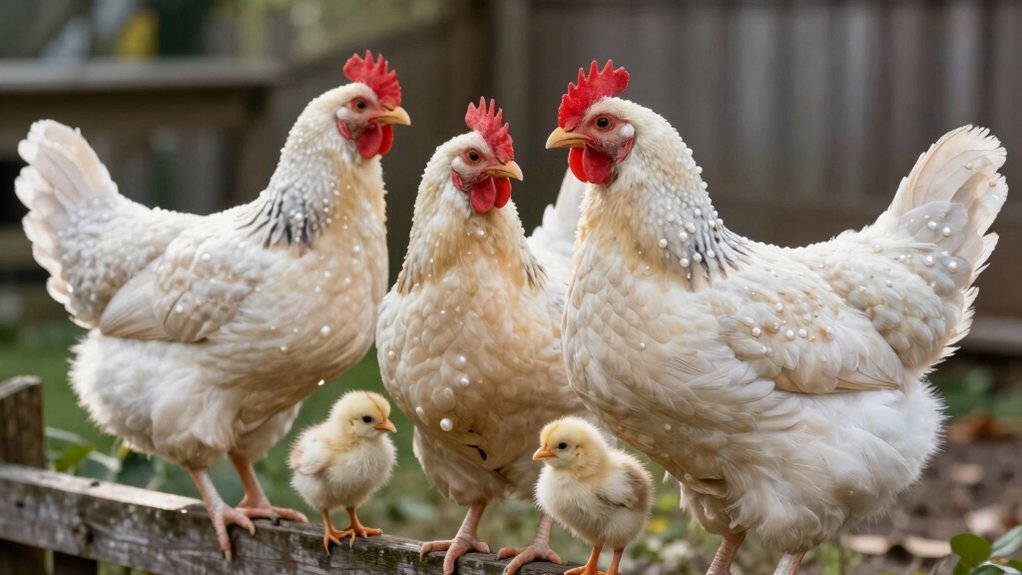
You’re probably wondering how a Pearl White Leghorn pullet will look when she’s ready to start laying. You’ll see a compact bird that weighs about four pounds at maturity, noticeably lighter than most dual‑purpose breeds. Her body stays narrow and athletic, giving a streamlined, production‑focused silhouette.
Here’s the thing about her plumage characteristics: the feathers are a clean, bright white that fits tightly to the frame, not fluffy. A vivid red single comb sits atop her head, and yellow legs stand upright, ready for quick foraging. This mature appearance screams “layer bird,” not “meat bird,” and the uniform white makes the flock look cohesive. Like other top performers such as Golden Comet hybrids, these birds are bred specifically for high annual egg output rather than bulk. Unlike giant breeds that can reach heights of 22 to 30 inches, the Leghorn remains a smaller, more agile fowl suited for efficient production.
All right, expect a lean, alert hen with a striking white‑and‑red contrast. This visual cue tells you she’s built for efficient egg output. Take note of these traits when you compare breeds, and you’ll pick the right bird for your backyard. While their small size limits meat production, these birds yield flavorful stock when utilized for that purpose.
How Does Feed‑to‑Egg Conversion Compare to Other Layer Breeds?
How does Pearl White Leghorn feed‑to‑egg efficiency stack up? You’re probably wondering why this breed matters for commercial economics and global comparisons. The short answer: they convert roughly 2 lb of feed into 1 lb of white eggs, a 0.5 lb‑egg‑per‑lb‑feed ratio that outpaces most dual‑purpose layers.
All right, here’s the thing: a typical Leghorn lays 280‑320 eggs per year, about six a week, while a heavier heritage hen may only manage 200. That extra output means you spend less on feed per dozen eggs—often around 3 lb versus 4 lb for larger breeds.
Obviously, lighter bodies need less maintenance feed, so on a per‑bird basis you save money. In global comparisons, Leghorns dominate white‑egg markets because their high yield and low feed cost improve profit margins. This superior efficiency contrasts with other prolific layers like the Australorp, which is known for record-breaking annual output but possesses a heavier body requiring more maintenance feed. While Leghorns excel in volume, breeds like the Golden Comet are also notable for laying huge red-brown eggs and can produce up to 330 eggs per year, often starting earlier than other breeds. Unlike these high-volume specialists, the Buff Orpington offers a balance of steady production and a docile temperament, laying 200 to 280 brown eggs annually even in colder weather.
Takeaway: Pearl White Leghorns give you the best feed‑to‑egg math for commercial egg production. Next, consider which housing system maximizes that efficiency.
What Housing Works Best for Pearl White Leghorn Layers?
You’re probably wondering why the feed‑to‑egg advantage matters if the coop feels cramped. The answer: stress kills production. Give each Pearl White Leghorn at least 4 sq ft inside and 10‑15 sq ft outside, then watch the birds thrive. While these minimums support basic needs, providing larger indoor spaces beyond the baseline is beneficial to further reduce stress and prevent health issues among your hens. Although Leghorns are smaller birds, increasing indoor area is necessary if they do not get regular outdoor access to ensure their health and well-being.
How should I arrange the inside?
Space feeders, waterers, nest boxes and roosts apart to avoid bottlenecks. Use 12 × 12‑inch nest boxes, one per three or four hens, tucked in a quiet corner. Install roost bars 18‑36 inches high, spaced wide enough for comfort, and keep them clear of drafts. Ensure the design includes large access doors to simplify daily maintenance and cleaning routines.
What about climate control?
Strong ventilation systems move fresh air without creating drafts at roost level. Pair them with adequate coop insulation to keep winter cold out while letting heat escape in summer. This dry, well‑ventilated environment protects combs and keeps egg quality high.
Takeaway:
Give your Leghorns room, separate zones, and balanced airflow with insulation. Next, think about securing a predator‑proof run that matches their active nature.
How Can You Manage Flighty Temperament in a Backyard Flock?
Ever wonder why your Leghorns bolt at the slightest sound? You’re seeing flight triggers in action—quick overhead movements, loud noises, or a sudden approach spark instant panic. Obviously, a startled bird will flap, circle, and scream, making handling a nightmare.
How do you calm them? Now, start with predictable, low‑stress interactions. Approach from a visible distance, announce yourself, and keep your voice soft. Wear the same clothes each day so you don’t become a new “flight trigger.” Sit quietly for a few minutes daily; short sessions build trust building without forcing contact. Since chickens naturally rest from dusk till dawn, maintaining a consistent evening routine helps reinforce their sense of security during their nightly roosting period.
What about rewards? Offer mealworms or greens on the ground, then hand‑feed once they approach. Pair the treat with a calm call; the sound becomes a cue for safety. Reward the calmest birds first—social birds help nervous flockmates settle.
How to shape the environment? Limit overhead activity, keep dogs and machinery away during chores, and avoid crowding. Provide ample space for retreat and keep feeders and waterers in the same spots. These steps reduce anxiety and reinforce trust building, much like the themes of responsibility and animal care found in children’s books about chickens. Since chickens are highly motivated to perform natural behaviors, preventing them from expressing these instincts can lead to harmful behaviors born of frustration.
Takeaway: Consistent, gentle exposure and a stable environment turn flighty Leghorns into a calmer flock. Next, consider how to structure your daily routine to keep those flight triggers at bay. Chickens are prey animals and react instinctively to perceived threats.
What Health and Hardiness Tips Keep Pearl White Leghorns Thriving Year‑Round?
You’re probably wondering how to keep your Pearl White Leghorns healthy all year, especially with their big combs and tight feathering. Heat resilience starts with shade and airflow; place a well‑ventilated coop in a breezy spot, add a light‑colored roof, and keep water cool and fresh all day. Now, give them dry bedding and a dust‑bath area to prevent ammonia buildup and parasites. Cold protection means blocking drafts while still allowing moisture to escape above the roost. Use deep, dry litter, wide roosts, and inspect comb tips each morning for frostbite. While these birds are hardy, they remain most comfortable and productive within the 65 to 75 degrees range, so extra preparation is essential when temperatures drop below 20 degrees Fahrenheit. To further shield your flock from chilling northwest winds, consider strategic coop placement alongside your existing windbreaks. Routine checks keep you ahead of problems. Watch appetite, feather quality, and egg output; any dip signals stress or disease. Takeaway: Manage temperature, moisture, and nutrition daily, and you’ll see thriving, resilient birds. Ready to set up your coop for year‑round comfort?
How Can You Prevent Broodiness and Keep Egg Production Continuous?
Any hen that starts sitting on a clutch is basically saying, “I’m ready to brood,” and that instantly stalls egg output. You’re probably wondering how to keep that from happening. Here’s the thing: remove eggs as soon as you can—ideally two or three times a day—so the hen never sees a full clutch to incubate.
How do you break the broody cycle?
First, block nesting sites. Pull the broody hen out of the box, close the box, and give her a bright, perch‑only cage for three to six days. Light discipline and a lack of soft bedding create environmental disruption that discourages sitting. Remove all eggs from the nest box immediately to prevent her from perceiving a clutch.
What about cooling?
Give a cool water bath (not freezing) to lower her chest temperature; a ventilated cage underneath helps too.
Takeaway: Consistently disrupt nesting cues, use bright light, and cool her body to keep laying steady. Ready to try a quick egg‑collection routine?
What Feeding Schedule and Diet Formulation Optimize Egg Size and Uniformity?
How should you time feed changes to keep egg size steady? You start chicks on a 20–21% protein starter for the first six weeks, then shift to a 16–18% grower until they hit 16–20 weeks. Around point‑of‑lay, introduce a 16% layer feed with free‑choice oyster shell. Keep the ration constant once laying begins; avoid abrupt swaps because sudden changes spike intake fluctuations and shrink eggs.
What nutrients matter most? Energy drives egg weight, but balanced amino acids—especially methionine and lysine—ensure uniform yolk size. High‑quality calcium and trace minerals like manganese, zinc, and selenium support shell thickness. Feed additives that improve gut health can boost nutrient absorption, but only if ingredient quality stays high.
Takeaway: Stick to the age‑based schedule, give steady access to a well‑balanced layer diet, and monitor water and calcium. Next, ask yourself how you’ll manage feeder space and lighting to keep consumption consistent.
How Can You Select and Care for Pearl White Leghorn Chicks for Long‑Term Success?
You’re probably wondering how to pick the right Pearl White Leghorn chicks and keep them thriving past the brooder.
Which chicks pass the health test?
Look for bright, alert eyes, clean vents, and dry down. Strong legs, straight toes, and a balanced posture signal good genetics. Choose birds from reputable hatcheries that follow ethical breeding practices and proven incubation methods.
How should you set up the brooder?
Maintain a warm, draft‑free space with non‑slip flooring and dry bedding. Give each chick enough floor area to avoid crowding, and place feed and water where all can reach them without competition. Clean daily to keep ammonia low.
What’s the long‑term care plan?
Provide secure, spacious housing, calm handling, and regular health checks for parasites or leg issues. Offer perches sized for a light, active breed and protect combs from frostbite in winter.
Takeaway: Selecting healthy chicks, using proper incubation, and creating a stress‑free brooder set the stage for a productive, long‑lasting Leghorn flock. Next, decide on your flock size and layout before the first hatch.