You’ve got taste buds that number around 7,900, but chickens possess roughly 767—fundamentally different in structure and distribution. Their egg-shaped taste buds cluster across the palate rather than concentrate on the tongue, enabling strategic sensory contact during feeding. While you perceive sweet, bitter, salty, sour, and umami, chickens detect only bitter, salty, sour, and umami through limited receptor diversity. This distinction profoundly shapes their nutritional preferences and feed acceptance patterns in ways that’ll surprise you.
Taste Bud Anatomy in Chickens
Morphological distinctiveness sets chicken taste buds apart from their mammalian counterparts. You’ll notice chickens possess ovoid, egg-shaped taste buds rather than the onion-like structures you’d find in mammals. Their taste buds feature unique tubular architectures with long canals terminating in surface pores—a structural adaptation absent in mammalian species. Each bud contains 50–100 fusiform taste cells clustered in garlic-bulb-like configurations, differing fundamentally from the elongated cells characterizing human taste buds. Additionally, the ability of chickens to taste reflects their unique adaptations to local dietary variations, which is vital for determining their food choices. This specialization allows chickens to better identify homemade chicken treats, enhancing their dietary satisfaction and ensuring they receive necessary nutrients. Moreover, distinguishing between various food types aids chickens in selecting suitable poultry supplies, further promoting their overall health and well-being. Chickens also benefit from an understanding of their dietary requirements to process balanced nutrients efficiently.
This taste bud evolution reflects chickens’ specialized dietary requirements. Their narrow pores, measuring merely 1–2 micrometers wide, with apical cells oriented toward the opening, facilitate direct contact with food particles. These anatomical variations represent adaptive responses to avian physiology and chicken diets, enabling efficient gustatory sensation despite reduced taste bud numbers compared to humans. Chickens have a smaller number of taste buds compared to mammals, with approximately 767 taste buds in chickens versus 7,902 in humans, yet this reduced quantity does not diminish their capacity for precise gustatory discrimination.
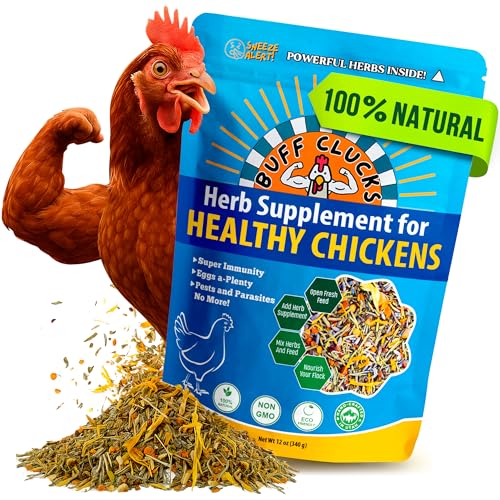
Herbs For Happy Hens: Packed with ingredients of oregano, basil, garlic, rosemary, red pepper, lavender, and calendula, this herbal chicken treat helps support your chickens. Supports strong immune systems, vibrant feathers, and calm nesting.

ESSENTIAL POULTRY GRIT FOR CHICKENS & GAMEFOWL: Premium grit for chickens made from natural granite grit for chickens, essential for grinding whole grains and improving digestive health for poultry; a must-have to include in your chicken coop accessories

High Calcium Chicken Grubs: Compared to traditional dried mealworms, our BSFL dry powder insect feed boasts 85x calcium. This high calcium content enhances eggshell strength and promotes bone health in your hens, ensuring they lay sturdy eggs. Perfect for supporting robust egg production and overall poultry well-being.
Where Taste Buds Are Located
Unlike mammals, which concentrate taste buds on specialized tongue structures, chickens distribute theirs strategically throughout the oral cavity in a pattern that mirrors their feeding mechanics. You’ll find approximately 69% of chicken taste buds concentrated in the palatal location—specifically within the anterior maxillary gland opening region, palatine papilla region, and posterior palatal zone. This palatal dominance positions sensory receptors exactly where feed first contacts oral mucosa during ingestion. You may also be interested to know that chickens can serve as hosts for ticks and other parasites, potentially complicating backyard chicken care. You’ll uncover roughly 29% embedded in the base of your chicken’s oral cavity along the anterior mandibular gland region, extending laterally across the floor of the mouth. Only about 2% occupy the posterior keratinized tongue regions. This taste bud distribution aligns perfectly with swallowing mechanics, ensuring your chicken samples food at its ideal sensory contact point. Understanding how to protect against predators can help maintain a safe environment for your chickens while they feed.
How Chicken Taste Buds Compare to Human Taste Buds
While chickens possess functional taste systems, their gustatory capabilities differ fundamentally from humans at both molecular and functional levels. You’ll find that chickens have remarkably fewer taste buds—roughly 50 to several hundred compared to your 8,000–10,000. More importantly, receptor diversity is severely limited; chickens lack the sweet receptor gene T1R2 entirely and possess only three bitter receptors versus your approximately 25. This reduced receptor diversity constrains chicken sensitivity and discrimination ability across taste modalities. While chickens detect bitter, salty, sour, and umami compounds, their thresholds and acuity differ substantially from humans. Chickens cannot perceive sweetness through canonical pathways, and their tolerance to capsaicin reflects less-responsive TRPV1 variants. These molecular and anatomical differences create coarser flavor discrimination despite regional taste-bud density variations. The taste buds are located at the back of the oral cavity, which further influences how chickens process and respond to different food items.

SPICY & SAVORY THAI PEANUT COATING – Crafted in Thailand with real peanuts, chili, garlic, lemongrass, and Thai spices. This Gluten-Free Thai Seasoned Coating Mix creates a sweet, spicy, and nutty crust for chicken, fish, pork, or tofu—crispy outside, tender inside.

HEALTHY HENS LAY MORE: The electrolytes for chickens feature Amaferm, a prebiotic that helps to support comfort and digestive health, leading to more eggs in less time. A relaxed hen is a productive hen, so get your birds back on track fast

Flea treatment dogs chewable long term protection: Flea and tick for dogs chews comes with 200 per bottle
The Cellular Structure of Avian Taste Buds
Beneath the chicken’s oral epithelium lies a taste bud architecture that’s fundamentally distinct from the mammalian model at every organizational level. You’ll find four principal cell classes: sensory cells with low cytoplasmic density, supporting cells with dense cytoplasm, follicular cells, and basal cells functioning as undifferentiated precursors. What distinguishes avian taste buds is their distributed progenitor activity—proliferating cells populate the bud interior, not confined to the basal layer. This widespread cellular turnover accelerates taste cell lifespans to 3–4 days versus mammals’ 8–24 days. A minority of intermediate cells exhibit synaptic specialization, forming classical junctions with afferent gustatory nerves for signal transmission. These structural features reflect birds’ rapid sensory renewal and continuous environmental exposure. Notably, chickens possess approximately 767 taste buds, substantially fewer than humans’ 7,902, and these taste buds are primarily distributed across the palate rather than concentrated in specialized papillae structures.
Molecular Markers and Taste Perception
The chicken’s capacity to detect and discriminate tastants relies on a molecular architecture that’s both conserved with and divergent from the mammalian model. You’ll find that α-gustducin and vimentin serve as reliable molecular markers, labeling overlapping taste-bud cell populations and revealing substantially higher bud counts than traditional scanning electron microscopy methods. These markers, combined with RNA-seq validation of gustatory-enriched genes like TAS1R3 and PCDH10, enable you to distinguish gustatory epithelium from surrounding tissue with precision. The intracellular transduction cascade—including TRPM5 and PLCβ2—mirrors mammalian pathways, supporting taste perception through conserved signaling mechanisms. Confocal photomicrographs demonstrate that taste buds arrange in clusters throughout the chicken’s oral cavity, revealing the structural complexity underlying their gustatory competence. Additionally, chickens can incorporate nutritional benefits from various foods, suggesting a broader spectrum of taste preferences beyond what might be expected. Interestingly, the presence of certain herbs, such as oregano and garlic, can enhance their overall wellbeing, impacting not only their health but possibly their taste preferences too. This molecular framework explains how chickens perceive amino acids, bitter compounds, and other tastants despite lacking the canonical sweet receptor gene present in humans.
What Flavors Can Chickens Detect
Four primary taste modalities—bitter, salty, umami-like, and sour—structure how chickens perceive and respond to dietary flavors, each mediated by distinct molecular receptors and peripheral taste organs positioned strategically throughout the oral cavity.
Your chickens’ bitter sensitivity relies on a limited T2R receptor repertoire that triggers strong aversion to toxic compounds like quinine and denatonium, protecting them from ingesting harmful substances. Chickens can also be attracted to nutritional treats like sunflower seeds in moderation, as their taste perceptions enhance their ability to select beneficial foods. This is similar to how they can be drawn to scrambled eggs as a protein-rich treat during periods of increased nutritional needs. Chickens thrive on a balanced diet, which includes species-appropriate foods that support optimal health and productivity, including termites which provide a high-protein food source. Additionally, a varied diet incorporating appropriately sized grit is crucial for maintaining optimal digestion. Salt regulation operates through epithelial sodium channels, driving attraction to moderate sodium levels while rejecting excessive concentrations—critical for electrolyte homeostasis. Umami detection occurs via T1R3-containing complexes that guide protein-rich feed selection, supported by palatal taste bud clustering. Sour detection completes their flavor landscape, enabling acid discrimination during feeding decisions. These taste organs demonstrate efficient cell renewal mechanisms, allowing chickens to maintain sensory acuity throughout their lives. Together, these four taste modalities create an integrated sensory system optimizing nutritional intake and toxin avoidance.

May improve the hardness and durability of egg shells

Necessary For Digestion - Made up of insoluble crushed quartzite or granite, grit remains in the bird's gizzard to help with digestion. Grit is an essential part of your bird’s diet and should always be provided.
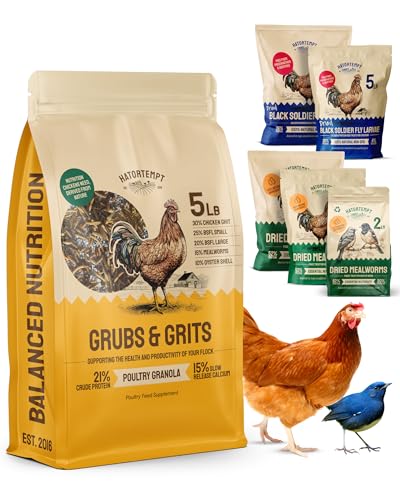
Balanced Blend: No preservatives or low value fillers, this all-in-one chicken food supplement includes mealworms for chickens, poultry grit, oyster shells and black soldier fly larvae for chickens in one protein and calcium packed blend
How Taste Buds Develop in Chicken Embryos
Understanding how chickens detect bitter, salty, umami, and sour compounds requires examining when and how their taste buds form during embryonic development. Embryonic taste bud formation initiates at day 17 when primordia emerge as spherical cell clusters. Rapid proliferation occurs during days 17-21, reaching approximately 80 taste buds by day 19. These structures then undergo taste bud maturation stages, elongating into ovoid shapes and positioning their pores toward the oral cavity by hatch day 21. Significantly, the embryonic system becomes responsive to quinine, fructose, and various salts before hatching. Unlike neural crest cells that contribute to other sensory structures, chicken taste bud cells derive from non-neural crest lineages during their embryonic development. Upon emergence, taste buds function fully and remain largely stable, though post-hatch variations occur depending on genetic background and sex. Rapid cellular turnover of 3-4 days maintains functional taste bud tissues throughout life.
Differences Between Broiler and Layer Chickens
Broiler and layer chickens represent two distinct phenotypes selectively bred for fundamentally different productive purposes, resulting in substantial divergence in their physical characteristics, physiological demands, and economic viability. Broiler characteristics include rapid muscularization, achieving market weight exceeding 2 kg within 6-8 weeks through high-protein, energy-dense diets. Their rounded body morphology and accelerated growth trajectory necessitate superior feed conversion ratios. In contrast, layer characteristics emphasize streamlined physiology optimized for prolonged reproductive output spanning 70+ weeks. Layers develop more gradually over 18-20 weeks and require calcium-supplemented nutrition supporting sustained ovulation. You’ll observe that broiler farming demands shorter management cycles with minimal disease exposure, while layer operations require extended infrastructure investment, including controlled lighting protocols exceeding 16 hours daily, to maintain productive performance across extended production periods. As part of their digestive process, chickens utilize their crop’s role in breaking down food. Modern poultry management software enables real-time monitoring of flock health, feed consumption, and environmental conditions to optimize productivity in both broiler and layer operations.

BLEND OF SOURCES OF CALCIUM : Chick’N Calcium from the Chick’N Swell product line is made from a blend of sources of calcium: calcium chloride and calcium propionate to provide essential calcium for all laying poultry including chickens, ducks, and quails; from backyard flock to commercial farms, our product is the perfect addition to your chicken water.

Essential Calcium Supplement: Pecking Order Oyster Shell is a rich source of calcium, crucial for the development of strong and sturdy eggshells. Adequate calcium intake helps prevent common issues like thin or brittle shells, ensuring your eggs are consistently high quality.
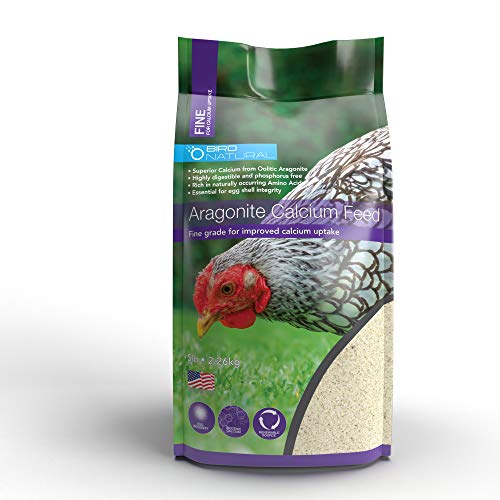
Superior calcium from Oolitic Aragonite
Practical Implications for Poultry Nutrition and Feed Selection
The distinctions between broiler and layer chickens‘ growth trajectories and nutritional demands find direct expression in how taste perception influences feed acceptance and intake optimization across these production systems. You’ll enhance feed consumption by formulating umami-rich diets that leverage chickens’ robust protein sensitivity, supporting accelerated growth in broilers. Since taste buds cluster posteriorly, you should prioritize visual appeal alongside palatability adjustments. You can strategically incorporate bitter-avoidant ingredients to boost intake in taste-sensitive birds while monitoring age-related taste bud decline—peaking early then declining—to adjust your nutritional strategies accordingly. Notably, nutritional formulations designed for broilers often emphasize higher protein levels to align with their rapid growth needs. According to studies on daily feed requirements, adult chickens typically consume about 120 grams of feed, which highlights the importance of optimizing taste and nutrient delivery. Your flavor preferences optimization requires early exposure protocols that imprint beneficial feed associations, establishing lifelong dietary acceptance patterns critical for maintaining uniform flock nutrition throughout production cycles. Chicken taste buds regenerate rapidly with turnover every 3 to 4 days, necessitating consistent feed formulation strategies to maintain stable intake patterns.

{Healthy Flock} Proper nutrition and a well-balanced microbiome can help your poultry defend against dangerous pathogens. Brewer's Yeast with Probiotics, Prebiotics and Niacin can help achieve exceptional health in your flock

Vitamins & Electrolytes. Dairy Feed Supplements And Health Aids

Use by date: This product’s use by date is determined by the Period After Opening symbol. The Period After Opening symbol is marked by a box with a numerical number (X) followed by letter M for months. The symbol denotes that the product is recommended to be used within X months of opening