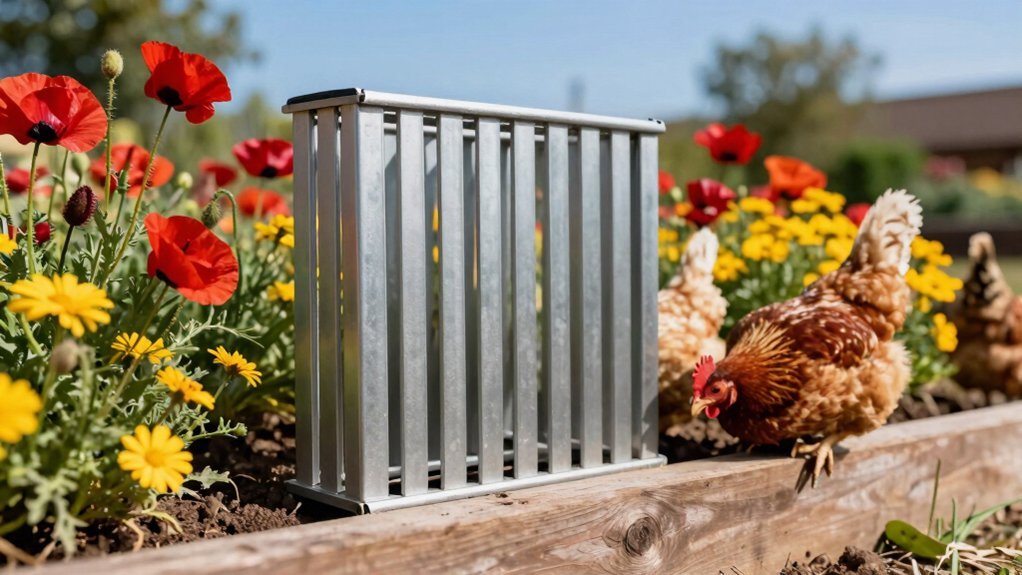
You’re probably wondering why your chickens keep turning your flower beds into a digging site, and you’re right to look for a quick fix. First, set up a 4‑foot‑high fence of 1/4‑inch hardware cloth or welded wire and bury the bottom 6‑8 inches, adding an L‑shaped skirt to stop digging; then cover any raised beds with the same taut mesh. Finally, add motion‑activated sprinklers or plant lavender and rosemary around the perimeter for a scent and surprise deterrent. This combo gives you a sturdy physical block, a sensory scare, and a low‑maintenance solution—keep reading for more easy tricks.
Select the Most Effective Physical Barriers
All right, here’s the thing: decorative fencing looks nice, yet it can be leapt over by curious birds, so treat it as a visual cue, not a lock. Pair it with a low‑height frame that resists leaning, and you get a solid first line of defense.
Now, if you want a tech boost, electrical deterrents and sonic repellents can complement the mesh. A low‑voltage fence gives chickens a mild shock they learn to avoid, while ultrasonic emitters emit frequencies chickens dislike but humans can’t hear. Since digging is an instinctive behavior used to create dust baths for feather maintenance, barriers must also block access to loose soil where this activity occurs. Mixing a small amount of diatomaceous earth into these loose areas can help control external parasites by damaging their exoskeletons, though care must be taken to minimize respiratory risks from inhaling the fine silica particles. Using construction sand in designated areas offers a coarse, chemical-free alternative that prevents respiratory issues while satisfying the birds’ bathing instincts.
Takeaway: combine a tightly‑wired hardware cloth barrier with optional electronic deterrents for reliable, low‑maintenance protection. Ready to choose your barrier type?
A mixed seed border of wildflowers, cilantro, fenugreek, peas, lettuce, poppy seeds, and buckwheat creates a natural physical barrier that deters chickens from reaching the central plants.
Install Low‑Height Fencing to Keep Chickens Out of Flower Beds
If you’re wondering whether a short decorative fence can really keep chickens out, the answer is yes—when you treat it as both a visual cue and a modest physical barrier.
What height works best?
A 12‑ to 24‑inch fence gives visual discouragement without blocking sightlines. Chickens see the picket or wire line, treat it as a psychological barrier, and usually pause before hopping over.
Which material should you choose?
Pick hardware cloth or small‑gap wire; the smooth surface prevents injuries, and the gaps stop chickens from squeezing through. Non‑shiny panels blend with garden décor and stay low‑maintenance. While standard fencing relies on physical obstruction, some gardeners also utilize electric poultry netting to create a flexible, humane deterrent that protects plants without harming the birds. Understanding that chickens are living animals driven by biological resilience rather than supernatural forces helps explain why they persistently test barriers until a clear boundary is established.
How to install for maximum effect?
Enclose the whole bed, leaving no gaps at corners or ends. Keep the fence a few inches away from plants so flowers don’t press against it. Deer netting can be added to increase height if wind becomes an issue. You can also layer heavy rocks around the base of the fence to further discourage scratching and prevent chickens from digging underneath.
Takeaway: A low‑height, chicken‑safe fence creates a clear visual cue and a gentle psychological barrier, deterring most birds while preserving garden openness.
Next step: Test a 2‑foot fence around one bed and observe if your flock respects the boundary.
Bury the Fence Base to Stop Slip‑Under Access
Why bury the fence base matters
You’re wondering why a buried edge stops chickens slipping under. The answer: a trench installation forces them to hit solid barrier before they reach soil, so they can’t just waddle through a gap. Dig a 15‑30 cm trench along the fence line, place hardware cloth, and backfill with compacted soil, rocks, or gravel—these burial materials lock the mesh in place. While securing the bottom is critical, remember that a fence height of at least 4 to 6 feet is generally recommended to prevent chickens from flying or jumping out and to protect them from predators.
How deep should you go?
Most guides recommend 12‑24 inches, but if predators are aggressive, push it to 18‑24 inches. Extend the mesh outward in an L‑shape; the horizontal skirt sits flat, preventing digging from the side. Keep the fence tight to eliminate crawl‑through gaps. Using 1/4-inch hardware cloth ensures the barrier resists strong predators and prevents smaller intruders like snakes from squeezing through. Just as sturdy posts spaced about six feet apart provide structural integrity for a chicken run, a firmly anchored base prevents the entire fence line from shifting under pressure.
What to check later?
Inspect after rain or frost; refill eroded spots and tighten fasteners. A well‑buried base, combined with a sturdy fence, gives you a reliable, low‑maintenance barrier.
Ready to reinforce the top? Consider adding a welded‑wire overlay for extra strength.
Put Up Welded Wire or Sturdy Chicken Wire for a Tough Barrier
You’re probably wondering which mesh will actually stop chickens from nosing into your flower beds without turning your garden into a construction site.
What mesh rigidity should I pick?
Now, welded wire gives you solid mesh rigidity because the joints are fused, so the grid won’t bow when a bird pushes. Choose 1/2‑inch or 1‑inch openings; the smaller size blocks most pests, while the larger still holds shape. Galvanized steel adds material durability, resisting rust and keeping the fence looking tidy for years. The chicken tunnel was built from a 100‑foot, 2×4‑inch welded wire fence to give them a dedicated pathway. To further secure your garden, you should bury wire mesh underground to prevent chickens from digging underneath the barrier. Just like securing a coop against predators, ensuring your barrier has no openings greater than 1/4 inch prevents smaller pests from squeezing through. Much like the aluminum frames used in secure coops, selecting rust-resistant materials ensures your garden barrier remains sturdy and predator-resistant for years.
How do I install it for maximum strength?
All right, attach the panels to a wooden frame or sturdy posts, using 4‑ft‑high rolls for a clean line. Tighten every corner; a rigid perimeter stops chickens from leaning or slipping through.
Takeaway: Welded wire offers the best mix of rigidity and durability for a garden barrier. Next, decide how high you need the fence to keep your chickens out.
Cover Raised Beds With Wire Mesh to Keep Chickens Out
When you wonder why chickens keep slipping into your raised beds, the answer is simple: they’re finding a way over or through the top.
How does a mesh roof stop them?
You stretch one‑inch galvanized chicken wire or finer hardware cloth across the opening, then fasten it tightly to a wooden frame. The mesh blocks heads and feet while letting light and air in. Tension the cloth before you staple or screw it, and overlap seams on larger beds.
What do I need for the frame?
A 2×2 lumber frame works well; it’s light enough to lift but sturdy for tension. Add hinges or liftable brackets if you need frequent access.
How do I keep it working?
Regular frame maintenance means checking for loose staples, rust, or sagging after storms. Replace any bent sections promptly.
Takeaway: A taut, well‑fastened mesh cover gives chickens no entry point and stays durable with simple frame maintenance. Ready to build yours?
The beds’s bottom planking was reinforced with additional legs to prevent sinking.
Add Rock or Gravel Borders Around Flower Beds
All right, you’re wondering why chickens keep digging right up to your flower beds.
How does stone sizing stop scratching?
You’ll see that 4‑ to 8‑inch rocks are heavy enough that chickens can’t easily shift them, unlike fine mulch or pea‑sized gravel. Bigger stones create a solid perimeter, so the birds can’t pry the edge aside to reach loose soil. Use a consistent stone sizing of at least a few inches and you’ll protect new plant roots from being exposed. Since chickens are highly motivated to perform scratching behavior inherited from their wild ancestors, they will persistently work to uncover loose soil unless physically blocked by such barriers. While chickens are opportunistic feeders that might hunt small pests, this instinct does not stop them from relentlessly scratching at garden soil for bugs and grit.
What gravel width works best?
A wide edging—about 12‑18 inches—gives you a sturdy barrier that chickens can’t hop over or scratch through. Tight mulch‑to‑rock boundaries keep the perimeter seamless, preventing chickens from finding a weak spot to dig through.
Takeaway: Choose large, stable rocks and a generous gravel width to form a physical wall that chickens won’t bother. Next, consider pairing this edge with a low fence for extra security. Implementing designated dust bathing areas away from your beds further reduces the urge for chickens to scratch at your flower bed borders.
Install Motion‑Activated Sprinklers to Deter Chickens
If you’re wondering why chickens keep hopping into your flower beds, the answer is simple: they’re not scared of the plants, they’re just curious about the open space.
How does a motion‑activated sprinkler work?
You mount the unit where chickens enter most often, point it outward, and set the infrared sensor to detect their heat. When a bird triggers the sensor, a 5‑second burst sprays 2–3 cups of water, startling the chicken and creating an invisible barrier.
Why is it water‑conserving?
Each activation uses only a few cups, far less than a continuous sprinkler. You can adjust spray distance and sensitivity, so you avoid waste on rain or passing wildlife.
What about seasonal adjustments?
In summer, set a wider detection range to cover hot, active birds; in cooler months, narrow the zone to prevent unnecessary sprays when chickens are less likely to roam. Since chickens often flee their coop due to uncomfortable conditions or stress, this external deterrent also helps identify if your flock is trying to escape an issue inside their housing. Providing adequate outdoor space within their designated area can further reduce the urge to wander into restricted garden zones by satisfying their natural need for exploration. Ensuring your flock has access to 10 square feet of run space per bird can significantly decrease their motivation to invade flower beds in search of room to roam.
Takeaway:
A correctly placed, finely tuned sprinkler deters chickens while saving water. Next, consider how you’ll position the unit for ideal coverage.
Plant Lavender, Rosemary, and Other Strong‑Smelling Herbs
You’re probably wondering why a few herbs can keep chickens away from your flower beds.
How do strong‑smelling herbs work?
You plant a dense row of lavender, rosemary, mint, thyme, or sage along the bed edge. Their aromatic companion planting creates a scent barrier that chickens find unpleasant. Lavender acts as a herbal insect repellent and also calms nearby birds, while rosemary adds woody structure and a pungent odor that discourages scratching. Although fresh lavender is safe for them to eat, chickens generally avoid it due to its strong fragrance. While some herbs like basil offer antibacterial effects when consumed, the intense aroma of lavender and rosemary primarily serves as a deterrent in this context.
Which herbs should you choose?
Pick lavender for its calming fragrance and rosemary for its upright growth. Add mint or oregano for extra pungency, and sprinkle basil or dill for variety. Space plants 6‑12 inches apart so they fill the border and overlap scents.
What’s the result?
Your flower beds stay intact, and the herbs double as a pleasant garden feature. Next, consider how to arrange these herbs for maximum coverage.
Build Dedicated Scratch and Dust‑Bath Zones for Chickens
When you wonder why your chickens keep digging up flower beds, the answer is simple: they’re looking for a place to scratch and dust‑bathe.
What makes a good zone?
Pick a dry, sunny corner with a bit of shelter—under a shed eave or a shrub works. Dig a 24‑36‑inch square pit, 8‑12 inches deep, and fill it with loose soil, sand, and a handful of wood ash. This “bedding renovation” gives them the friable material they crave, and the depth lets larger birds roll comfortably.
How do you keep it functional?
Replace the top few inches of soil every few weeks; the birds toss material out, so a quick soil replacement keeps the bath attractive. Add a layer of sand for drainage, and keep the area free of mud.
Takeaway: A dedicated scratch‑and‑dust‑bath zone satisfies natural instincts, redirects digging, and protects your flower beds. Next, consider how far to place it from the most vulnerable plants.
Drainage holes are essential to prevent the material from staying wet after rain.
Place Flower Beds Farther From the Coop for Less Temptation
What’s the practical takeaway? All right, combine distance with physical barriers—fencing, netting, or hard edging—to keep chickens out. Even a modest separation cuts damage dramatically, especially when you add a dedicated dust‑bath area to pull their attention away. Ready to sketch your new garden‑chicken map? Consider using raised beds to make planting areas harder for chickens to access.