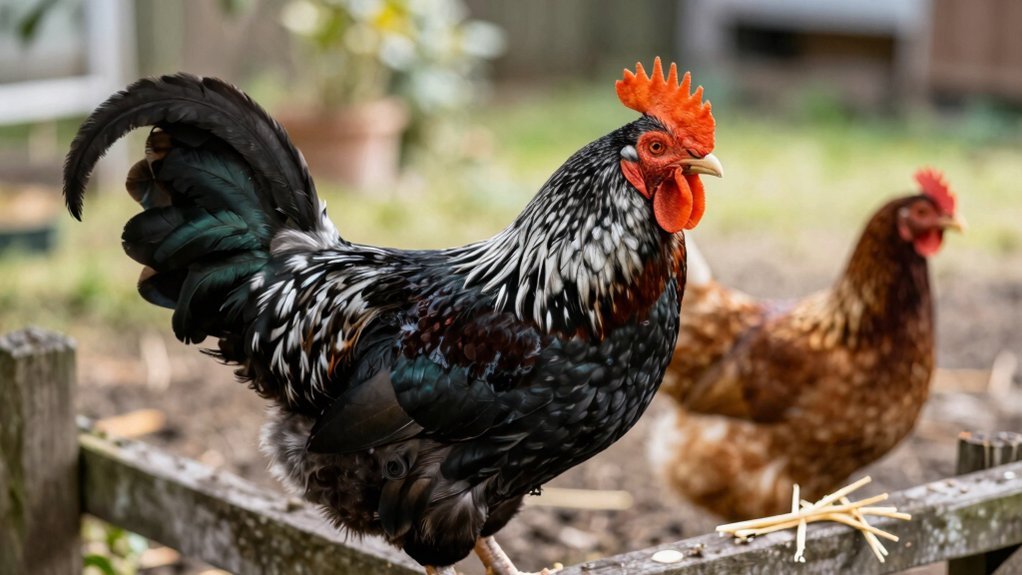
You’re probably wondering what makes the Bantam Barred Rock special, and why it’s a solid pick for a small flock. It’s a true miniature of the classic Barred Rock—single‑comb, clean‑legged, black‑and‑white barred plumage, weighing about 32‑36 oz—recognized by the APA in 1940, and it lays roughly 200‑225 tiny brown eggs a year while staying calm, friendly, and frost‑tolerant. If you keep it in a dry, well‑ventilated coop with about 1‑2 sq ft per bird and feed a quarter‑cup of layer mash daily, you’ll get reliable eggs and a docile pet; stick around and you’ll learn more about its history, housing, and nutrition.
What Is a Bantam Barred Rock? – Quick Definition
What’s puzzling you is why a “Bantam Barred Rock” isn’t just a tiny chicken. You’re seeing the same black‑and‑white barred plumage you love on a full‑size Barred Rock, yet the bird weighs only about 32 oz for hens and 36 oz for roosters. The barred genetics that give the classic stripe pattern stay intact, so there’s no breed confusion—just a miniature version that the American Poultry Association officially recognized in 1940.
Here’s the thing: a Bantam Barred Rock is a single‑comb, clean‑legged bantam kept for ornament, shows, and small‑flock utility. It lays brown, bantam‑sized eggs, roughly two to three per week, making it a practical pet for backyard flocks. While the standard variety is celebrated as a dual-purpose bird, this bantam retains the same friendly disposition in a compact form. Their overall size is about one-third to one-fourth that of standard chicken breeds, making them a compact choice for backyard flocks, though their egg production varies by breed and their eggs are notably smaller than those of full-sized chickens.
All right, remember: you get the same friendly, docile temperament and cold‑hardiness as its larger cousin, but in a compact size that fits limited space. Like the Plymouth Rock Bantam, this breed is appreciated for its calm temperament and adaptability to confined areas. The takeaway? It’s a true miniature of the Barred Rock, not a different breed. Ready to learn about its history?
Bantam Barred Rock History and Origin
If you’re wondering why the Bantam Barred Rock‘s story feels like a New England saga, you’re on the right track. You’ll find its roots in Massachusetts, where early records show a 1849 Boston show and a pivotal 1869 Worcester exhibition by D.A. Upham.
What sparked the breed’s fame? Breeders mixed Dominique, Black Java, Cochin, and Brahma, sometimes adding White‑faced Black Spanish, Malay, or Dorking. Modern genetics confirms Dominique’s heavy imprint, with Java and Cochin still evident.
Why the breed controversies? Early exhibitors disputed credit, and the APA’s 1874 Standard of Perfection finally settled the claims.
Takeaway: The Bantam Barred Rock emerged from a collaborative, contested effort in mid‑19th‑century Massachusetts. While this specific breed has recovered, many other heritage chicken breeds remain endangered due to industrial agriculture favoring uniform commercial lines. To maintain accurate records for such flocks, owners often rely on poultry leg bands for tracking breeding stock and monitoring age. It is important to note that true bantams have no large counterpart, distinguishing them from miniature versions of standard breeds. Next, explore its physical traits.
Bantam Barred Rock Physical Characteristics
What does a Bantam Barred Rock actually look like? You’re probably picturing a tiny version of a Plymouth Rock, and you’re right. The bird stays compact, with a broad, balanced body, a long back and deep chest. Roosters tip the scales at about 36 oz (1 kg) and hens at 32 oz (907 g), so weight comparisons show only a slight difference.
How does its feather pattern work? The black‑and‑white bars create a striking “hawk coloring” that doubles as feather camouflage, breaking up its outline among shrubs and straw. Roosters tend to look a touch lighter because the barring gene links to sex, and as they mature, only males develop saddle feathers and longer hackle feathers that distinguish them from hens. Unlike breeds with unique feather structures such as the fluffy crests of Silkies or the curled plumes of Frizzles, the Bantam Barred Rock maintains smooth, flat-lying feathers across its head and body. While the standard Plymouth Rock boasts pure white plumage, the Bantam variety specifically displays the iconic barred pattern.
What about the head and legs? You’ll see a moderate single comb, a short yellow beak, and wide reddish‑brown eyes. Legs stay clean, yellow‑skinned, and four‑toed, with no shank feathering.
Takeaway: You can identify a Bantam Barred Rock instantly by its bold barred plumage, compact build, and clean legs. Next, you might wonder how its temperament matches this striking look. Their friendly disposition makes them a delightful addition to any backyard flock.
Bantam Barred Rock Temperament & Behavior
What makes a Bantam Barred Rock’s temperament so easy‑going? You’re probably wondering why they seem calm yet curious. Obviously, their sweet, friendly nature makes handling a breeze, and they’ll follow you around like a loyal dog. Like their standard-sized Plymouth Rock relatives, these bantams are renowned for their docile temperament which makes them exceptionally safe and rewarding for children to handle.
How do you keep them happy? Use simple training methods—like clicker cues—to reinforce gentle behavior, and add behavioral enrichment such as dust‑baths, perches, and foraging toys. These activities satisfy their strong foraging instinct and prevent boredom. You can further reduce boredom and prevent bullying by creating inexpensive DIY puzzle dispensers that challenge chickens to peck out hidden treats. Since Barred Rocks are consistent layers that often continue producing through winter, maintaining their calm demeanor year-round requires ensuring they have adequate light and proper nutrition to support this steady output.
What about flock dynamics? They slot into a low‑to‑middle pecking order, stay non‑aggressive, and get along with mixed breeds, though they can be a bit pushy.
Takeaway: A calm, curious bird thrives on gentle training and enrichment, making it perfect for first‑time keepers. Ready to set up a coop that meets those needs?
Bantam Barred Rock Egg Production & Broodiness
How many eggs can a Bantam Barred Rock actually lay? You’re probably wondering if the numbers make sense for a small bird. Typically you’ll see 150‑200 eggs a year, about 2‑3 per week, and some sources even list 225. The eggs are brown, bantam‑sized, and perfect for home use, not commercial volume. While standard Barred Rocks are known for laying large eggs, bantam varieties produce smaller versions suitable for household consumption. Here’s the thing about fertility rates: expect roughly 40‑55 % of eggs to be fertile when you keep an 8‑to‑1 hen‑to‑male ratio. Good nutrition and consistent lighting boost those odds. All right, broody interruptions can cut your supply. When a hen goes broody, she stops laying to sit on a clutch, which may last a week or more. Managing nest boxes and removing eggs can keep production steady. Takeaway: you’ll get modest but reliable output, but plan for occasional broody pauses. Next, consider how to set up a coop that supports both laying and occasional incubation, perhaps utilizing boxing gloves for roosters to manage male aggression safely within the flock. Bantams generally begin laying between 24 to 30 weeks of age, which is slower than larger breeds.
Bantam Barred Rock Hardiness & Climate Tolerance
If you’re wondering whether a Bantam Barred Rock can survive your winter chill, you’ve asked the right question. Their tight feathering and high Feather Density trap warm air next the body, acting like a natural down coat. This breed’s northeastern roots mean it’s built for cold snaps, so you’ll see them huddling happily even when temperatures dip below freezing.
Here’s the thing: the single, relatively small comb still invites frostbite risk, especially on roosters. For Frostbite Prevention, keep the coop dry, add a windbreak, and consider a lightweight mask on the comb during extreme cold.
All right, remember that while they tolerate cold better than heat, a well‑ventilated, insulated shelter remains essential. The takeaway: with proper shelter and a bit of extra care for the comb, your Bantam Barred Rocks will thrive year‑round. Consider checking housing needs next.
Bantam Barred Rock Housing Requirements
You’re wondering how much space a Bantam Barred Rock really needs to feel comfortable, and that’s a great question. For coop space, aim for 1–2 sq ft per bird, but give them a little extra floor room to keep the flock moving smoothly. When you’re doing space planning, remember that two bantams can share the area of one standard chicken, so a small family of four fits nicely in a modest coop.
Now, the run should provide 2.5–4 sq ft per bird. A larger enclosure reduces stress and lets them dust‑bathe, scratch, and stretch their wings. Choose sturdy, weather‑proof material selection—like untreated pine or galvanized wire—to keep predators out while staying breathable. While these smaller birds need less room than standard breeds, providing larger spaces than minimums is beneficial to reduce stress and health issues among hens. Adequate spacing is crucial to prevent stress and disease, which can arise when birds are kept in overly crowded conditions. Overcrowding can lead to health problems so it is best to err on the side of a larger, well-ventilated coop.
All right, roosts need 4–6 inches per bird and sit 1.5–2 ft off the ground; multiple levels prevent competition. One nesting box per four to five hens (10×12×10 in) keeps eggs safe and dry.
Takeaway: give each bantam enough coop, run, and roost space, and pick durable, safe materials. Next, think about feeding and nutrition to round out their care.
Bantam Barred Rock Feeding & Nutrition
You’re probably wondering when to switch from starter to grower to layer feed for your bantam Barred Rocks.
When do I change the feed?
Now, feed starter until about eight weeks, then move to a grower with 18‑20 % protein and 1‑2 % calcium.
All right, once you see the first eggs, change to a layer containing 15‑17 % protein and 3‑5 % calcium.
To ensure strong eggshells and sustained performance, begin this transition gradually around 16 to 18 weeks of age.
How much should I feed?
Obviously, bantams eat less than standard hens—often a quarter cup a day.
If they free‑range, they’ll nibble less commercial feed, so adjust portions accordingly.
Do I need extra nutrients?
Nutritional supplements like oyster shell help during laying if calcium falls short.
Grit is essential when you offer whole grains or kitchen scraps.
For optimal eggshell quality, it is best to offer large particle calcium separately so hens can regulate their intake according to individual needs.
Takeaway: match each stage to protein and calcium targets, keep portions small, and add supplements only when needed. Ready to set up your feeding schedule?
Bantam Barred Rock Ideal Uses & Getting Started
You’re probably wondering how those feed changes translate into a real backyard setup. Here’s the thing: you can fit a flock of bantam Barred Rocks into a modest coop selection, and they’ll still lay about 225 brown eggs a year. Their calm, docile nature makes them perfect for families, kids, or educational projects where close interaction matters.
Now, let’s talk sourcing chicks. Look for hatcheries or reputable breeders that list bantam Barred Rocks explicitly, not the standard Plymouth Rock. Verify single‑comb, clean‑legged birds with the classic black‑and‑white barred pattern before you commit.
Finally, plan secure fencing and predator‑proof housing before the chicks arrive. Start with a small group, observe their temperament, and adjust perches and nest boxes to their size. Takeaway: a compact coop, careful sourcing, and simple safety steps let you enjoy reliable egg production without a large footprint. Ready to choose your coop and order those chicks?
Because they require minimal feed, bantam Barred Rocks keep your winter feed expenses low.