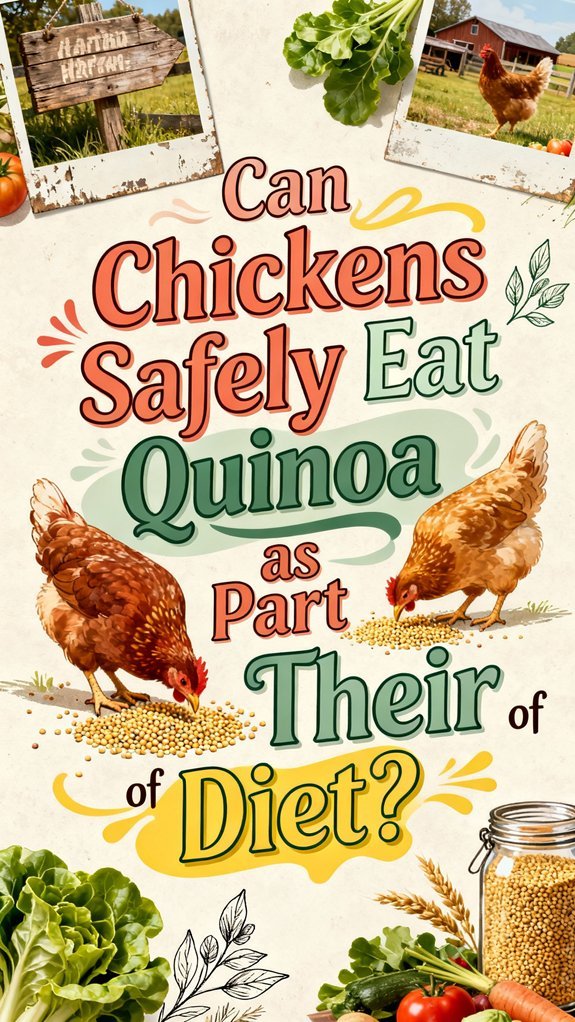
You can safely feed your chickens quinoa as a nutrient-dense supplement containing 11-18% protein with all nine essential amino acids. It’ll provide elevated iron, potassium, and B vitamins exceeding conventional grains. Keep inclusion at 15% of their diet for balanced nutrition. Remove saponins—the bitter outer hull—through rinsing or cooking to improve palatability. Introduce it gradually over 1-2 weeks while monitoring flock health. The preparation methods and specific benefits for egg and meat quality reveal why this grain’s becoming a valuable poultry staple.
Nutritional Benefits of Quinoa for Chickens
When you incorporate quinoa into your flock’s diet, you’re providing a nutrient-dense grain that outperforms conventional cereals across multiple nutritional categories. You’ll supply elevated levels of calcium, phosphorus, iron, and B vitamins compared to corn, barley, wheat, and oats. Each 100g of raw quinoa delivers 5.1mg iron, 622mg potassium, and essential minerals including manganese, magnesium, copper, and zinc. Additionally, quinoa can be included in homemade chicken treats, enhancing their overall health and contributions to a balanced diet. Moreover, feeding oregano as a supplement alongside quinoa may further boost your chickens’ immune system.
Different quinoa varieties offer distinct advantages. High-saponin quinoa promoted thigh muscle development by 9.6% in broilers, while sprouted quinoa provides 6.4g fiber per 100g—exceeding your chickens’ daily fiber requirement. You can safely feed unprocessed quinoa at up to 15% of your birds’ diet without risking growth depression. Establish consistent feeding frequency to optimize nutrient absorption and muscle development through improved IGF1 gene expression in breast tissue. However, feeding saponin-free quinoa without protease additives may result in increased mortality rates and elevated liver enzyme markers in your flock.
Protein and Amino Acid Profile
Quinoa’s protein composition—ranging from 11% to 18%—substantially exceeds conventional cereals and positions it as a valuable supplement for poultry nutrition. You’ll find that quinoa contains all nine essential amino acids, with particularly high lysine (5.1-6.4% of protein) and methionine (0.1-1% of protein) levels. This amino acid balance complements grain-based diets effectively, addressing deficiencies you’d encounter with cereals alone. The benefits of high-quality protein in a chicken’s diet can lead to improved overall health and productivity. Additionally, including nutritious treats like quinoa in moderation can support your chickens’ immune system and digestive health, particularly in light of common issues like Sudden Death Syndrome that can affect chicken populations.
The protein digestibility profile rivals casein, a high-quality milk protein, making quinoa nutritionally competitive. However, you should note that tyrosine or phenylalanine may limit amino acid utilization in some applications. Additionally, quinoa demonstrates higher energy, calcium, and phosphorus compared to conventional grains like corn, barley, wheat, and oats, further enhancing its nutritional value for poultry. For best results in poultry diets, you’re advised to cap quinoa inclusion at 15% maximum, ensuring your birds receive balanced nutrition without compromising overall diet formulation or performance outcomes.
Essential Micronutrients and Minerals
Beyond its amino acid profile, quinoa‘s micronutrient density offers poultry nutritionists a compelling mineral and vitamin resource, though bioavailability challenges require careful consideration during feed formulation. Quinoa delivers appreciable iron, magnesium, and potassium concentrations exceeding conventional cereals, supporting hematological function and electrolyte balance. B-vitamin levels—particularly thiamine, riboflavin, niacin, and folate—surpass corn and wheat, contributing supplemental micronutrient profiles when included at moderate levels. Proper cooking or soaking of quinoa significantly enhances the digestibility and nutrient absorption for your flock.
However, phytate binding considerably reduces mineral bioavailability. You’ll find phytate complexes calcium, zinc, and iron, limiting their absorption unless phytase or processing intervenes. Saponin presence further complicates mineral interactions by potentially interfering with nutrient uptake. Consequently, you shouldn’t rely on quinoa as your sole mineral source; limiting inclusion to 15% preserves micronutrient benefits while minimizing anti-nutritional effects and maintaining formulated premix efficacy.
Meat and Egg Quality Improvements
While phytate and saponin interactions complicate mineral bioavailability, they’ve paradoxically emerged as beneficial compounds influencing meat composition and preservation. When you incorporate high-saponin quinoa into your flock’s diet, you’ll observe significant nutritional enhancement through improved thigh muscle development (9.6% increase, p=0.008) and elevated yields in wing, neck, and back muscles (2.9 abs.%, p=0.007). Your meat quality improves substantially when quinoa coating delays lipid oxidation (1.07 versus 2.39 mg MDA/kg) and reduces protein oxidation (4.20 versus 6.44 nmol carbonyl/mg protein). Additionally, quinoa-coated products maintain lowest microbial loads (5.8 × 10³ cfu/g after 24 days) compared to controls (1.8 × 10⁵ cfu/g), effectively extending shelf life and ensuring superior meat preservation without synthetic preservatives. The lipid profile improvements observed in broilers receiving quinoa supplementation suggest broader metabolic benefits that extend beyond growth metrics to influence overall meat composition quality. Furthermore, quinoa’s effect on dietary requirements aligns with the essential nutritional needs for optimal meat production, further enhancing its value in a balanced chicken diet.
Understanding Saponins and Anti-Nutritional Factors
To optimize your broiler feeding program, you’ll need to understand saponins—primary anti-nutritional factors concentrated in quinoa’s outer seed hull that impart an unpalatable bitter taste to poultry. Saponin levels vary from 0.14% to 0.73% depending on quinoa variety, creating variable anti-nutritional impact across feed formulations.
You’ll encounter a paradox: while saponins depress feed intake and growth when quinoa serves as your primary energy source, native high-saponin quinoa maintains broiler performance at control levels. Purified, low-saponin quinoa paradoxically causes 10% mortality and considerably lower performance indices. The unique characteristics of quinoa, such as distinctive growth requirements, make it a particular concern for poultry farmers.
Your quinoa also contains phytic acid, tannins, and trypsin inhibitors, compounding the anti-nutritional impact. However, you can mitigate these factors through soaking protocols or enzyme supplementation without removing beneficial saponins’ biological properties. Washing quinoa effectively reduces these anti-nutritional substances while preserving the seed’s nutritional value for broiler diets.
Safe Preparation Methods
Safe rinsing removes saponin coatings effectively. Use a small-hole colander and rinse raw quinoa under running water for 20 seconds in small portions, then air dry briefly on a towel before feeding. This precaution is particularly important because toxic plants such as azalea or foxglove should be avoided in their diet. Additionally, mites infestations can also affect chickens, so ensuring a clean eating environment is essential for their health. Moreover, chickens need adequate hydration to survive, as their health can decline rapidly without water. Including treats like quinoa in moderation can help provide important nutrients that may contribute to improved meat quality for your chickens. Additionally, keeping chickens healthy during their maturation phase is essential for optimal development stages.
Sprouting techniques enhance digestibility and safety considerably. Soak quinoa with water for approximately eight hours to initiate sprouting, which improves nutrient bioavailability compared to raw consumption. Quinoa sprouts are particularly valuable as a calcium source for laying hens, contributing to overall health and improved egg quality.
Alternatively, you can cook quinoa by submerging boil-in-bag portions in water and boiling for 10 minutes, then draining thoroughly. Cooking eliminates saponin coatings while increasing palatability through tenderness. Both methods render quinoa suitable as an occasional treat for your chickens.
Recommended Feeding Rates and Guidelines
Because quinoa’s nutritional profile differs substantially from conventional grains, you’ll need to carefully calibrate inclusion limits to prevent performance losses in your flock. For laying hens, maintain quinoa at 5–15% of total diet; for growing broilers, keep it below 10–15% to avoid documented growth depression. Pullets and breeders require conservative inclusion at ≤10% during developmental phases. Chickens can have issues with their crop function if overfed, so moderation is key.
Implement gradual introduction over 1–2 weeks while monitoring weight gain and feed conversion. This staged approach lets you detect adverse responses early. Adjust nutrient ratios accordingly—quinoa’s higher protein and different energy density than corn or wheat require recalibration of your base ration. During colder months, you may consider mixing cooked quinoa with protein sources like ground beef to enhance nutrient intake and provide extra warmth and energy for your flock. For chicks during the starter phase, minimize quinoa entirely and rely on formulated starter feed. Treat quinoa as an occasional supplement rather than continuous staple to maintain nutritional balance.
Effects on Gut Health and Microbiota
When you introduce quinoa to your flock’s diet, you’re not simply adding calories and protein—you’re altering the microbial ecosystem within your birds’ gastrointestinal tract. Quinoa’s saponins and polyphenols shift microbial composition toward beneficial taxa while enhancing fermentation activity. This increased fermentation produces short-chain fatty acids (acetate, propionate, butyrate) that strengthen intestinal barrier integrity and reduce systemic inflammation markers like IL-6 and serum LPS. Interestingly, just as young chicks benefit from consuming cecal feces to establish their microbiome, the right dietary components can significantly enhance gut health. Additionally, the introduction of quinoa might improve the overall health and productivity of your flock, similar to how high egg-yielding breeds thrive on a balanced diet. Microbial enzymatic activities intensify, facilitating carbohydrate fermentation. However, processing matters greatly—saponin removal or soaking changes bioactive profiles, resulting in different gut responses. Unprocessed, high-saponin quinoa produces more pronounced metabolic changes than purified alternatives. The polyphenols in quinoa, including compounds like quercetin and esculin, have been shown to enhance the composition and diversity of gut microbiota while reducing pathogenic bacteria. You’ll observe reduced digester pH and enhanced cecal microbial metabolic activity, supporting overall gastrointestinal health in your birds.
Cost, Sourcing, and Practical Considerations
While quinoa’s nutritional and probiotic benefits for your flock are well-documented, its economic viability hinges on strategic sourcing and feed integration. Your cost analysis reveals significant savings through multiple sourcing strategies. Home-grown quinoa residue eliminates grain purchase expenses entirely, while bulk store quinoa provides affordable protein supplementation without specialized procurement. Pre-washed commercial varieties bypass labor-intensive rinsing, reducing preparation overhead. Unprocessed high-saponin quinoa avoids purification costs, maintaining broiler performance at 3-5% inclusion rates. Furthermore, hens like the Buff Orpington are known for their reliable laying habits, and incorporating quinoa into their diet can support overall health and egg production. Cooked human leftovers repurposed as treats minimize waste while cutting dedicated feed purchases. Quinoa leaves contain more protein than traditional grains, making them an excellent alternative to conventional grain feed for your flock. You’ll achieve ideal results mixing tablespoons of quinoa with eggs twice weekly during molting periods. This multi-source approach maximizes nutritional returns while substantially reducing operational feed costs for sustainable poultry management.