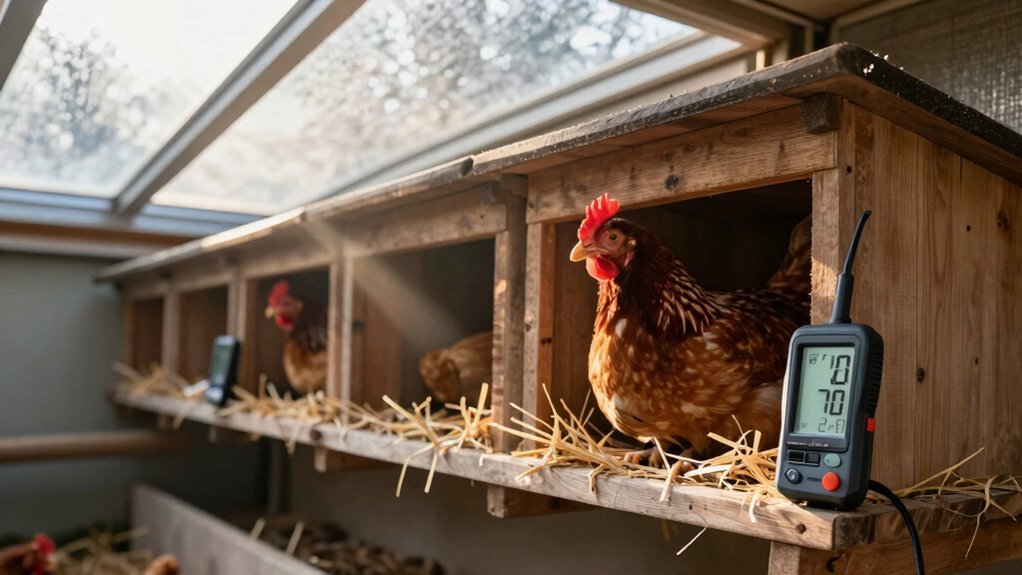
You’re probably wondering exactly how many hours, what brightness, and which setup will keep your hens laying consistently. You need a steady 14‑16 hour light window each day, with at least 10‑15 lux at bird level—think of a warm‑white LED that’s about 0.5‑1 foot‑candle (5‑10 lux) placed 2‑3 feet above the perch. Add a 30‑minute light increase each week as days shorten, and make sure the hens get 8‑10 hours of darkness for rest and immune health. This simple schedule will trigger hormone release and keep production steady, and if you follow it, you’ll uncover the next steps to fine‑tune your coop lighting.
How Many Light Hours Really Trigger Egg Laying?
How many light hours really trigger egg laying? You’re probably wondering why 14 hours keeps popping up. Here’s the thing: hens need a photoperiod that reaches about 14 hours before they start laying, because that length signals spring’s seasonal feathering and even aligns loosely with lunar cycles that affect hormone rhythms. Anything shorter sends a shutdown signal, so production drops.
Now, think of it like waking up to a sunrise that’s just bright enough to start your day—if the sunrise never reaches that threshold, you stay in bed. In practice, you add low‑intensity morning light to hit the 14‑hour mark, then gradually stretch toward 16 hours for peak output. However, you must ensure chickens receive 6-8 hours of darkness each night to rest properly and maintain their immune health. Sunlight also plays a critical role by providing essential Vitamin D which supports calcium absorption for strong bones and eggshells. To further support the energy-intensive process of egg laying, providing a balanced diet rich in protein and calcium is crucial alongside your lighting strategy.
All right, remember: the 14‑hour rule is a solid baseline, but breed, age, and health can tweak it. Your next move? Test a consistent 14‑hour schedule and watch the flock’s response before tweaking further. Uniform light exposure is essential to prevent shaded areas that could reduce overall effectiveness.
Why 14‑16 H of Egg‑Laying Lighting Is the Sweet Spot
You’re probably wondering why 14‑16 hours of light keeps popping up in every guide. Here’s the thing: chickens’ reproductive hormones respond to daylength, not brightness. When you give them 14 hours, you hit the threshold that triggers laying; push to 16 hours and you reach the peak spring‑like photoperiod that maximizes output. Anything less, say 12 hours, drops melatonin secretion and slows egg production, while over 16 hours adds no benefit and can cause circadian disruption. This light requirement is critical because shorter daylight hours fail to stimulate the reproductive systems regulated by a light-sensitive gland in their heads.
Why does this range feel natural? Think of it as a seasonal cue—long days signal abundant food and safe conditions for raising chicks. Your flock’s internal clock loves consistency, so a steady schedule avoids stress and keeps hormone levels stable. Since hens typically produce one egg every 24 to 26 hours, their laying time shifts slightly later each day if light exposure isn’t managed consistently. This daily rhythm is part of a larger reproductive cycle that typically lasts about 24 to 27 hours, allowing hens to get into a pattern of laying nearly one egg per day.
Takeaway: Aim for a reliable 14‑16‑hour light cycle to sync hens’ biology with ideal egg laying. Next, consider how to ramp up light for pullets without forcing early maturity.
How to Ramp Up Light for Pullets Without Forcing Early Maturity
If you’re wondering why you can’t just crank up the lights for pullets right away, it’s because premature photostimulation can force early sexual maturity and cause health problems. You need to keep the house dark until the planned stimulation week, then raise day length gradually.
How do you avoid a sudden jump?
Use blackout curtains to seal out sunrise and sunset, then add 30‑minute light increments each afternoon. After a week, extend the morning period by another half hour. This step‑down approach mimics natural outdoor synchronization while keeping the total day length at 8‑10 hours until you’re ready.
When should you start the ramp‑up?
Around 17‑20 weeks, once 80 % of birds hit target weight and uniformity. Increase light by no more than two hours total, split between morning and evening, and watch for any stress signs. Since hens typically reach sexual maturity between 18 weeks and 6 months depending on the breed, aligning your light schedule with this natural window prevents the health issues associated with forcing production too soon. For Rhode Island Reds specifically, this onset often occurs between 18 to 25 weeks under optimal conditions, though some may start as early as 16 weeks. These hardy birds are also considered excellent dual-purpose options for those interested in both egg and meat production alongside their laying capabilities.
Takeaway: Control darkness first, then add light slowly and evenly. Next, check your flock’s weight and uniformity before you begin the final increase.
What Lux Level Is Optimal for Laying Hens?
Most people wonder exactly how bright a laying‑hen house should be, and you’re right to ask. You’ll find the sweet spot lies around 10–15 lux at bird level, which matches the Lohmann Breeders recommendation and the APA 10–30 lux range for most layers. If you measure at the feed trough, aim for roughly one foot‑candle (≈10.8 lux).
Now, the type of light matters. Warm‑spectrum bulbs keep hens active without overstimulation, while cool‑white can feel harsh. Choose a bulb wattage that delivers the needed lux without overheating—usually a 15‑watt LED works for a 4‑foot‑wide aisle.
All right, remember to check corners and nest boxes; they should stay dimmer than activity zones to encourage proper laying. Providing natural daylight alongside artificial sources helps reach the 14–16 hours of light per day needed to stimulate consistent laying. This increase in daylight triggers the pineal gland to activate the hen’s reproductive system, resuming egg production after the winter slowdown. While lighting is critical, keep in mind that breed maturity also influences when hens begin laying, with some starting as early as 16 weeks and others taking up to 28 weeks.
Takeaway: Aim for 10‑15 lux, use warm‑spectrum LEDs, and match wattage to coverage. Next, plan a lighting schedule that respects natural roosting patterns.
Morning‑First Egg‑Laying Lighting Schedule for Natural Roosting
Morning‑first lighting can feel confusing, but you’re on the right track. You’ll set a fixed “first light” at 4 AM, run it for three hours, then let sunrise take over. This supplement timing tricks the hens’ circadian rhythm into thinking the day started earlier, which boosts hormone release for egg laying.
Here’s the thing: keep the light warm‑white, bright enough to see feed, and use a timer so the pattern never slips. A stable morning‑only block avoids sudden switches that stress the flock and preserves essential dark time for roosting. Since chickens rely on natural light cues to determine when to roost and settle for the night, maintaining this consistent dark period ensures they return to their coop safely at dusk. Because chickens naturally seek elevated roosting spots like bars or treetops to sleep securely from dusk till dawn, your lighting schedule must guarantee they have enough time to find these perches before total darkness falls. While human routines like coop door timing help shape daily rhythms, the flock ultimately synchronizes its rest with sunrise and sunset. All right, the takeaway: a simple 4 AM‑7 AM schedule, timed by a reliable timer, supports natural roosting while extending perceived daylight. Next, consider how you’ll adjust the schedule as days lengthen.
Week‑by‑Week Daylight Extension to 16 H
How do I extend daylight week by week without shocking the hens? You’re wondering how to stretch natural light to 16 h without a production dip. Here’s the thing: start when daylength falls to about 15 h and add a 30‑minute block each week, using Commercial lighting techniques that mimic sunrise.
What increment works best?
A 30‑minute weekly boost feels like easing a car into a higher gear—smooth, not jerky. If you prefer a faster climb, add a full hour per week, but keep the total under 16 h to avoid stress.
How do I schedule it?
Apply Light timing strategies that turn lights on at 4:00 AM, then off at 8:00 PM, creating a steady 16‑hour window. Keep the evening dark period consistent; hens love a regular night. Even the most productive breeds typically lay only 5 to 6 eggs per week rather than daily, so consistent lighting is crucial for maximizing their natural output. Supporting this increased activity requires feeding balanced layer feed to ensure hens receive the 16-18% protein and elevated calcium needed for strong eggshells.
Takeaway
Gradual, timed extensions keep egg production steady. Next, decide whether a 30‑minute or 60‑minute weekly step fits your flock’s rhythm. Remember that decrease in daylight naturally triggers molting, so supplementing light helps prevent this energy-intensive process from halting your egg supply during colder months.
How Many Dark Hours Are Needed for Healthy Egg‑Laying Hens?
If you’re wondering how many dark hours your hens truly need, you’ve hit the right topic.
Why does darkness matter?
Darkness gives hens a chance to roost, recover, and reset their reproductive clock. You’ll find that a 24‑hour day with 14–16 hours of light leaves 8–10 dark hours, which matches most guidelines. This window supports circadian synchronization, keeping the laying rhythm steady and reducing stress. Adequate rest also ensures the hen’s body can properly manage the complex eversion of the cloaca during egg-laying to prevent fecal contamination. Interestingly, while hens need darkness for full rest, they are capable of unihemispheric slow-wave sleep where one eye stays open to watch for predators even while resting.
What happens if you cut it short?
Too much light shortens rest, disrupts roosting, and can weaken immune function. Hens may lay erratically, and overall welfare drops.
How to manage it?
Set a reliable timer, keep the coop dark from evening through night, and aim for 8–10 hours of darkness each day.
Takeaway: Consistent 8–10 dark hours keep your flock healthy, productive, and in sync. Next, consider how to adjust lighting when seasons change.
Managing Seasonal Daylight Drops With Supplemental Egg‑Laying Lighting
You’re probably wondering why your hens slow down when daylight drops and how you can keep them laying without overcomplicating things.
How do I extend daylight without stressing the flock?
Now, set a timer for a warm‑white LED that adds 15‑30 minutes each week until you reach 14‑16 hours total. This gradual ramp mimics spring, avoids shocking hormones, and fits seasonal lighting strategies.
What’s the best placement for Winter coop lighting?
All right, mount the bulb 2‑3 feet above the perch, away from bedding and feathers, so the light stays bright but not harsh. A 25‑watt LED provides enough intensity for a small flock without overheating.
What result should I expect?
Obviously, consistent Winter coop lighting can boost egg output by 10‑15 % compared with natural short days, but only if you also supply water, feed, and health care.
Takeaway: add light slowly, keep it steady, and watch your hens stay productive. Ready to set the timer?
Lighting Mistakes That Reduce Egg Laying and How to Avoid Them
Even though you’ve read about adding a few extra hours of light, you’re probably still wondering why a tiny timing slip can shut down egg production. A missed start or sudden off‑switch throws the flock’s circadian clock, lowering feed intake and hormone balance. The fix? Use a reliable timer and never flip the switch manually.
What happens if you give too few or too many hours?
Below 14 hours, hens often stop laying; above 16 hours, stress spikes and longevity drops. Add light gradually—about one hour per week—until you hit a stable 14‑16‑hour window.
How bright should the coop be?
Aim for 0.5‑1 foot‑candle (5 lux). Dim light hides feeders; blinding light sparks pecking. Choose warm‑white LEDs and avoid cool‑white bulbs that confuse the birds.
Why does placement matter?
Even light distribution prevents dark corners where hens hide and skip feeding. Position fixtures over feeders and waterers, and turn lights off at night to let them roost naturally.
What about the fixtures themselves?
Regular fixture maintenance—dust removal and bulb checks—keeps output consistent and extends bulb life. Replace flickering bulbs promptly.
Takeaway: Consistency, correct duration, proper intensity, and tidy, well‑placed fixtures keep your flock laying smoothly. Next, set a timer and map your coop’s light zones.