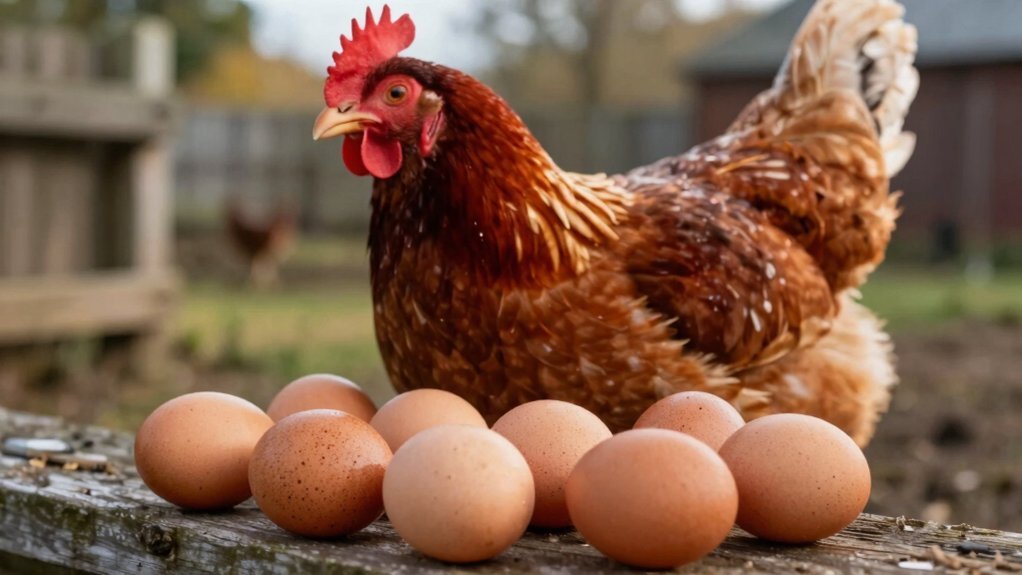
You’re probably wondering why Rhode Island Red hens lay brown eggs, and the answer’s simple: a dominant allele makes them deposit protoporphyrin pigment, giving shells a light‑to‑medium brown that can range from pale tan to deep mahogany. Younger pullets lay the lightest shades, then the color deepens for a couple of years before aging hens start laying paler eggs. Stress, cramped housing, or poor nutrition can also fade the hue, while good care keeps it rich. If you keep digging, you’ll uncover how size, strain, and seasonal lighting further shape these eggs.
What Color Are Rhode Island Red Eggs?
What color are Rhode Island Red eggs? You’re probably wondering why you see light brown, classic brown, or even tan shells from the same breed. Here’s the thing: egg genetics drive pigment biology, and the breed’s genes code for protoporphyrin, the brown pigment that coats the shell. Because each hen’s expression of those genes varies, you’ll notice shades ranging from pale tan to deep brown, sometimes even near‑white on the light end of the spectrum.
Why does the shade shift? Age, stress, and diet tweak how much pigment the hen deposits, so a 30‑week‑old bird may lay darker shells than a younger one. While color variation is normal, the onset of this production typically occurs when hens reach 18 to 25 weeks of age, depending on environmental factors like light exposure. These hardy birds are also considered excellent dual-purpose options for farmers seeking both reliable egg production and meat. Notably, industrial strains often provide higher yields than heritage ones, though both maintain the breed’s characteristic brown egg color.
Bottom line: Rhode Island Red eggs are brown, but expect a spectrum of browns, not a uniform color. Next, explore why brown shells matter to the breed’s identity.
Why Brown Shells Define Rhode Island Red Eggs
You’re probably wondering why the brown shell matters more than the egg’s size or taste. The answer lies in genetic mapping: Rhode Island Reds carry the dominant allele that drives protoporphyrin deposition, the pigment biochemistry that stains the shell. This pigment lands in the cuticle during the final glandular stage, so the interior stays white while the exterior shows a rich brown.
Why does that define the breed? Brown shells act like a visual fingerprint. Farmers use the hue to confirm a flock’s lineage, and you’ll see the same trait across Plymouth Rocks and Sussex. The pigment amount, not shell thickness, dictates shade intensity, giving you light warm brown to deep mahogany tones. These hardy birds maintain strong production even on marginal diets while laying between 200 to 300 large brown eggs annually. Their active and curious nature complements this productivity, though owners must monitor for respiratory issues to ensure the flock remains healthy.
What should you remember? The brown shell is a breed‑specific marker, not a quality indicator. It tells you the hen’s genetics are intact. Next, you might explore how age or diet tweaks the shade. These hens are also prized for their friendly temperament alongside their consistent production of brown eggs.
How Egg Shade Varies With Age and Strain
Why does the egg’s brown shade change as the hen ages?
You’re probably noticing that your pullet variability shows lighter shells at first, then the color deepens. During the first 1‑2 years, the hen’s pigment glands mature, so the brown becomes richer and more consistent. Once she hits peak production, around 2‑3 years, you’ll see a steadier hue across the flock.
What makes some Rhode Island Reds lay darker shells than others?
Strain divergence explains it. Heritage lines often produce a broad range of brown tones, while modern production strains favor lighter, more uniform shells. Even within a single flock, a few hens may still lay pale eggs, especially after a molt or a stressful period. Notably, heritage strains typically live longer and maintain robust characteristics compared to production birds that prioritize high egg output over longevity. While production birds focus on output, other friendly and hardy breeds are often selected by beginners for their adaptability and consistent laying patterns. These resilient birds are known for their ability to maintain egg production even under less-than-ideal care conditions.
What should you expect as your hens get older?
Older birds usually lay lighter, less saturated shells as pigment production wanes. The shift is gradual, not sudden, and you’ll notice more variation in later years.
Takeaway: Egg shade reflects both age and strain, so expect lighter shells from pullets, richer colors at peak, and a gentle fade as hens age. Next, you might wonder how diet or lighting could tweak those shades.
Can Diet and Housing Lighten or Darken the Shell?
You’ve probably wondered why some Rhode Island Red eggs look darker after a diet tweak or a change in coop lighting.
Can feed additives really shift shell shade?
Here’s the thing: genetics set the base brown, but feed additives can nudge pigment deposition up or down. Adding black‑soldier‑fly larvae or microalgae may make the cuticle richer, giving a slightly deeper hue, yet studies show the overall color shift stays subtle. It is crucial to remember that variations in egg shell color result solely from genetics rather than diet or environment, meaning any dietary influence is minor compared to the hen’s inherited traits. While nutrition plays a secondary role in shade, providing a specially formulated diet with balanced protein and calcium is essential for supporting healthy eggshell formation and consistent production.
Does housing stress affect darkness?
All right, stressors like predator presence or cramped space can blunt pigment deposition, leaving shells paler. Conversely, calm, well‑ventilated housing keeps the hen’s metabolism steady, preserving the usual brown intensity.
Takeaway
You can fine‑tune shade a bit with diet and stress‑free housing, but you won’t overhaul the breed’s natural color. Next, consider how age and strain further influence shade.
It is also important to remember that factors like molting seasons can cause temporary variations in egg color shades throughout the year regardless of diet or housing conditions.
Typical Egg Size & Weight of Rhode Island Red Eggs
How big are Rhode Island Red eggs, really? You’re probably wondering why they seem to change size. Here’s the thing: egg size progression starts with small peewee eggs from pullets, moves to medium in the first few weeks, then settles at medium‑to‑large for most mature hens, and can even hit large‑to‑extra‑large in later years if the strain is strong.
Now, egg weight benchmarks give you a concrete picture. Early lay might be about 15 oz per dozen, then climbs to 16–17 oz, and fully mature hens often reach roughly 19 oz per dozen—larger than the store‑bought average. While other productive breeds like the Lohman Brown also lay approximately 300 extra-large eggs yearly, Rhode Island Reds consistently deliver sizable brown eggs within their own impressive range.
Obviously, you’ll notice a reliable, sizable brown egg from a Rhode Island Red. Takeaway: expect a steady growth from small to large, with weight nudging up to 19 oz per dozen as hens mature. Next, you might explore how often they lay each week. As resilient hens producing 200-300 eggs per year, their consistent output is matched by the substantial size of each individual egg. While egg dimensions vary by age, supporting your flock with high-protein starter feed ensures they reach their full growth potential for optimal production.
Laying Frequency of Rhode Island Red Eggs (Weekly & Yearly)
You’re probably wondering why the size of a Rhode Island Red egg seems to change, and the answer lies in how often the hens actually lay. You’ll see 5–6 eggs most weeks, sometimes 5–7 at peak, because each egg needs 24–26 hours to form. A healthy hen can almost hit one egg a day, but a “skip” day appears when the cycle stretches a bit.
How many eggs do you get each year?
On average you’ll collect 250–300 eggs annually from production strains, while heritage birds hover around 150–250. Exceptional layers can top 320. Seasonal production patterns cause a modest dip in autumn and winter, and molting impact cycles can pause laying for several weeks. Like the steady laying traits found in Wyandottes, Rhode Island Reds maintain consistent output even during colder months. It is important to note that reduced daylight during winter months can further influence this laying frequency alongside breed and age. Just as Barred Rocks require adequate light to maintain productivity, ensuring your flock receives 12 to 16 hours of daily light can help stabilize egg production rates.
Takeaway: Expect steady weekly output with a slight seasonal slowdown and occasional molting pauses. Next, explore what influences shell color.
Factors That Darken or Lighten Shell Color
Why do some Rhode Island Red eggs look darker than others? You’re probably wondering if the shade is random, but pigment genetics set a baseline brown, while cuticle deposition adds the final polish.
What makes the shell darker?
Here’s the thing: older hens often lay lighter eggs because protoporphyrin deposition wanes with age, especially after a molt that can temporarily boost darkness. Good nutrition, especially probiotics, can boost pigment intensity, and low stress keeps cuticle deposition steady, giving you a richer brown. Consistent access to balanced layer feed ensures hens receive the specific calcium and protein levels needed to maintain strong shells and stable pigment production throughout their laying cycle. Since essential amino acids like lysine and methionine are critical for overall health and feather development, ensuring their presence in the diet supports the metabolic processes required for consistent egg quality.
What lightens the shell?
Now, high cage density, frequent disturbances, or dietary imbalances reduce cuticle deposition, making shells appear paler. Genetics still caps the darkest possible shade, but management factors can pull the color toward the lighter end of the breed’s range.
Takeaway
You control intensity with feed, stress, and environment, but you can’t rewrite pigment genetics. Next, compare Rhode Island Red shells to other brown‑egg breeds.
Comparing Rhode Island Red Eggs to Other Brown‑Egg Breeds
Now, compare production. Commercial hybrids give you a stone‑cold consistent brown shell, but Rhode Island Reds retain natural variation—still about 250‑300 eggs a year. Plymouth Rocks tend to be calmer, while New Hampshires share a close lineage, making egg color alone unreliable for ID.
All right, the takeaway: egg shade won’t tell you the breed, but production rates and temperament will. Next, ask yourself which trait—hardiness, temperament, or volume—matters most to your flock.
Using Egg Color to Identify Rhode Island Reds
Egg color can seem like a quick shortcut, but it’s a shaky one. You’re probably wondering if the brown shell tells you you have a Rhode Island Red. Here’s the thing: brown eggs are common, but they don’t guarantee Breed confirmation. Egg rarity myths pop up because people think a specific shade means a specific breed, yet many brown‑egg layers look alike.
Now, use egg color as a clue, not a verdict. Pair the shell hue with classic Rhode Island Red traits—deep red plumage, yellow legs, single comb, and red earlobes. When those match, you’ve got a stronger case.
All right, remember: shell color alone won’t seal the deal. Check the bird’s appearance and flock records for reliable identification.
Common Misconceptions About Rhode Island Red Egg Quality
You’ve probably heard that brown shells mean better eggs, and that’s a common mix‑up after focusing on color. The truth is, shell hue comes from genetics, not nutrition, so a Rhode Island Red’s brown egg isn’t automatically superior. Look at shell strength, albumen clarity, yolk color, and freshness—those are the real quality markers.
Why does shell structure matter?
Now, the thick, dense shell you see on a Rhode Island Red isn’t a magic shield; it’s a product of breed differences and calcium intake. A strong shell protects the albumen and yolk, keeping the egg fresh longer. If the shell cracks easily, the egg’s quality drops faster.
Are Rhode Island Reds low‑quality by default?
Here’s the thing: their popularity doesn’t weaken the egg. Productive strains lay 200‑300 eggs a year, often with large, durable shells. Hatchery lines may differ, but good management and proper feed keep quality high.
What about size and season?
Obviously, eggs grow as hens mature, and winter light cuts production. Larger eggs don’t guarantee richer yolk; freshness and shell integrity still count. Supplemental lighting and balanced diet help maintain output.
Takeaway: Shell color isn’t a quality cue; focus on shell structure, albumen, yolk, and freshness. Your next step? Check your hens’ diet and lighting to keep those brown eggs at their best. Rhode Island Reds are known for their hardy nature, thriving in substandard conditions and tolerating free‑range environments.