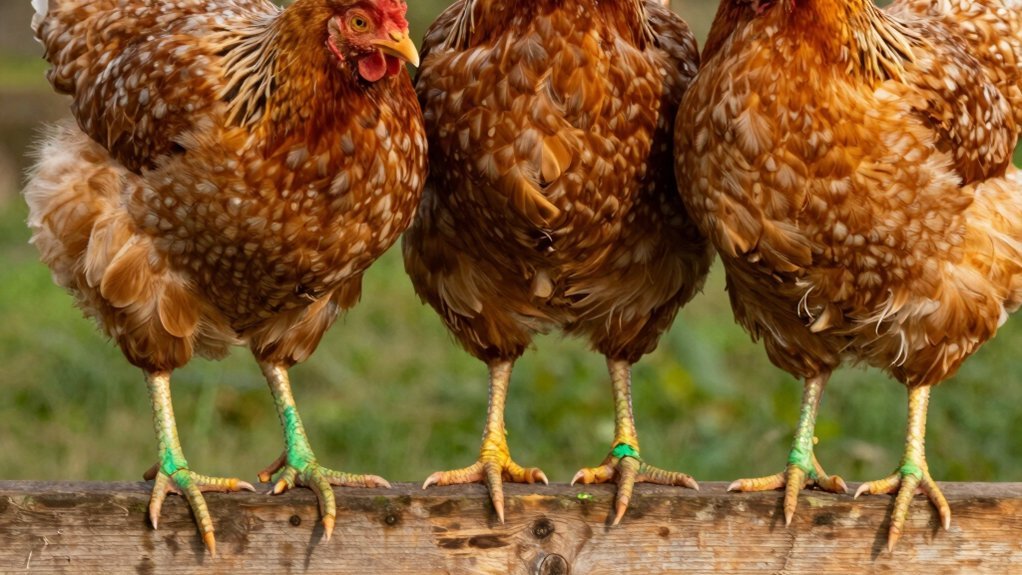
You’re probably wondering why some chickens sport that unexpected willow‑green shank and what it actually means. Green legs are a genetic blend of melanin and carotenoids, not a health badge, so you don’t need to worry about their color unless it suddenly changes. Breeds like Easter Eggers, Ameraucana relatives, Olive Egger hybrids, Isbar (Silverudd’s Blue), and some Skkie or Wyandotte crosses often display this trait, especially when a dark melanin base meets a yellow carotenoid overlay from diet or age. Keep an eye on overall health—bright eyes, clean feathers, steady appetite—rather than leg hue, and you’ll know if anything’s off. If you keep watching, you’ll uncover how these green‑shanked birds link back to historic breeding and conservation efforts.
Are Green Legs a Sign of Good Health?
Are green legs really a sign of good health? You’re probably wondering why some chickens flaunt a jade hue while others don’t. Here’s the thing: leg color is mostly genetics, not a health badge. A breed may sport green shanks all its life, and that’s perfectly normal. This specific coloring often arises from the interaction of melanin expression and dermal melanin inhibitor genes rather than any indicator of vitality. While feather pigmentation relies on complex factors like melanin and carotenoids, leg shading follows its own distinct genetic rules unrelated to these plumage traits. Just as a mutation in the KRT75 gene causes structural defects in curly feathers, specific genetic markers dictate leg pigmentation independently of overall vigor. What actually matters is how the bird moves. If you see limp‑walking, swelling, or a sudden darkening, think circulation problems or injury. Green muscle disease, a tissue issue in the breast, shows that “green” can signal degeneration elsewhere, not wellness. So, focus on bright eyes, clean feathers, and steady appetite. Those signs outweigh any leg pigment. Takeaway: Green legs don’t guarantee health; watch behavior and overall condition. Next, ask which breeds naturally have green shanks.
Which Breeds Are Known for Green‑Shanked Legs?
You’re probably wondering which chickens actually sport that jade‑green shank you’ve seen in pictures. Here’s the thing: the Easter Egger and its Ameraucana relatives top the list, showing slate‑to‑olive legs thanks to color variations caused by genetic mutations. Olive Eggers and some Silkie crosses also flash greenish shanks, especially when blue‑skin genes mingle with other pigments. While these birds are often celebrated for their unique appearance, it is worth noting that the dominant gene responsible for blue egg pigmentation in Ameraucanas is distinct from the factors influencing leg color. Although Ameraucanas are genetically distinct from the mixed-breed Easter Eggers, both can display these leg colors while laying eggs in shades of blue, green, or brown.
Now, look at backyard mixes. Wyandotte, Plymouth Rock, and Marans crosses often surprise you with willow‑green legs, a clear sign of mixed ancestry. Even Leghorn hybrids can turn out green‑shanked, though it’s rare in pure lines.
All right, the takeaway: green legs usually signal cross‑breeding or line variation, not a breed standard. If you spot them, expect a blend of genetics rather than a pure‑bred label. Next, ask yourself which traits—comb, feather color, egg hue—match the bird you’re observing. Just as genetic makeup determines whether a hen lays green eggs through pigment interaction, it also dictates the unique coloration of their legs.
How Do Chickens Get Green Legs?
You’ve probably wondered why some chickens look like they’re wearing jade‑green socks. The secret lies in pigment layering. A dark melanin base in the leg skin gives a slate‑gray tone, then yellow xanthophyll deposits sit on top, mixing to look green.
Now, color genetics decides which birds get that dark foundation and which produce the yellow overlay. Genes that boost melanin produce a black or blue‑gray undercolor, while other genes permit yellow skin. When both are present, the result is a willow‑green shank. Just as eggshell colors vary by breed due to specific genetic markers, leg coloration is a distinct genetic trait influenced by specific biological factors. Much like how protoporphyrin IX pigment creates brown eggshells through specific deposition, the green leg hue relies on the precise interaction of underlying and overlaying pigments.
Here’s the thing: diet and age can shift the balance, but the core green comes from that dual‑pigment sandwich. Just as comb types vary by breed to regulate temperature, leg coloration is a distinct genetic trait influenced by specific biological factors.
Takeaway: green legs aren’t a single pigment; they’re a genetic combo of dark and yellow layers. Look for breeds with both traits, then watch how feeding and laying cycles tweak the shade.
How Can You Identify Green‑Legged Birds in Backyard Flocks?
You’re probably wondering why some of your backyard birds sport jade‑green shanks while others don’t.
What clues should you check first?
Look at comb type, feather pattern, and facial feathering. Pea combs, muffs, or beards often accompany green shanks in Easter Eggers and Ameraucana‑type birds. Pair that with a partridge or mottled plumage, and you’ve got a solid hint. These hybrids are also known for their friendly temperament alongside their quirky physical traits.
How does diet or age factor in?
A feed nutrition analysis can reveal mineral levels that sometimes deepen leg hue, but it’s not the main cause. Bird age variations matter too—young chicks may show lighter green tones that darken as they mature.
What about egg color?
Blue or green eggs usually signal the same genetics that give you green legs. While the color of blue eggs results from genetics, not diet, all breeds require balanced nutrition to stay healthy and productive.
Takeaway: Combine leg color with comb, feather, and egg clues, and you’ll reliably spot green‑legged birds. Next, record your observations to refine your flock’s breed profile.
While true Ameraucanas typically have slate blue legs, the presence of green legs often indicates mixed heritage in Easter Eggers rather than the pure breed standard.
What Do Green Legs Reveal About History & Conservation?
All right, now think about green legs conservation. The breed survived a steep drop from 11.4% of Poland’s flock in 1961 to just 1–2% by 1973, so researchers keep closed flocks—ZK with 1,170 birds in 2014 and Z11 at Chorzelów—to protect those rare alleles. Takeaway: Green shanks are a living record of historic breeding and a rallying flag for conservation. Next, ask yourself which local flock could benefit from preserving this heritage. Supporting small-scale farmers is essential to maintaining the genetic diversity of such endangered breeds against industrial uniformity. Implementing selective breeding strategies allows these conservation programs to improve flock quality while safeguarding unique genetic traits. Unlike modern hybrid techniques that cross distinct lines for rapid growth, these efforts prioritize genetic disorders avoidance to ensure the long-term health and welfare of the heritage population.