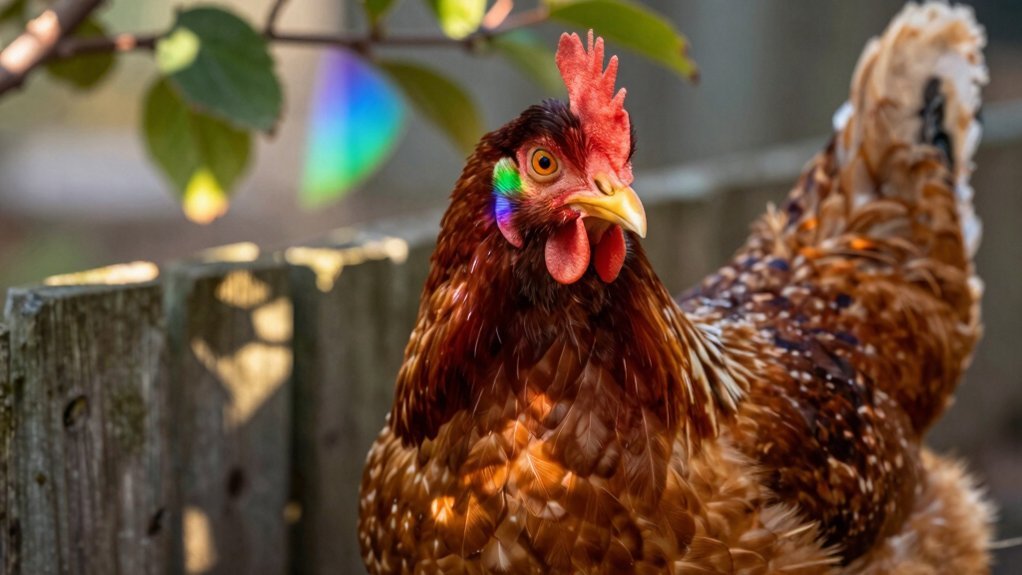
You’re probably wondering why red corn stands out while green lettuce fades, and the answer is that chickens have tetrachromatic eyes—four cone types (violet ≈ 415 nm, blue ≈ 455 nm, green ≈ 508 nm, red ≈ 571 nm) and a UV‑sensitive oil droplet that lets them see from about 350 nm up to 780 nm. This gives them a richer palette than humans, especially in the ultraviolet and deep‑red ranges, so bright warm hues like red and orange naturally grab their attention. Now that you know the basics, you’ll see how this vision shapes their feeding choices and coop behavior.
What Is Tetrachromatic Vision in Chickens?
What makes chickens see more colors than you do? You’re probably wondering why your feathered friend spots hues you miss. Here’s the thing: chickens are tetrachromatic because their cone anatomy includes four photoreceptor types, not three like yours. Each cone type peaks at different wavelengths, spanning from deep red to near‑UV violet. Cone genetics drives this extra class, giving chickens a broader color‑processing system. While their visual system relies on unique cone structures, their skeletal structure also demonstrates distinct evolutionary adaptations similar to how human fingers differ from chicken wing bones. Research into their cognitive complexity reveals that these sophisticated visual abilities support advanced mental functions often overlooked in food animals.
How does that extra cone work? Think of a painter with four primary colors instead of three; you can mix more shades. Chickens’ four cones let them discriminate subtle differences in the same hue that looks identical to you. This finer discrimination aids foraging, social cues, and predator detection. UV vision expands their ability to detect hidden patterns. Takeaway: Chicken tetrachromacy stems from unique cone anatomy and genetics, expanding their visible spectrum beyond human limits. Next, explore how that extra cone lets them see ultraviolet light. Although chickens perceive red light clearly, this specific wavelength tends to be calming for them compared to white light, which is why it is often used in coops to manage behavior.
What Chickens See in the UV Spectrum That Humans Miss?
You’re probably wondering why chickens seem to spot things you can’t—because they see ultraviolet light that’s invisible to us. You’ll notice insects glint like tiny mirrors against grass, and seeds that look dull to you suddenly pop with UV reflectance, giving chickens a built‑in foraging guide that short humans miss.
Here’s the thing: predator markings that blend into foliage in visible light often betray a bright UV edge, letting chickens spot a hawk’s silhouette faster than you could. Even fence netting that looks plain to you can appear neon‑bright under UV, warning birds of a barrier.
double‑cone photoreceptors give chickens extreme sensitivity to movement, making them react to even the slightest rustle. All right, the takeaway is simple: chickens navigate their world with a hidden UV map that highlights food and danger, so what you ignore becomes their advantage. Beyond vision, they also rely on functional sense of smell to detect predators and select food, proving their sensory world is far richer than sight alone. Although they possess some rod cells, their eyes lack the sensitivity required for true night vision, making them essentially blind in total darkness. This unique visual setup is supported by side-placed eyes that provide a nearly 300-degree panoramic field of view, allowing them to monitor their surroundings for threats while foraging. Next, you might wonder how wide their overall color range really is.
Full Color Range Detectable by Chicken Color Vision
If you’re wondering why chickens seem to see a rainbow you can’t, it’s because their eyes capture a broader slice of light—from about 350 nm in the ultraviolet all the way to 780 nm deep red. You’re probably curious how that translates to everyday colors. Chickens are tetrachromatic, with cone peaks near 415, 455, 508, and 571 nm, so they resolve violet, blue, green, yellow, and red plus a UV band humans miss.
Now, this range lets them spot black insects against green foliage because UV reflects off the insects’ exoskeletons while surrounding leaves absorb it. The same principle underlies color camouflage: predators that blend into UV‑rich backgrounds become invisible to them. Although their vision is sharp, their food choices are influenced more by visual cues like size and color rather than taste alone due to their limited number of taste buds. This keen eyesight helps them actively forage for essential nutrients found in grasshoppers, beetles, worms, and larvae that form a significant part of their omnivorous diet.
All right, the takeaway: chickens see a richer spectrum, from UV to deep red, giving them superior detection of food and predators. This ultraviolet perception also aids in social interactions and identifying healthy mates within their complex communities. Next, explore how their cone mosaic sharpens color discrimination.
How the Interwoven Cone Mosaic Boosts Color Discrimination
Why does the interwoven cone mosaic matter for your color perception? You’re probably wondering how a chicken can see such vivid hues. The answer lies in its cone arrangement: five types—violet, blue, green, red, and double cones—each form their own mosaic yet weave together across the retina. This interlacing creates spatial uniformity, so every patch samples the full spectral distribution instead of isolated “hot spots.” Same‑type cones never sit next to each other, thanks to a density‑dependent yardstick that spreads them evenly. The result is a hyperuniform pattern that balances luminance processing with color sampling, giving you consistent discrimination no matter where you look. This precise visual processing helps chickens detect subtle movements while they engage in uni-hemispheric slow-wave sleep to remain alert to predators. However, despite this advanced vision, exposure to loud or sudden noises can cause stress that negatively affects their health and productivity. Properly designed external nesting boxes can further reduce stress by providing secure, accessible laying spaces that minimize disturbances during egg collection.
Takeaway: The interwoven mosaic guarantees uniform color coverage across the visual field.
Next step: Explore why red and orange attract chickens.
Why Red and Orange Attract Chickens (Evolutionary Food Cues)
Why do red and orange catch a chicken’s eye? You’re probably wondering why those warm hues dominate feeder designs. The answer lies in chickens’ innate food‑seeking behavior: their tetrachromatic eyes spot long‑wavelength colors as high‑contrast beacons against green grass and brown soil.
Here’s the thing: in the wild, ripe berries and insects often glow red or orange, so natural selection wired chickens to notice those cues first. When you present a bright red treat, you tap into that ancient shortcut, shortening their search time and sparking pecking. While wild chickens primarily consume insects and worms for essential protein, domesticated birds still retain the visual instinct to identify these nutrient-rich targets by color.
All right, learned color preferences also matter. After a few successful pecks on a red pellet, a chicken begins to associate that hue with reward, reinforcing the attraction. While they do not understand human words, chickens rely on sophisticated communicative behaviors to express emotions and social cues alongside their visual interactions.
Takeaway: red and orange work because they blend evolutionary salience with learned cues, making them powerful attention grabbers. Next, you might ask how these cues translate into actual feed acceptance. This visual drive is part of a broader set of highly motivated behaviors rooted in survival that chickens instinctively work to perform.
How Chicken Color Vision Shapes Feed Acceptance and Preference
You’re probably wondering why a chicken’s first peck often follows the brightest feed particle, and that’s a great question. Chickens are tetrachromatic, so they see ultraviolet and differentiate hues we can’t. When a pellet glows with a new shade, Color based novelty triggers Neural pathways activation in the retina, making that piece stand out. That flash of novelty draws the first peck, even before texture or smell matter.
Here’s the thing: warm hues like red or orange dominate, but green and blue usually lose out. If you present the same feed in several contrasting colors, the visual contrast can outweigh the actual hue, guiding the flock’s choice. Bright, uniform coloring helps chicks recognize a feed type quickly, while uneven spots can erode trust. This visual recognition is especially vital when transitioning birds to starter/grower feeds to ensure they consume the correct protein levels for their growth stage. Quality formulations designed for this phase provide balanced protein levels to support muscle and bone development without the excessive calcium found in layer rations.
Obviously, color alone won’t mask bad taste or odor. Once the bird samples a novel color and finds the feed palatable, it learns the association and repeats the choice. Consistent coloring speeds up that learning loop, especially during changeover periods. While visual cues drive initial selection, sunlight exposure is equally critical as it regulates the circadian rhythms and hormone production that ultimately stimulate consistent laying performance.
Takeaway: Use distinct, stable colors to spark interest, then let the bird’s taste confirm the feed. Next, test a few color variations with your flock to see which sparks the quickest acceptance.
Applying Red/Orange Attractants in Coop Management
How can red/orange cues boost feeder use? You’re probably wondering why those bright hues work, and the answer lies in chicken color memory and emotional associations. Chickens remember the red of cracked corn and the orange of sunrise, so they link those shades with tasty rewards. When you paint feeder rims red or add orange tags, you tap into that memory, sparking curiosity and a quick approach.
Now, place the colored parts at eye level and keep them clean. High‑contrast warm colors stand out against wood and litter, guiding birds straight to the feed. Pair the hue with a familiar shape, and you’ll see more pecks and less wandering. While visual cues aid feeding, remember that hens also require 6-8 hours of darkness each night to rest properly and maintain their immune health. Additionally, using red lighting at night can reduce aggressive pecking because it prevents chickens from clearly distinguishing each other’s combs and wattles.
All right, test one feeder at a time. If the flock gathers faster, you’ve confirmed the cue works. The takeaway: use red/orange sparingly, cleanly, and strategically to steer traffic and boost feeding. Next, ask yourself which coop area could benefit from a bright visual guide.
Color Constancy in Chicken Color Vision: Recognizing Colors Under Changing Light
What does color constancy mean for chickens? You’re probably wondering how a chicken still sees a red pepper as red at sunrise and noon. Here’s the thing: chickens keep color perception stable despite shifts in light spectra, so they recognize the same hue even when illumination changes dramatically.
How was this tested? Researchers trained birds on a rewarded color‑choice task, then switched the lighting. The training influence mattered—different conditioning methods altered how well chickens held onto the correct color. After a five‑minute adaptation, they tolerated shifts three to four times larger than natural light changes, outperforming goldfish and honeybees in species comparison.
What does this mean for you? Chickens can reliably spot ripe food or mates across varied lighting, making their vision robust in the coop. Next, consider how lighting design might leverage this constancy for better feeding outcomes.
Common Misconceptions About Chicken Color Perception
You’ve probably heard that chickens see the world in dull grays, but that’s a myth. You’re right to wonder why people say that, because chicken vision facts show a completely different picture. Chickens are tetrachromats, with red, green, blue, and ultraviolet cones, so they actually see a richer spectrum than we do.
Here’s the thing: color perception myths often claim chickens are colorblind or only see monochrome shades. In reality, their visual range spans roughly 350–780 nm, extending into UV, which helps them spot food, predators, and mates. Their oil droplets sharpen color discrimination, especially in blue and red.
All right, you might think bright red foods mean weak vision. Obviously, bright colors simply trigger learned preferences; chickens also weigh odor, texture, and motion. The takeaway? Chickens have sophisticated color vision, not the dull gray view many assume. Curious about how UV influences their behavior? Explore studies on UV‑based foraging cues next.