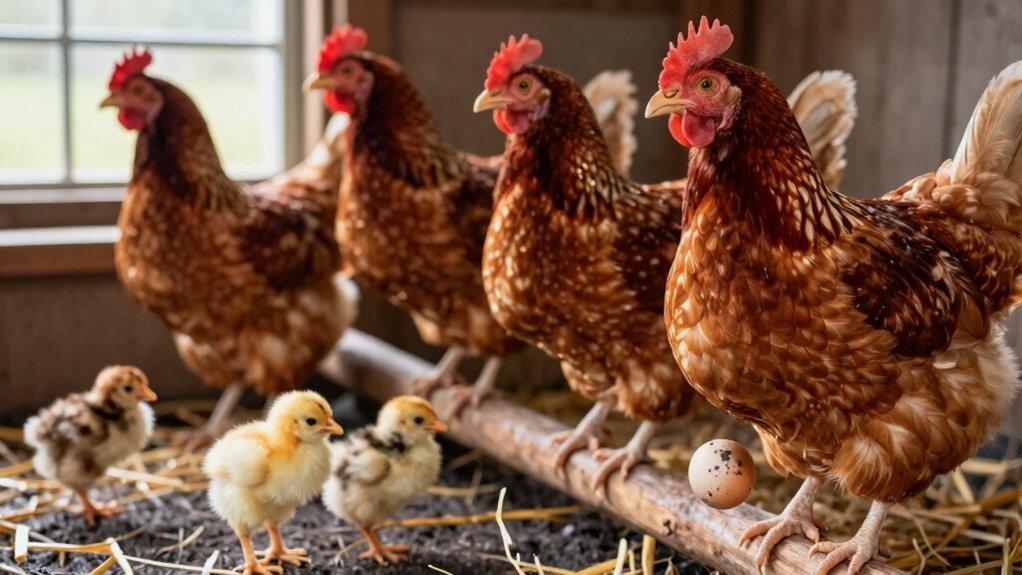
You’re probably wondering why Hy‑Line Browns are such reliable layers, and you’re on the right track. They start laying around 20 weeks, hit a 90 % peak for the first two years, and give you roughly 470 brown eggs in a 100‑week cycle, with size growing from under 45 g to over 60 g by week 70. Their genetics, precise light (14‑15 h/day) and feed (16‑18 % protein, calcium supplements) keep feed conversion near 2 kg feed per kg egg, so they stay efficient and produce strong shells. If you keep lighting, nutrition, and space steady, you’ll see consistent production—more details await if you keep exploring.
Why Hy‑Line Browns Are a Leading Egg Layer
Why does a Hy‑Line Brown stand out as a top egg layer? You’re probably wondering why this breed gets all the buzz. Here’s the thing: genetic selection has honed each hen to lay nearly 500 rich brown eggs in 100 weeks, hitting 481.8–514.5 hen‑day eggs. That consistency fuels commercial scalability, letting farms predict output and manage inventory with confidence.
Now, think about feed costs. Hy‑Line Browns convert 2.06–2.24 kg feed per kg eggs, a 5‑gram reduction per dozen each generation—so you spend less on feed while still hitting high numbers.
All right, what does that mean for you? You get a reliable, long‑cycle layer that fits large‑scale operations without sacrificing egg quality or shell color. Takeaway: the breed’s genetics and efficiency make it a practical, profitable choice for any commercial egg producer. What’s your next step—checking hatchery availability? While popular hybrids like the Hy-Line Brown dominate commercial farms for their high yields, other heritage breeds such as Ancona and Australorp are also valued for their excellent egg-laying and foraging abilities in different farming contexts. Although commercial hybrids lead in volume, backyard keepers often prefer breeds like the Rhode Island Reds for their resilience and ability to produce 200-300 eggs per year in varied climates. For those seeking alternatives with similar prolific laying capabilities, breeds like the White Leghorns can also produce between 250 to 320 eggs annually.
When Do Hy‑Line Browns Begin Laying?
Takeaway: With stable light, nutrition, and low stress, your Hy‑Line Browns should start laying by about 20 weeks, even if winter tries to slow them. Next, ask yourself how many eggs they’ll produce over 100 weeks. While specific timelines vary by breed, similar high-production hybrids are known to begin laying between 16 to 22 weeks of age. Although production breeds often mature quickly, heritage or dual-purpose breeds can take significantly longer, sometimes up to 28 weeks to begin laying. After reaching maturity, these hens will maintain peak egg production for approximately the first two years before output gradually declines.
How Many Eggs Do They Produce in 100 Weeks?
How many eggs can a Hy‑Line Brown lay in 100 weeks? You’re probably wondering why the numbers swing between 453 and 483. Here’s the thing: hen‑day counts hit 468–483 eggs because they ignore mortality, while hen‑housed counts—453–467—reflect real‑world losses. In practice, you’ll see about 460–480 eggs per hen‑housed bird, a figure that holds up across market fluctuations. Breed comparisons show that other commercial layers often sit a few dozen eggs lower, so the Hy‑Line’s persistency gives you a competitive edge. Obviously, management, genetics, and housing drive the gap between the optimistic 483‑egg peak and the conservative 453‑egg floor. Takeaway: expect roughly 470 eggs per hen, adjust for your flock’s health, and you’ll gauge profitability accurately. While hybrids like the Golden Comet produce 250-300 eggs annually, the Hy-Line Brown significantly outperforms many standard hybrid and heritage breeds over an extended laying cycle. Even compared to the Australorp, known for laying up to 364 eggs per year, the Hy-Line Brown demonstrates superior output over a 100-week cycle. It is important to remember that reduced daylight during winter months can decrease production, though high-performing breeds are often managed to mitigate these seasonal drops. Next, ask yourself how egg size and shell quality will affect your market‑ready product.
Egg Size and Shell Quality: From First Egg to Market‑Ready Brown
If you’re wondering why the first eggs feel tiny and then suddenly hit that big‑brown size, you’re asking the right question. Your hens start with a modest first egg size, often under 45 g, then grow steadily as they hit 26 weeks, reaching about 45.5–47.4 lb per case. By 32 weeks they’re near 48 lb per case, and by 70 weeks they push past 60 g, delivering the market‑ready brown you expect.
Here’s the thing: strong shell quality travels with that growth. Hy‑Line Brown hens lay eggs with a dark shell color and robust shells that survive handling, thanks to genetics and careful lighting, nutrition. However, even genetically superior layers can produce crumbly shells if they suffer from calcium and vitamin D3 insufficiencies or other stressors like heat and disease. To ensure consistent shell thickness as egg size increases, provide large particle calcium separately so hens can regulate their intake and release minerals slowly overnight. Layer feeds typically contain optimal protein levels of 16-18% alongside sufficient calcium to support both the increasing egg mass and the hen’s overall health.
All right, remember: as the egg gets bigger, the shell stays thick enough for transport. The takeaway? Monitor size trends and maintain a balanced diet, and you’ll consistently harvest large, dark‑shelled eggs. Ready to fine‑tune your lighting program?
What Makes Hy‑Line Browns So Feed‑Efficient?
Why do Hy‑Line Browns use so little feed for so many eggs? You’re right to wonder—this breed’s feed efficiency isn’t magic, it’s genetics and smart care.
What genetic interactions drive efficiency?
Here’s the thing: decades of selection have tuned genetic interactions that channel energy straight into egg mass. You’ll see a feed conversion of 1.95–2.10 kg feed per kg eggs, and a utilization of 0.48–0.51 kg egg per kg feed. Those numbers mean each gram of feed yields more egg than most layers.
How do management technologies reinforce the trait?
Now, consistent management technologies—early‑life feeding targets, uniform body‑weight goals, and precise intake monitoring—keep the birds at ideal weight by 17 weeks. This early nutrition sets the stage for the genetic potential to shine, letting you harvest 408–467 eggs with only 105–117 g of feed daily. Transitioning to a balanced layer feed around 16 to 20 weeks ensures the increased calcium and protein levels needed to sustain this high production without compromising shell strength or hen health. Selecting high-quality commercial feed matched to your flock’s specific age and production needs further reduces waste and maintains optimal health throughout the laying cycle. To support digestion and overall health alongside these precise rations, providing access to appropriate supplements like calcium is essential for laying hens.
Takeaway
Genetic interactions give the baseline, and management technologies activate it. Next, you might explore how housing choices affect those numbers.
Survival Rates: Livability Up to 100 Weeks
What does “livability to 100 weeks” actually mean for a Hy‑Line Brown flock? You’re probably wondering why the numbers matter. Here’s the thing: the breed’s survival benchmarks show about 91‑92 % of birds still alive at week 100 under commercial conditions.
Now, early in the cycle you’ll see roughly 97 % survival at 60 weeks, then a steady 5‑6‑point drop by the end of the laying period. That decline reflects normal cumulative losses, not a sudden catastrophe.
Obviously, flock longevity hinges on nutrition, housing, biosecurity, and stress control. If you keep those factors tight, you’ll stay near the benchmark and avoid costly culling. Unlike ISA Browns which typically live only 2 to 4 years due to reproductive system stress, well-managed commercial flocks can sustain high livability through their second laying cycle. While laying hens are generally leaner and raised for a longer lifespan than meat birds, understanding the specific molting cycles that temporarily pause egg production is essential for managing flock health over such an extended period. Although industrial layers have shortened lives compared to heritage breeds that can reach 10 years or more, proper care significantly extends their healthy years beyond typical production norms.
Takeaway: expect around nine‑in‑ten birds to reach 100 weeks if you manage the flock well. Next, ask yourself how to protect that 90 % peak‑production window.
How to Maximize the 90 % Peak‑Production Period
You’re probably wondering why the 90 % peak‑production window feels so finicky. You need to hit light stimulation timing at about 1380 g body weight, usually 15–16 weeks, and keep photoperiod at 14–15 hours. If birds lag, add 30 minutes each week until you reach 16 hours, but don’t overdo it—earlier light boosts egg numbers while slightly shrinking size. To maintain this consistency when natural daylight drops, install supplemental artificial lighting to ensure hens receive the full 15 hours required for maximum output.
All right, now focus on feeding shift strategies. Switch from a low‑density pre‑lay diet after 10–12 days to a modest early‑layer feed, keeping methionine + cystine under 90 % of lysine. When weight targets hit, shift quickly; rapid diet changes keep the flock on track.
Here’s the thing: consistent light and smooth diet shifts sustain the 90 % window. The takeaway: match light timing to weight, and manage feed density precisely. Next, ask yourself how you’ll monitor egg size to fine‑tune nutrition. Remember that natural daylight lengthening in late winter or early spring naturally triggers reproductive systems once hens have completed their fall molt.
Adapting Hy‑Line Browns to Intensive vs. Backyard Housing
If you’re wondering whether Hy‑Line Browns will thrive in a backyard coop or a high‑tech layer house, you’ve hit the right spot.
How does genetic selection affect each system?
Here’s the thing: breeders chose these birds for robustness, nesting instinct, and low‑stress temperament, so they handle both intensive cages and free‑range pens. In a commercial setting, market segmentation drives uniformity—controlled light, feed, and ventilation keep egg output near 500 in 100 weeks.
What changes when you move to a backyard?
Now, you’ll need predator‑proof shelter, dry litter, and consistent feed. The same genetic strengths give you calm birds and reliable lay, but variable lighting and nutrition lower total eggs. Expect fewer than commercial numbers, yet you gain welfare perception and personal interaction.
Takeaway: The breed’s genetic selection lets you succeed in either arena; just match management intensity to the housing style. Next, consider how you’ll balance lighting and nutrition for ideal results.
Common Care Mistakes for Hy‑Line Browns and How to Fix Them
Takeaway: Spotting and correcting these errors early keeps your hens healthy and productive.
Why does my feed keep changing? You’re probably mixing starter and layer feeds forever. Switch to layer crumble once laying starts, and shift gradually over two weeks. This prevents soft shells and keeps egg output steady. Overcrowding can also stress hens, reducing egg production; ensure at least 3‑4 sq ft per bird in the run.
How can I stop my chicks from overheating? Keep brooding temps at 35‑37 °C initially, then lower a few degrees each week. Maintain 60 % humidity; lower levels cause dehydration and dusty vents.
What about predator protection and illness treatment? Secure a sturdy coop with screened vents, but don’t seal it so tightly that air stagnates. Inspect daily, treat any signs of illness immediately, and sanitize drinkers to stop bacterial spread.
All right, what’s the main fix? Balance nutrition, temperature, and housing, then act fast on health issues.
Next step: Review your feeding schedule and coop ventilation to catch any gaps.
Starter Pack Essentials: Hatchery, Feed, and Biosecurity for Hy‑Line Browns
Takeaway: Warm brooder, immediate water, proper crumble, and clean, disinfected equipment set the stage for healthy Hy‑Line Browns. Next, plan your daily feeding schedule and monitor litter conditions.