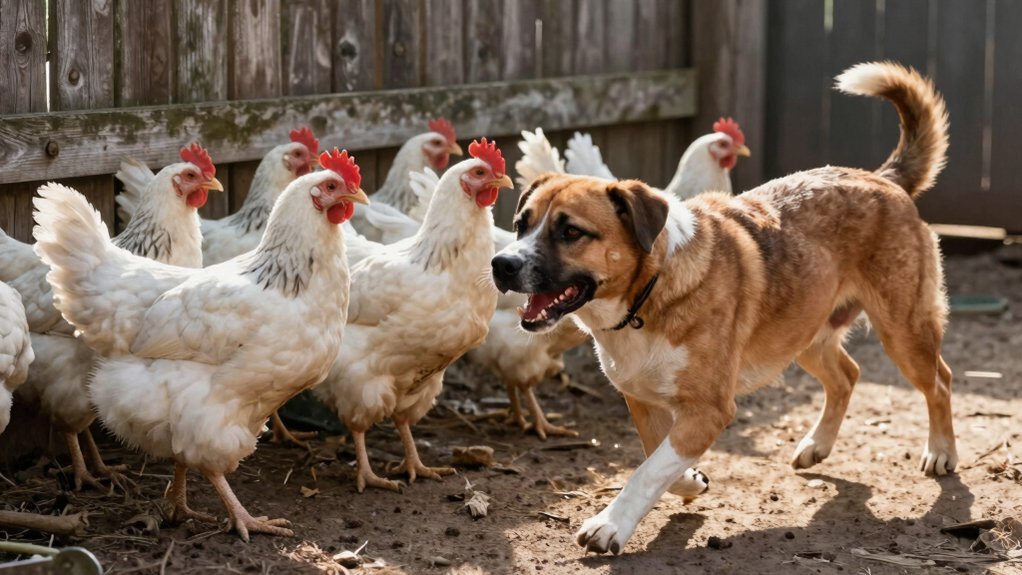
You’re probably wondering if dogs actually eat chickens or just kill them for sport, and the answer is both—most dogs act on prey drive, not hunger, so they often chase, grab, and shake a bird without taking a bite. The thing is, a single high‑energy dog can wipe out ten hens in minutes, especially if you have a sighthound or terrier with a strong chase instinct. To protect your flock, start with a 4‑6‑foot solid fence, bury hardware‑cloth skirts, and train reliable “leave it” and recall commands; then you’ll have a solid chance of keeping both dog and chickens safe. If you keep reading, you’ll uncover more practical steps.
Do Dogs Actually Eat Chickens?
Do Dogs Actually Eat Chickens? You’re probably wondering why your flock seems terrified even when no meat disappears. Here’s the thing: many dogs kill chickens without any feeding instinct kicking in. Their hunting behavior often looks like a game of chase—grab, shake, and leave the carcass. Obviously, a dog with a strong prey drive treats the bird as a target, not a snack, and you’ll find dead birds scattered, not eaten. Unlike burying remains which is common with foxes and coyotes, domestic dogs often leave the evidence of their attack visible on the ground.
Why does this matter? Because a single kill can trigger panic, stress, and broken necks, reducing egg production for days. Even if the dog never bites the flesh, the trauma kills. Just like coyotes, dogs are intelligent predators that remember chicken locations and may return to the same spot to attack again. Effective training requires consistent supervision to immediately correct aggressive acts and reinforce calm behavior around the flock.
Takeaway: Assume every dog presence is a lethal threat, not just a feeding one. Secure fences, supervise, and plan for the worst. Ready to protect your flock? Slow acclimation is key to training.
Why Do Dogs Attack Chickens?
Why do dogs attack chickens? You’re wondering why your pet might see a flock as a target. The answer lies in prey drive—dogs inherit a hunter’s instinct that spikes when a bird flutters. Breed research shows hunting and ratting lines carry stronger chase genes, while some herding breeds react to movement as a control cue. Even a well‑fed dog can chase because the thrill releases dopamine, reinforcing the habit.
Now, training methods matter. Weak recall or impulse control lets arousal turn into a sprint. Early, calm exposure reduces novelty; without it, chickens stay exciting “new toys.” High energy and boredom push a dog toward the flock for stimulation. Unlike predators such as raccoons or foxes that often kill for food, dogs frequently leave fewer remains behind because they may carry off entire chickens or cause death through chasing rather than eating. While raccoons are known to carry diseases like roundworm and rabies that pose additional risks to flocks, dogs primarily threaten through physical trauma and stress induced by the chase. However, other predators like minks are known to kill chickens not just for food but apparently also for sport, which can lead to devastating losses for backyard and small-scale farmers.
All right, the takeaway: your dog’s genetics, early socialization, and current training shape the attack risk. Next, ask yourself how you’ll strengthen recall and manage energy before the next encounter. Adding a remote correction device can interrupt the chase instantly.
How Much Damage Can One Dog Do to a Chicken Flock?
You’re probably wondering how much damage a single dog can wreak on your flock, and that’s a smart question. A loose dog can kill ten hens in minutes, and an Italian greyhound once wiped out an entire backyard flock in two to three minutes. Dogs don’t stop after one bite; they keep hunting until birds are dead, scattered, or unreachable, so predator frequency spikes dramatically when a dog breaches your fence.
What does a single attack look like?
You’ll find carcasses haphazardly strewn, blood and feathers everywhere, and torn wire or bent panels. Even if the dog doesn’t eat, it leaves broken necks, puncture wounds, and shattered wings. Survivors often suffer severe trauma, panic, and reduced egg production for days. Like raccoons that may only consume the head or weasels that eat internal organs, dogs often engage in surplus killing where they massacre multiple birds without consuming them.
Takeaway: One dog can decimate a small flock in a single, frantic bout, upending flock dynamics and raising predator frequency instantly. Secure fencing and constant supervision now to prevent that catastrophic scenario. Just as foxes exploit weak points, dogs can breach enclosures that lack sturdy, predator-proof materials designed to withstand determined attacks. Maintaining secure construction with vigilant inspections for gaps ensures your coop remains a fortress against both canine and wild predators.
Which Breeds and Temperaments Pose the Biggest Risk of Attacking Chickens?
All right, you’re probably wondering which dogs actually pose the biggest danger to your chickens after hearing how a single dog can wipe out a flock.
Which breeds have the highest prey drive?
Sighthounds—Greyhounds, Whippets, Borzois, Italian Greyhounds, Salukis—chase anything that moves. Terrier and ratting breeds—Jack Russells, Yorkies, Rat Terriers, Miniature Pinschers—have a built‑in kill instinct. Even small dogs can out‑pace a hen.
Do herding instincts matter?
Border Collies, German Shepherds, Shetland Sheepdogs treat chickens like livestock to herd, not ignore. Their fixations on movement trigger stalking and nipping unless you train them early.
What about guardian dogs?
Great Pyrenees, Anatolian Shepherds, Kangals, Komondors, Kuvasz, Maremma, Spanish Mastiffs usually protect flocks, but they still need boundaries and consistent exposure.
Takeaway: Breed isn’t destiny, but high‑prey‑drive breeds and unchecked herding instincts raise risk. Challenge breed misclassifications and owner misconceptions with solid training and supervision. Just as young chicks are vulnerable to cat attacks due to their small size, puppies or untrained dogs pose the greatest threat to your youngest birds regardless of breed. Like bears drawn to chicken feed, dogs are often lured into coops by the scent of food or the movement of the flock, making secure storage and supervision critical.
Next, ask yourself: what physical barriers can you add to keep any curious dog out of the coop? Remember that even determined dogs can be stopped by installing secure multi-step latches on your coop doors to prevent them from pushing their way inside.
What Physical Barriers Stop Dogs From Attacking Chickens?
You’re probably wondering exactly how a fence can keep a curious dog out of your chickens, and that’s a great question.
What fence height and material work best?
A 4‑to‑6‑foot fence deters medium and large dogs. Use chain‑link or welded wire instead of light poultry wire. Reinforce corners, gates, and seams with hardware cloth; ½‑inch mesh stops a dog from prying panels apart. While this height contains many breeds, lighter or more active flyers like bantams and Leghorns may require fencing closer to 5 to 6 feet to prevent them from escaping over the top.
How do you stop a dog from digging under?
Excavation prevention is key. Bury a hardware‑cloth skirt at least 12 inches deep—2 feet for persistent diggers—around the perimeter. Add no‑dig stakes or deep anchors, and lay gravel or mulch to make tunneling harder and breaches obvious. Implementing multiple layers of fencing creates an additional defensive barrier that further complicates access for determined predators.
What extra barriers help?
Cover runs with a roof and lock coop doors at night. A solid gate and lockable latch keep dogs out even if they find a gap.
Takeaway: Combine height, sturdy reinforcement materials, and excavation prevention for a dog‑proof enclosure. Next, consider how you’ll train your dog to respect the fence. While physical barriers are vital against dogs, remember that a well-designed coop also provides proper ventilation to prevent respiratory infections and maintain overall flock health.
How Can I Train My Dog to Respect Chickens and Prevent Attacks?
You’re probably wondering how to turn a sturdy fence into a lasting peace treaty between your dog and your chickens.
How do I start the introduction?
Begin with a leash or harness and a barrier like a run or kennel. Keep the dog at a distance where it notices the birds but doesn’t fixate. Short, calm sessions—five minutes max—let you gauge reaction. Reward any relaxed glance with a treat.
Which commands matter most?
Teach “leave it,” “off,” “stay,” and a reliable recall before you ever let the dog roam free near the flock. Use a firm “off” when it lunges, then praise calm sitting. Practice around adults, chicks, eggs, and the yard.
How do I build long‑term safety?
Supervise every off‑leash moment, keep training varied, and retreat if excitement spikes. A kennel or pen becomes a safe fallback when you can’t watch. Just as maintaining a rodent-proof environment is key to protecting backyard chickens from mice rather than expecting them to control infestations, consistent management is vital for dog safety. Much like securing coops against opportunistic scavengers prevents possums from accessing vulnerable chicks, your vigilance ensures dogs do not exploit similar weaknesses in your flock’s defense. While dogs cannot catch coccidia from chickens due to host-specific protozoa, keeping the areas clean remains a crucial part of overall flock hygiene and health management.
Takeaway: Consistent, controlled exposure and strong impulse control let you protect flock and prevent attacks. Next, ask yourself how you’ll maintain supervision as the birds grow.
Patience is essential because the training process often takes weeks, not days.
What Immediate Post‑Attack Actions Should I Take for Injured Chickens?
You’ll want to whisk the injured chicken away from the dog and the rest of the flock, then settle it into a quiet, warm, dim spot where it can’t be startled.
How do I stabilize the bird right away?
Now, wrap the bird in a soft towel, keep it warm with a low‑heat lamp, and watch for shock signs like limp wings or cold feet. Obviously, gentle handling prevents further injury.
What’s the first step in avian first aid?
Here’s the thing: apply direct pressure with clean gauze to any bleeding, then use a little cornstarch on comb or wattles. Avoid hydrogen peroxide; it damages tissue.
How should I clean and protect the wound?
Rinse gently with sterile saline, remove only loose feathers if needed, and apply a poultry‑safe topical. Keep the area dry and monitor for swelling.
Takeaway: Stabilize, stop bleeding, clean, and protect—then seek vet care if bleeding persists or deeper injury is suspected.
What Long‑Term Strategies Keep Dogs From Harassing My Poultry?
How can I stop my dog from bothering my chickens for good? You’re right to wonder; the answer blends fences, training, and routine.
What physical barriers work best?
Secure coops, reinforced latches, and a 4‑foot high fence keep even the most unruly cats and disruptive rodents out, and they stop your dog from lunging or barking at the flock. Upgrade old wire, add a roof over the run, and lock doors at night. To truly secure the perimeter against digging, you should bury hardware cloth at least 12 inches deep or install an apron around the coop. Just as bird netting effectively shields flocks from aerial predators like hawks, it can also serve as an overhead barrier to prevent dogs from jumping into the run.
How do I manage my dog’s access?
Contain him with a leash, a long line, or a fenced dog yard. Supervised outings let you intervene before a chase becomes a habit.
What training keeps the peace?
Teach “leave it” and recall at a distance, rewarding calm behavior. Short, daily sessions gradually shrink the gap between you and the chickens.
What daily habits reduce predatory drive?
Exercise, puzzle toys, and scatter feeding burn excess energy, while a predictable schedule teaches your dog what to expect near the coop.
Takeaway: Combine a predator‑proof coop, controlled dog access, and consistent impulse‑control training for lasting safety. Next, set up a secure fence and start a five‑minute “leave it” drill today.