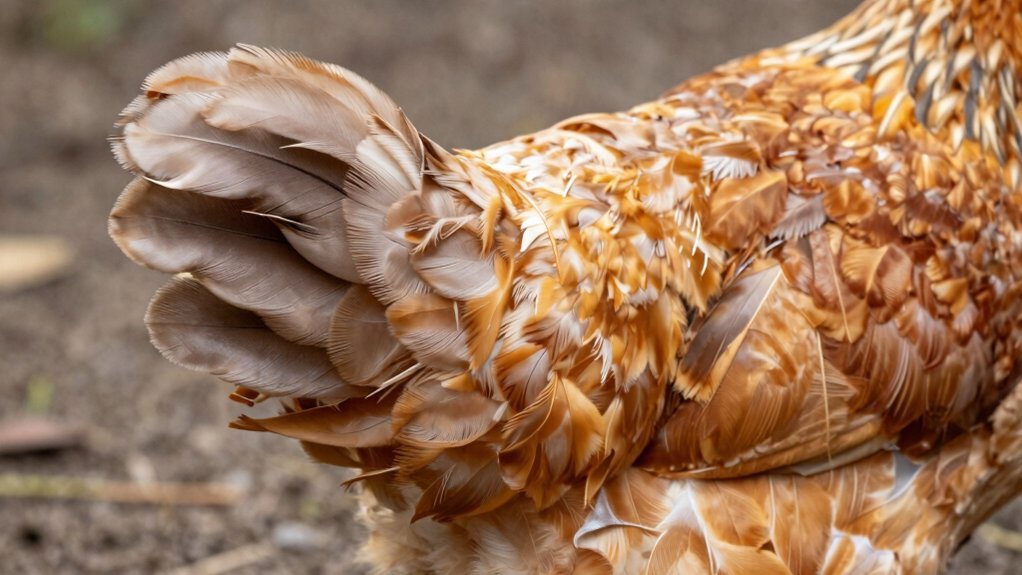
You’re probably wondering if chickens actually have tails, and yes—they do. Each bird sports a fan of stiff flight feathers called rectrices that attach to the pygostyle, a fused bone at the spine’s end, plus softer coverts that fill out the shape; these feathers act like a rudder, helping balance and steer during jumps or short flights. The length and curve of the main tail feathers can hint at sex—females often have shorter, rounder fans while males develop longer, curvier sickles—but you’ll need other clues or a quick genetic test for certainty. If you keep exploring, you’ll learn how breed genetics, nutrition, and stress affect tail growth and what that means for your flock.
Chicken Tail Feather Anatomy
What actually makes up a chicken’s tail? You’re probably wondering why it looks like a bundle of feathers rather than a single plume. The answer lies in the feather shaft anatomy and the vane barb structure that together form each tail feather.
The central shaft, or rachis, runs like a tiny spine, anchoring the feather in the follicle. Around it, the vane spreads out, its barbs interlocking like a tiny roof, while barbules hook together for stability. In hens, you’ll see mainly the main tail feathers plus a soft fluff underneath; roosters add greater and lesser sickles that curve dramatically.
All right, the shaft gives strength, the vane barb structure creates shape, and the combination defines the tail’s appearance. Takeaway: understanding these parts helps you spot health issues and sex differences. Next, you might ask how tail, hackle, and saddle feathers differ. Notably, every single one of these structures grows from a feather follicle and can be actively raised or lowered by muscle action to aid in communication or insulation. While tail feathers rely on interlocking barbules for rigidity, other unique feather types like those on Silkie chickens lack these structures entirely, resulting in a soft, fur-like texture. It is important to monitor these areas closely, as irritation from internal parasites can sometimes cause feather loss specifically around the vent region.
Differences Between Tail, Hackle, and Saddle Feathers
What’s the real difference between tail, hackle, and saddle feathers? You’re probably seeing a fan of feathers on the rear and wondering why it isn’t just “the tail.” Tail feathers grow from the pygostyle, form the visible rear fan, and tend to be long and conspicuous. Hackle feathers sit on the neck and upper back, framing the head; they’re narrower, often pointed in mature roosters, and help you sex the bird. Saddle feathers sit just ahead of the tail base on the lower back, draping over the rump and sometimes overlapping the tail.
Here’s the thing: breed differences affect feather texture and length, so a Silkie’s soft, rounded hackles differ from a Rhode Island Red’s glossy, pointed ones. While location defines these groups, specific genetic factors like sex-linked genes can also dictate the distinct patterns and colors found within these feather types across different breeds. Just as clean, mold-free inputs are critical for poultry health when supplementing diets with grains, maintaining the integrity of feather follicles requires proper nutrition and care to ensure healthy growth. Unlike standard breeds, Silkies possess feathers lacking barbicels that create a silk-like texture rather than the smooth, interlocking structure seen in most chicken tails.
All right, remember: location beats shape—tail = rear, hackle = neck, saddle = lower back. The takeaway? Identify each group by where it grows, then note texture and length for accurate sexing. Next, ask yourself how feather shape hints at age or health.
What Tail Feather Shape Reveals About Sex?
You’re probably wondering why the tail’s shape seems to hint at a chick’s sex, and you’re not alone. Here’s the thing: a longer, more defined tail often points to a female, while a shorter, rounder, fluffier rear leans male. This cue isn’t foolproof; breed, genetics, and individual variation can flip the script, so treat it as a hint, not a verdict.
Why does this matter culturally? Throughout history, tail feathers carried symbolism—think of the peacock’s fan as a male boast. Prehistoric evolution shaped these traits, linking longer tails to reproductive signaling in females of some lines. While tail appearance offers clues, observing behavioral differences such as males being bolder or more active can provide additional context as the chicks mature. Additionally, males typically develop thicker legs and more upright postures compared to females, offering another physical marker to support your visual assessment.
Obviously, you’ll get better accuracy by pairing tail clues with comb size, wing feathering, and later body traits. Take note of the timing—around 10‑14 days for males, a month for females—and remember it’s a supporting clue. While wing feather comparison provides a useful visual clue, it is not as precise as vent sexing, which requires professional skill.
Takeaway: tail shape offers a suggestive, breed‑dependent hint, not a definitive answer. Next, compare comb development to strengthen your guess.
Why Chicken Tail Feather Growth Can Be Delayed
Why does my chick’s tail look naked? You’re probably wondering if it’s a bad sign, and you asked the right question.
Is it genetics?
Here’s the thing: the sex‑linked K locus drives delayed tail feathering, especially the Kⁿ allele that can leave chicks nearly featherless until they’re twelve weeks old. Fast‑feathering birds sprout tail and wing feathers in the first week, while K‑carriers lag behind body plumage.
Could nutrition or stress be the culprit?
Obviously, a nutritional deficiency—particularly low protein—slows feather development, just like a garden without fertilizer. Overcrowding or sudden flock changes stress birds, and feather picking by mates creates missing spots that mimic delayed growth. While parasites typically cause patchy feather loss near the vent, they can also affect the neck and contribute to overall poor feather condition through parasite infestations. To support rapid regrowth and prevent delays, switching to a diet with higher protein levels ranging from 18% to 20% is often necessary during critical growth phases. Unlike the annual molt where feathers fall out starting from the head, this juvenile delay involves new pin feathers growing slowly within their waxy casings before fully unfurling.
How do you tell the difference?
If the bare tail persists beyond the juvenile period, think genetics; if it appears suddenly or only on a few birds, look for picking or parasites.
Takeaway: Identify whether the delay stems from genetics, diet, or flock dynamics, then adjust feed or management accordingly. Next, check your flock’s protein levels and observe any picking behavior. Adding extra protein during molt can support feather regrowth and reduce the risk of delayed tail feathering.
Long‑Tail Breeds and Special Tail Types
Long‑tail breeds can feel like a mystery, especially when you wonder why some chickens sport tails that sweep the floor while others stay modest. You’re right to ask—tail genetics drive those dramatic differences, and breed variations determine how far the sweep reaches.
Which breeds give you the longest curtains?
Phoenix birds, born from German‑Japanese crosses, keep saddle feathers around 18 inches, while Yokohamas can push roosters’ tails to three feet in ideal conditions. Sumatra chickens add a sweeping silhouette, and Cubalaya offers a dual‑purpose twist with a shorter, sturdy tail. Just as tail length varies by breed, Polish chickens display distinct color varieties ranging from white-crested black to complex laced patterns like silver and gold. The Red Shoulder Yokohama, originally from Japan, is particularly prized for its pheasant-like carriage and striking ornamental value rather than high egg production.
What makes Onagadori so legendary?
Onagadori’s non‑molting trait lets tail growth skyrocket, historically reported up to 27 feet. That rare gene combination explains why they’re prized by fanciers. These birds require specialized breeders who focus on preserving the breed’s distinctive traits through traditional practices like Tombaku.
Takeaway: Tail length isn’t random; it’s a blend of genetics and selective breeding. Now you know which breeds showcase extreme tails and why. Ready to explore how those feathers help you sex chickens?
How to Combine Tail Feathers With Other Clues When Sexing Chickens
It’s natural to wonder why tail feathers seem useful but never give a definitive answer. You’re right to ask how they fit with other clues.
How do wing feathers help?
Now, compare primary wing feather length to coverts. In sex‑linked crosses, females often have longer primaries, while males show even growth. If a chick’s tail feather appears early and its wing feathers match, confidence rises.
What about breed knowledge?
Obviously, fast‑feathering lines give clearer patterns. Check hatchery stock and parent breeds; autosexing varieties may rely more on color, making tail clues secondary.
Do body shape indicators matter?
Behavioral observations and rear shape can point you in the right direction. Males sometimes look rounder or fluffier, but posture and handling can mislead. Use several weak clues together, not a single trait. By six to eight weeks, males typically develop larger, redder combs and chunkier legs compared to females, providing a more reliable confirmation than early feather patterns alone. Unlike general breeds, Silkies are distinct because males have streamer feathers that are longer and skinnier than those of females, offering a specific visual cue once the birds are around nine weeks old. While some rely on leg thickness or behavior, these methods are less reliable than vent sexing, which remains the most accurate technique when performed by trained individuals.
Takeaway
Combine tail, wing, breed, and shape clues over several days for a steadier guess. Next, watch for secondary sex characteristics as the chick matures.
When to Use Genetic Testing for Definitive Sex Confirmation
You’re probably wondering when you should skip the feather‑guessing and go straight to DNA.
When does DNA beat visual clues?
If you raise Silkie or other monomorphic breeds, tail feathers won’t tell you anything. Here’s the thing: PCR‑based sexing catches the CHD1 marker on Z and W chromosomes, giving one band for males, two for females. Commercial services can return results in 2‑4 days with over 99 % accuracy, so you avoid costly rearing mistakes.
What samples work best?
Feather tips are quick and painless, blood works if you need more DNA, and eggshell membranes let you sex before hatch. Lab validation confirms the method, and high‑resolution melting can speed up turnaround.
When is it worth it?
Use testing when flock planning, breeding selection, or hatch timing hinges on certainty. The takeaway: when visual cues fail, genetic testing gives you reliable, humane decisions. Ready to pick a sample and send it off?